What is a vestigial structure?
The correct answer and explanation is :
A vestigial structure is an anatomical feature or behavior that has lost its original function through evolution. These structures were once functional in an organism’s ancestors but have become reduced in size, function, or completely obsolete in the modern species. Despite being non-essential or having diminished use, vestigial structures are retained in the organism’s body because they are inherited from evolutionary ancestors. Over time, they may persist without significant evolutionary pressure to remove them.
Explanation:
Vestigial structures are often the remnants of traits that were useful to previous generations of a species but are no longer necessary due to changes in the organism’s lifestyle, environment, or evolutionary adaptation. For example, the human appendix is a well-known vestigial structure. It is believed that the appendix may have played a role in digestion for herbivorous ancestors by helping to break down cellulose from plants, but in modern humans, it serves little to no function. However, it is still present, and although its function is not fully understood, it may play a minor role in immune system function.
Other examples of vestigial structures include:
- Wisdom teeth: In earlier humans, these teeth were useful for grinding plant material, but they are now often unnecessary and may cause dental problems.
- Tailbone (coccyx): The tailbone is a remnant of a tail, which was useful for balance in early ancestors.
- Wings of flightless birds: Birds like ostriches have wings that are no longer used for flying, though their ancestors could fly.
Vestigial structures are strong evidence of evolution and natural selection. They highlight how species adapt to their environments, and through this process, certain traits can be lost, minimized, or modified without being completely eradicated from the genome. These remnants provide clues to evolutionary history and the forces that shaped present-day organisms.
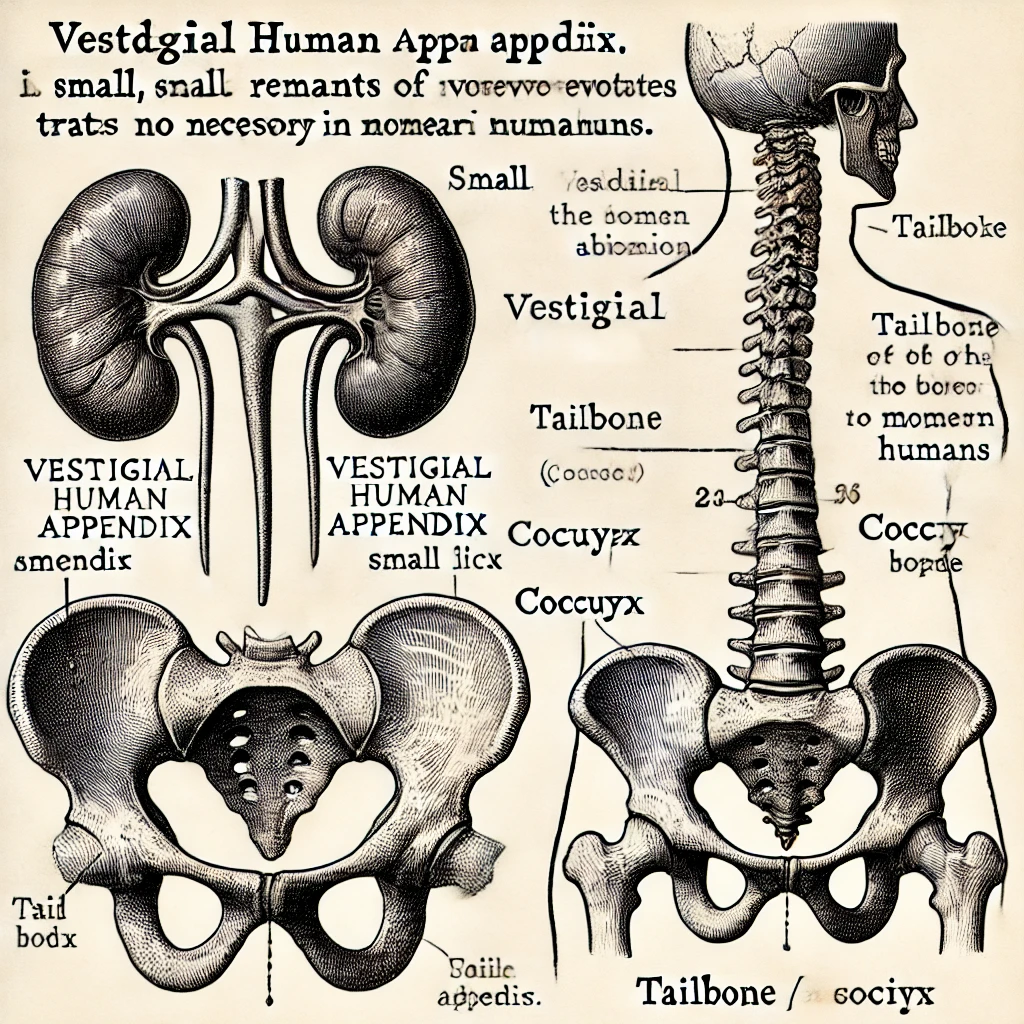
Here is an illustration showing vestigial structures in the human body, such as the appendix and tailbone (coccyx). It highlights how these features are remnants of evolutionary traits no longer necessary in modern humans.