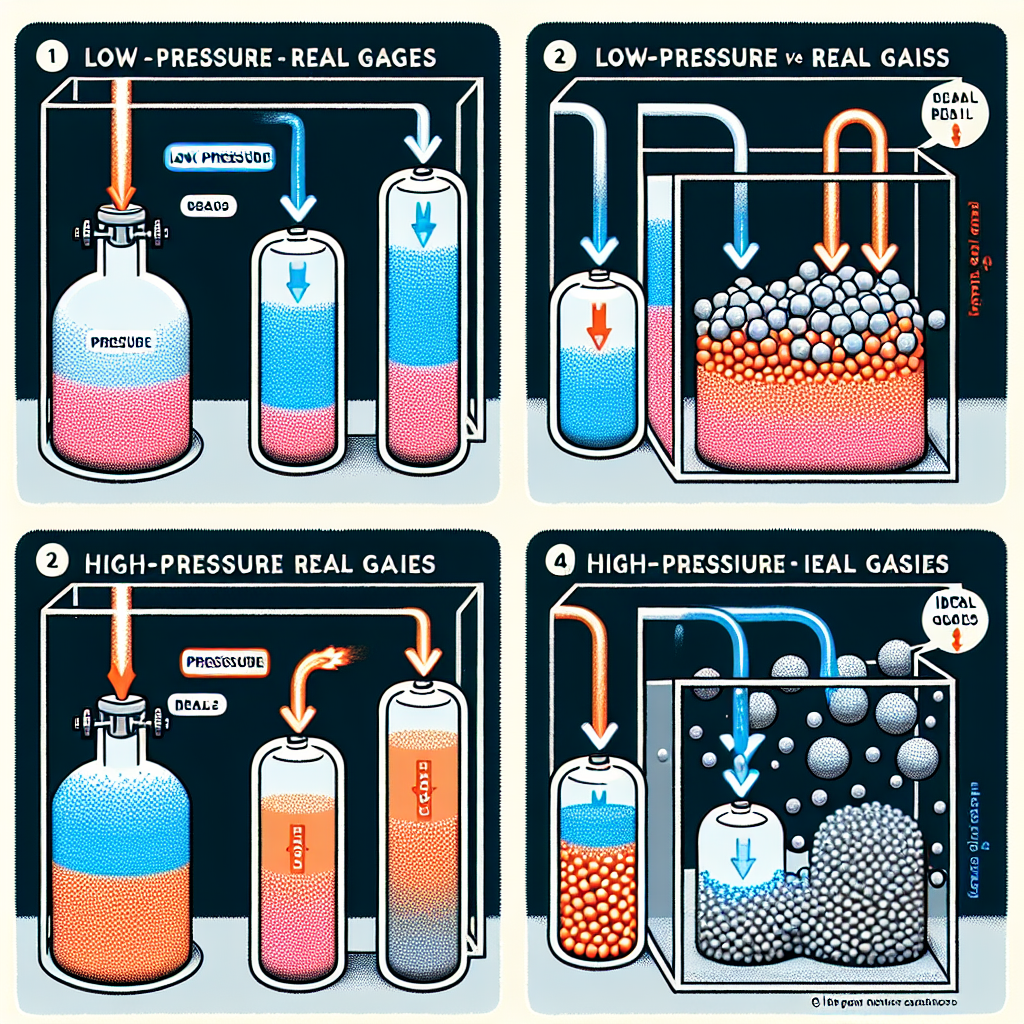
Which of the following correctly states the impact of pressure on the behavior of real gases compared to ideal gases?
At low pressure, real gas particles do not exert any force on the container, so they exert less pressure than ideal gases.
At high pressure, real gas particles take up more of the available space, so their volume is greater than ideal gases.
At low pressure, real gas particles expand to fill the container so their volume cannot be measured compared to ideal gases.
At high pressure, real gas particles are squeezed together, so they take up less volume than ideal gases.’
The correct answer and explanation is :
The correct statement is:
“At high pressure, real gas particles take up more of the available space, so their volume is greater than ideal gases.”
Explanation:
In the behavior of gases, ideal gas laws are often used as a model, assuming that the gas particles are point-like (having no volume) and do not experience any intermolecular forces. However, real gases deviate from this ideal behavior, especially under conditions of high pressure and low temperature.
- At low pressure, real gases behave more similarly to ideal gases because the intermolecular forces between gas particles become negligible when particles are far apart. The volume occupied by the gas particles themselves is much smaller than the volume of the container, and thus the gas behaves almost ideally. This means that real gases at low pressure have a volume similar to that predicted by the ideal gas law, where the volume is mostly determined by the container size and not the size of the gas molecules.
- At high pressure, the gas molecules are forced closer together, and their volume becomes significant. In this case, the volume of the gas is greater than predicted by the ideal gas law because the particles themselves occupy a finite volume, and this must be taken into account. In addition, intermolecular forces between gas molecules (attractive or repulsive) start to become significant. Ideal gas laws assume no intermolecular interactions, but real gases experience forces such as van der Waals forces, which affect their behavior. As the molecules get closer together at high pressure, these interactions become more pronounced, leading to deviations from ideal behavior. Thus, real gases at high pressure take up more volume than ideal gases would predict.
- At very high pressures (in extreme cases), real gases can also experience compression effects that may make their behavior even more complicated. For example, the gas molecules might interact strongly enough that they condense into a liquid, deviating even further from ideal gas behavior.
Thus, high pressure causes the volume of real gases to be greater than that of ideal gases because real gas particles have a finite volume and experience intermolecular forces that ideal gas theory ignores.