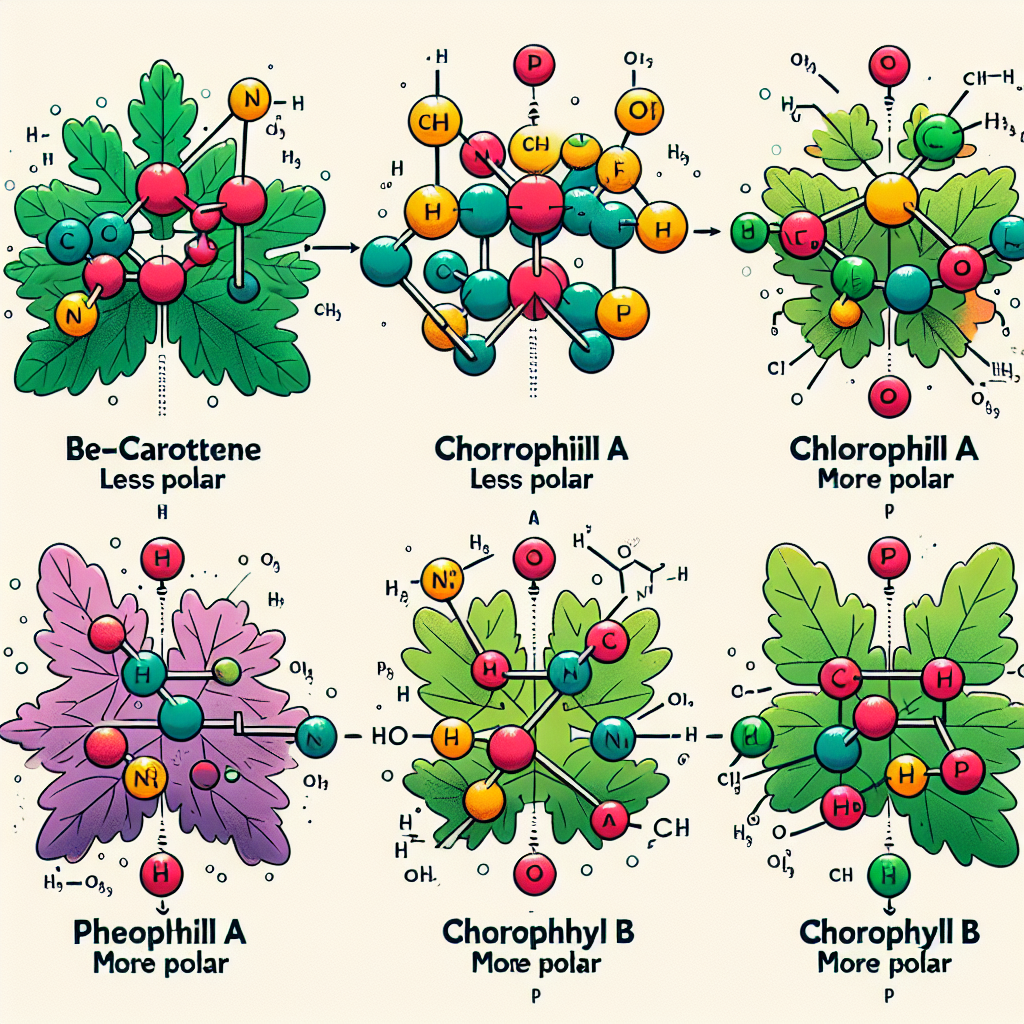
Arrange the following compounds in increasing order of polarity (from less polar to more polar).
A Beta-carotene
BChlorophyll A
CXanthopyll
DPheophytin
E Chlorophyll B
The correct answer and explanation is :
To arrange the given compounds in increasing order of polarity (from least polar to most polar), we need to consider the functional groups present in each molecule and their effect on the molecule’s polarity.
1. Beta-carotene (A):
- Functional Groups: Beta-carotene is a hydrocarbon with conjugated double bonds, which makes it non-polar. It does not have any highly electronegative atoms like oxygen or nitrogen that would contribute to polarity.
- Polarity: Since beta-carotene is a purely hydrocarbon with no polar functional groups, it is the least polar compound among the ones listed.
2. Chlorophyll A (B):
- Functional Groups: Chlorophyll A contains a long hydrophobic tail (phytol chain) and a porphyrin ring that holds a magnesium ion at its center. The porphyrin ring includes conjugated double bonds, which are somewhat polar due to the presence of the magnesium ion and the potential for coordination with molecules, although the overall structure remains largely non-polar.
- Polarity: Chlorophyll A has some polar characteristics due to the magnesium coordination, but overall, it remains less polar than others.
3. Xanthophyll (C):
- Functional Groups: Xanthophyll is a carotenoid containing oxygen atoms in the form of hydroxyl or epoxide groups, which makes it more polar than beta-carotene.
- Polarity: The presence of oxygen atoms (in hydroxyl or epoxide forms) makes xanthophyll more polar than beta-carotene but less polar than the chlorophyll compounds.
4. Pheophytin (D):
- Functional Groups: Pheophytin is similar to chlorophyll A, but the magnesium ion in its structure is replaced by two hydrogen atoms, making it less complex in its coordination. While it still has a porphyrin ring, the lack of the magnesium ion reduces some of its polar characteristics.
- Polarity: Pheophytin is more polar than beta-carotene and chlorophyll A because it lacks the magnesium center, but it still maintains some non-polar characteristics due to its hydrocarbon-like structure.
5. Chlorophyll B (E):
- Functional Groups: Chlorophyll B has a structure very similar to chlorophyll A, but it differs in having an additional aldehyde group in the side chain. This addition of a polar functional group makes chlorophyll B more polar compared to chlorophyll A.
- Polarity: Chlorophyll B is the most polar among these compounds due to the aldehyde group, which adds significant polarity to the molecule.
Increasing Order of Polarity:
From least polar to most polar, the compounds are:
A (Beta-carotene) < B (Chlorophyll A) < D (Pheophytin) < C (Xanthophyll) < E (Chlorophyll B)
Explanation:
The polarity of these compounds is mainly determined by the presence of polar functional groups such as oxygen (in hydroxyl, aldehyde, or epoxide forms) and the presence of metal coordination (like the magnesium ion in chlorophyll). Beta-carotene is a non-polar hydrocarbon, while chlorophyll A and pheophytin are slightly more polar due to the coordination of magnesium. Xanthophyll contains oxygen atoms, which increase its polarity. Finally, chlorophyll B is the most polar due to its additional aldehyde group.