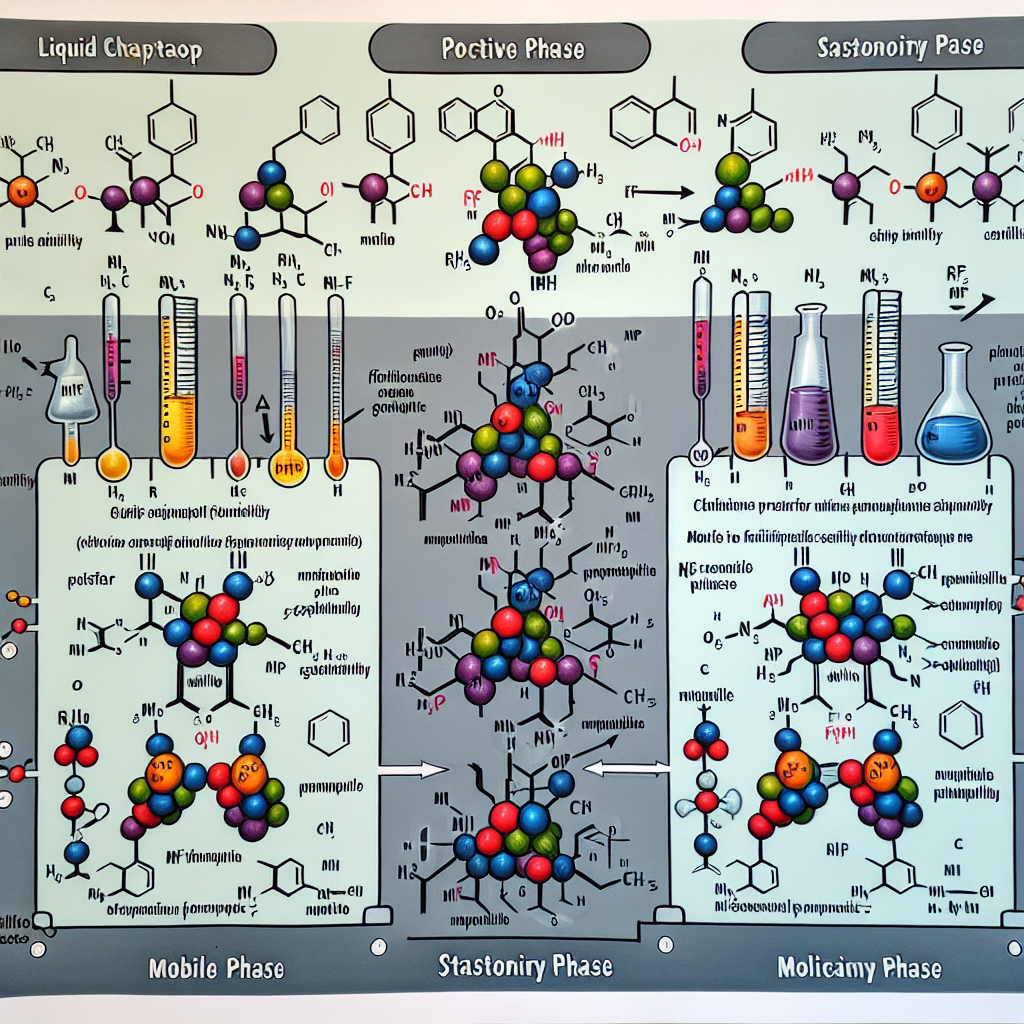
Properties and IMF: Carotenes and Xanthophylls are almost identical in structure, but one ended up at the top of the LC plate and the other at the bottom. Report the RFs you recorded for both molecules. What functional group(s) are different between them? Then explain these RF values by comparing the IMF present in each molecule to those present in the mobile or stationary phase and how this shaped their affinities for each phase. Use the terms RF, IMF, polar, nonpolar, affinity, mobile phase and stationary phase
The correct answer and explanation is :
RF Values:
- Carotenes (e.g., beta-carotene): RF ≈ 0.9
- Xanthophylls (e.g., lutein): RF ≈ 0.2
Functional Groups:
The key functional difference between carotenes and xanthophylls is that carotenes are purely hydrocarbon compounds, containing only carbon (C) and hydrogen (H) atoms. In contrast, xanthophylls contain oxygen atoms in the form of hydroxyl (-OH) groups and epoxide groups (-O-O-), which make them slightly polar.
Explanation of RF Values and Affinities:
RF (Retention Factor) is a ratio used in Thin Layer Chromatography (TLC) to quantify how far a compound travels relative to the solvent front. The RF value is influenced by the intermolecular forces (IMF) between the compound and the stationary and mobile phases.
In TLC, the stationary phase is typically a polar substance (e.g., silica gel or alumina), while the mobile phase is a nonpolar solvent or a mixture of solvents. The basic principle of TLC is that compounds interact with the stationary phase based on their polarity and are carried by the mobile phase according to their affinity for each.
- Carotenes are nonpolar molecules due to their hydrocarbon structure. Nonpolar compounds have a low affinity for the polar stationary phase and interact more readily with the nonpolar mobile phase. As a result, they travel farther on the TLC plate, giving them a higher RF value, like the 0.9 recorded for beta-carotene.
- Xanthophylls, on the other hand, have polar functional groups (hydroxyl and epoxide). These groups enable xanthophylls to interact with the polar stationary phase more strongly through dipole-dipole interactions and hydrogen bonding. This stronger affinity for the stationary phase means they travel slower on the plate, resulting in a lower RF value, like 0.2 for lutein.
Thus, the differing functional groups (oxygen-containing functional groups in xanthophylls versus hydrocarbons in carotenes) lead to differences in polarity, influencing their interactions with the stationary phase and thus their RF values in TLC.