Consider an atom of Sb. A. Write the full electron configuration. B. Write the abbreviated electron configuration (using the noble gas core). C. Draw the orbital diagram for the outer electrons of the atom (i.e. the electrons that come after the noble gas core).
Consider an atom of Sb.
A. Write the full electron configuration.
B. Write the abbreviated electron configuration (using the noble gas core).
C. Draw the orbital diagram for the outer electrons of the atom (i.e. the electrons that come after the noble gas core).
The correct answer and explanation is :
A. Full Electron Configuration for Antimony (Sb)
Antimony (Sb) has an atomic number of 51, which means it has 51 electrons. The full electron configuration is written by filling the orbitals in order of increasing energy levels, following the Aufbau principle, Hund’s rule, and the Pauli exclusion principle. The electron configuration is as follows:
Sb: 1s² 2s² 2p⁶ 3s² 3p⁶ 4s² 3d¹⁰ 4p⁶ 5s² 4d¹⁰ 5p³
This is the full electron configuration for Sb, showing all 51 electrons distributed across various orbitals in increasing energy levels.
B. Abbreviated Electron Configuration (Using Noble Gas Core)
The abbreviated (or shorthand) electron configuration uses the nearest noble gas before the element in question as a core, and then the remaining electrons are added after this core. The nearest noble gas preceding antimony is Krypton (Kr), which has an atomic number of 36 and a full electron configuration of [Kr].
Therefore, the abbreviated electron configuration for Sb is:
Sb: [Kr] 5s² 4d¹⁰ 5p³
This configuration shows that the electron configuration of Sb starts from the noble gas krypton, and then adds the remaining 15 electrons after that.
C. Orbital Diagram for the Outer Electrons of Antimony
The outer electrons of Sb are the electrons that come after the noble gas core, i.e., the electrons in the 5s, 4d, and 5p orbitals. These outer electrons are:
- 5s²
- 4d¹⁰
- 5p³
To draw the orbital diagram, we represent each orbital as a line, and each electron is shown as an arrow (up or down) to indicate the spin. The orbital diagram for the outer electrons is as follows:
- For the 5s orbital, there are 2 electrons, both paired in the same orbital.
- For the 4d orbital, there are 10 electrons, filling all 5 d orbitals with 2 electrons each.
- For the 5p orbital, there are 3 electrons, and according to Hund’s rule, these electrons will occupy the three p orbitals singly, with parallel spins.
Here is the orbital diagram for the outer electrons of Sb:
5s: ↑↓
4d: ↑↓ ↑↓ ↑↓ ↑↓ ↑↓
5p: ↑ ↑ ↑
This diagram shows how the electrons are arranged in the outermost energy levels of the atom.
Explanation
- Full Configuration: We begin with the 1s orbital and continue filling the orbitals in order of increasing energy.
- Abbreviated Configuration: Using the noble gas core (Kr), we abbreviate the configuration, making it more compact and easier to understand.
- Orbital Diagram: The orbital diagram visually shows how electrons occupy orbitals in pairs or singly, following the rules of quantum mechanics (e.g., Hund’s rule for filling degenerate orbitals).
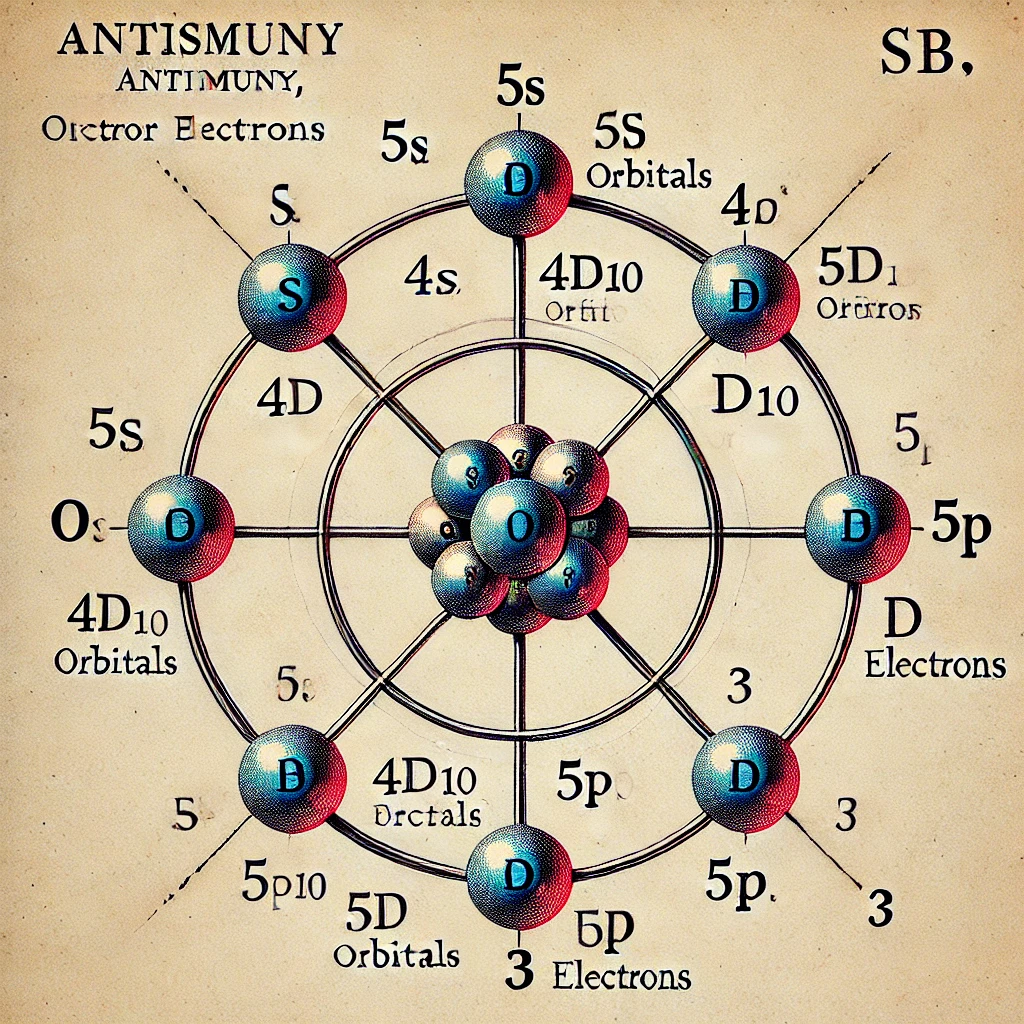
Here is the orbital diagram for the outer electrons of an antimony (Sb) atom, showing the 5s², 4d¹⁰, and 5p³ configurations. It illustrates how the electrons are distributed across the orbitals according to the rules of quantum mechanics.