Describe the process of lipid metabolism, starting from digestion in the mouth to absorption and transportation in the body. Include key enzymes, organs involved, and the role of bile in fat emulsification.
The correct answer and explanation is :
Lipid metabolism is the process through which the body digests, absorbs, and utilizes lipids (fats) for energy. It begins in the mouth and continues throughout the digestive system, with various enzymes and organs involved in the breakdown and absorption of lipids.
- Mouth: The process begins in the mouth where the enzyme lingual lipase, secreted by the salivary glands, starts breaking down triglycerides into diglycerides and free fatty acids. However, the digestion of lipids in the mouth is minimal compared to other stages.
- Stomach: In the stomach, gastric lipase, produced by the stomach lining, further breaks down triglycerides. The action of lipase here is limited, as the environment is acidic, and fats are not well-solubilized in this medium.
- Small Intestine: The majority of lipid digestion occurs in the small intestine. Upon entering the duodenum, bile produced by the liver and stored in the gallbladder is released. Bile contains bile salts, which emulsify large fat droplets, breaking them down into smaller droplets and increasing the surface area for enzyme action. This emulsification is crucial for efficient digestion. The enzyme pancreatic lipase, secreted by the pancreas, then breaks down triglycerides into monoglycerides and free fatty acids. The colipase enzyme assists pancreatic lipase in binding to the fat droplets for better efficiency.
- Absorption: The monoglycerides and fatty acids formed are absorbed by the epithelial cells lining the small intestine. Inside these cells, they are reassembled into triglycerides and packaged into chylomicrons, which are lipoproteins that transport lipids.
- Transportation: Chylomicrons enter the lymphatic system and are eventually released into the bloodstream, where they are transported to various tissues, including muscles and adipose tissue, for energy or storage.
This multi-step process ensures efficient digestion, absorption, and utilization of lipids.
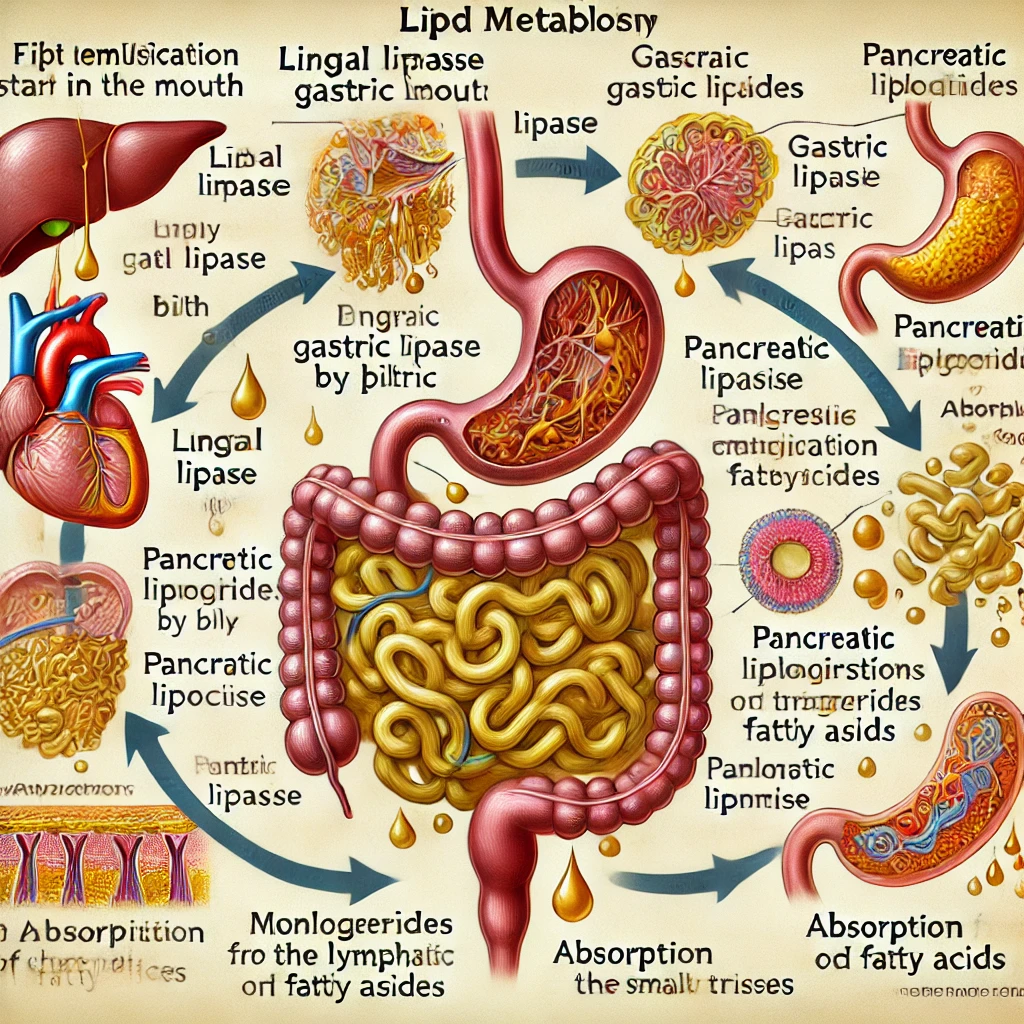
Here is a detailed diagram illustrating the process of lipid metabolism, from digestion in the mouth to absorption and transportation in the body. It shows the key enzymes, organs involved, and the role of bile in fat emulsification.