Explain why knowledge of cost behavior is important for managerial decision making. Explain a driver and give an example of a cost and its corresponding output measure or driver. Explain the difference between committed and discretionary fixed costs and give examples of each.
The correct answer and explanation is :
Knowledge of Cost Behavior for Managerial Decision Making
Understanding cost behavior is crucial for managerial decision-making because it helps managers predict how costs will change in response to changes in business activity. Cost behavior refers to how a cost changes as the level of activity (such as production or sales volume) changes. This understanding allows managers to make informed decisions regarding budgeting, pricing, cost control, and planning for future growth.
Driver and Cost-Output Relationship
A driver is a factor that causes or leads to a change in the cost of an activity or resource. For instance, in a manufacturing company, the number of units produced can be a cost driver that directly influences costs like raw materials or labor. An example of this would be the cost of raw materials. The output measure or driver in this case would be the number of units produced, as raw material costs typically rise as production volume increases.
Committed vs. Discretionary Fixed Costs
Fixed costs are those that do not change with the level of production or sales, and they can be categorized into two types:
- Committed Fixed Costs: These are long-term, stable costs that a company cannot easily change or avoid. They typically arise from long-term agreements or commitments. For example, a factory’s rent or depreciation on equipment is a committed fixed cost. These costs remain constant regardless of production levels and often require significant effort to alter.
- Discretionary Fixed Costs: These are short-term costs that can be adjusted or eliminated depending on the company’s needs and decisions. They are usually related to things like marketing, research, or employee training. For example, a company may decide to cut down on its advertising budget or delay a planned training program in response to financial constraints.
Summary
In summary, understanding cost behavior, drivers, and the distinction between committed and discretionary fixed costs is essential for managerial decision-making. It enables managers to make informed, efficient, and strategic decisions, ultimately leading to better financial performance and sustainable growth.
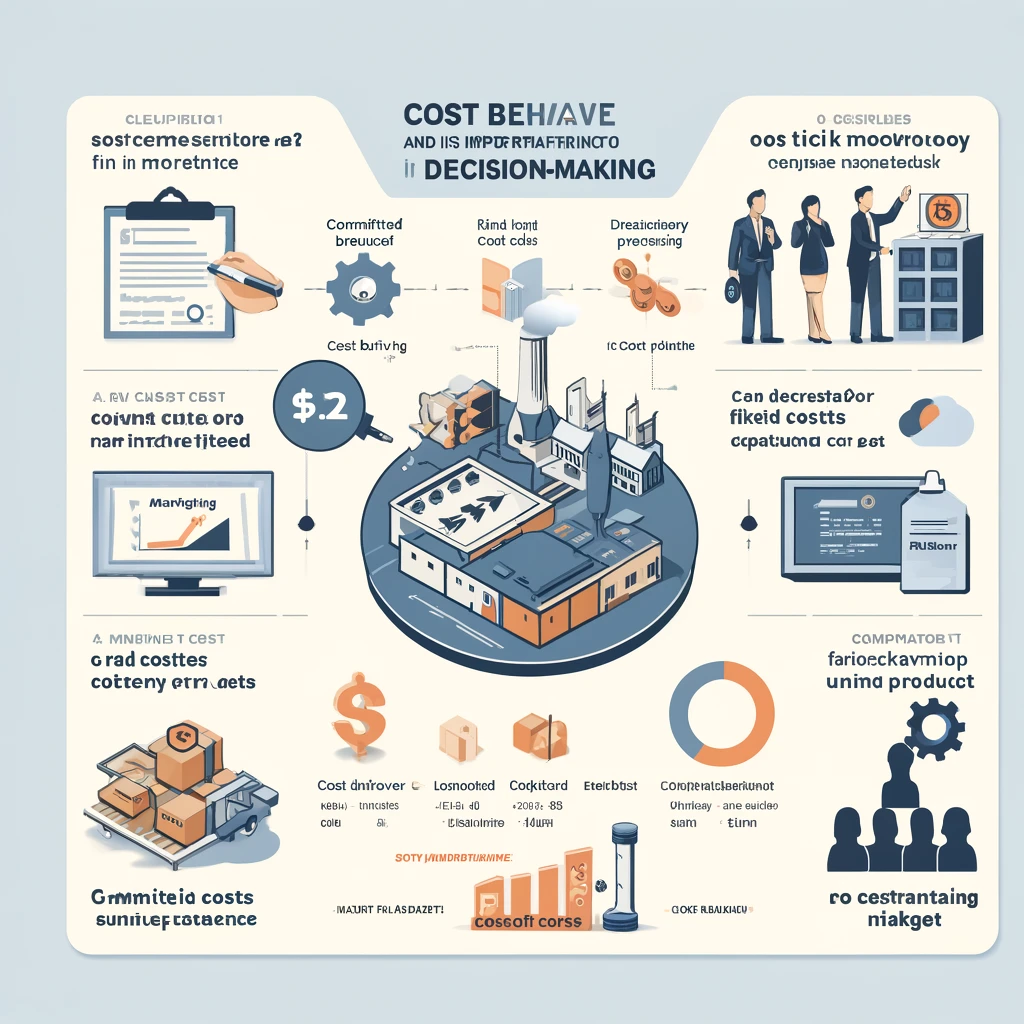
Here is the infographic that summarizes key concepts related to cost behavior and managerial decision-making, including cost drivers and examples of committed and discretionary fixed costs.