Which characteristic describes cut-through switching?
Error-free fragments are forwarded, so switching occurs with lower latency.
Frames are forwarded without any error checking.
Only outgoing frames are checked for errors.
Buffering is used to support different Ethernet speeds.
The correct answer and explanation is :
The correct characteristic that describes cut-through switching is:
Frames are forwarded without any error checking.
Explanation:
Cut-through switching is a type of switching method used in computer networking, particularly in Ethernet-based networks. It is one of the switching methods employed by network switches, along with store-and-forward switching.
Key Characteristics of Cut-Through Switching:
- Forwarding Without Error Checking:
In cut-through switching, as soon as the switch receives the destination address (which is typically located in the header of the Ethernet frame), it immediately forwards the frame to the next hop toward the destination device, without checking the entire frame for errors. This means the switch does not wait for the full frame to be received before forwarding it. Consequently, cut-through switching has lower latency compared to other switching methods, such as store-and-forward, which waits for the entire frame to be received before it performs an error check and then forwards it. - Low Latency:
One of the advantages of cut-through switching is its reduced latency. Since it begins forwarding the frame as soon as the destination address is read (even before the whole frame is received), it introduces less delay in the data transmission compared to store-and-forward, where the switch has to wait to receive the whole frame to check for errors. - No Error Checking:
Unlike store-and-forward switching, cut-through switches do not verify whether the frame has been received correctly or check for transmission errors. Therefore, any error in the frame (such as a corrupted frame) could propagate to the receiving end device without the switch detecting it. This could potentially result in higher errors in the network if the receiving devices do not handle errors properly. - Suitability for Time-Sensitive Applications:
Since cut-through switching offers lower latency, it is ideal for time-sensitive applications, such as voice or video communications, where minimizing delay is critical.
In summary, the cut-through switching method sacrifices error checking for reduced latency, making it ideal for scenarios where speed is more important than ensuring error-free transmission at every hop.
Image:
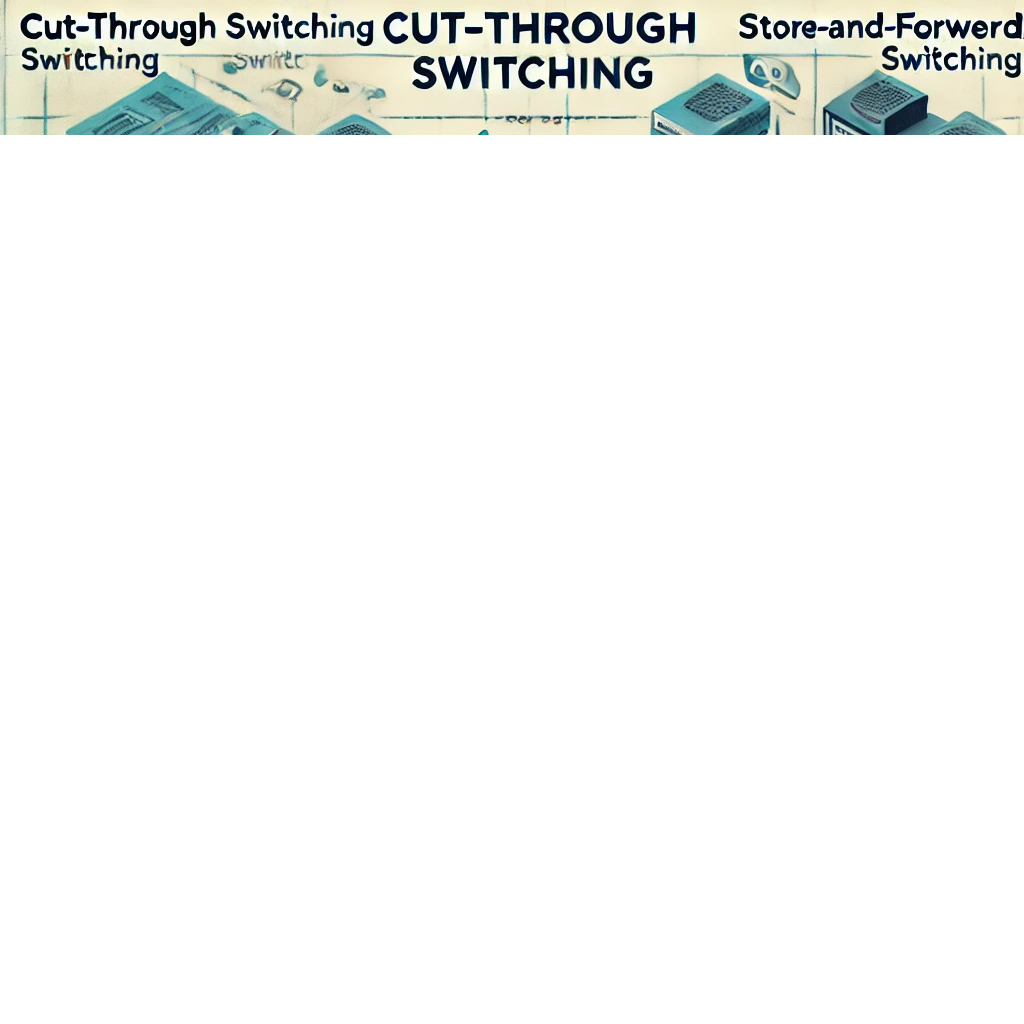
The image above illustrates the concept of cut-through switching, highlighting how frames are forwarded immediately once the destination address is read, without waiting for the entire frame to be received or error-checked. It also shows the comparison with store-and-forward switching, where the entire frame is received and checked for errors before being forwarded.