How does Environmental Ethics apply the approaches of Deontological Ethics, Teleological Ethics, and Virtue Ethics to ethical reasoning?
The correct answer and explanation is :
Environmental Ethics and Ethical Reasoning Approaches
Environmental ethics deals with the moral relationship between human beings and the environment, addressing how human actions affect the natural world. When applying different ethical frameworks such as Deontological Ethics, Teleological Ethics, and Virtue Ethics, each provides a distinct way to approach environmental issues.
- Deontological Ethics (Duty-based Ethics):
Deontological ethics, popularized by Immanuel Kant, focuses on adherence to rules or duties rather than the consequences of actions. In the context of environmental ethics, deontologists would argue that humans have a duty to preserve the environment, regardless of the outcomes. The inherent value of nature or species may be respected as a moral obligation. For instance, humans might have a moral duty to protect endangered species or reduce pollution because it is the “right” thing to do, independent of any particular benefit. - Teleological Ethics (Consequentialism):
Teleological ethics emphasizes the consequences of actions. In environmental ethics, a teleological approach would focus on the outcomes of human behavior toward the environment. For example, it may argue that deforestation is morally wrong if it leads to long-term environmental harm, like climate change or species extinction. From a utilitarian perspective, actions are right if they lead to the greatest overall benefit for both humans and the natural world. In this view, the impact of actions on ecological balance and sustainability would be central to ethical reasoning. - Virtue Ethics (Character-based Ethics):
Virtue ethics, grounded in the teachings of Aristotle, centers on the development of moral character. From this perspective, environmental ethics would encourage individuals to cultivate virtues such as respect, compassion, and responsibility toward the natural world. It emphasizes the importance of individuals forming an environmental character that naturally leads to sustainable behaviors. For example, a person who embodies virtues like mindfulness and respect for nature is more likely to make environmentally responsible choices, such as reducing waste or supporting renewable energy initiatives.
Each of these approaches provides a unique framework for evaluating environmental issues, shaping both individual behavior and broader policy decisions for environmental sustainability.
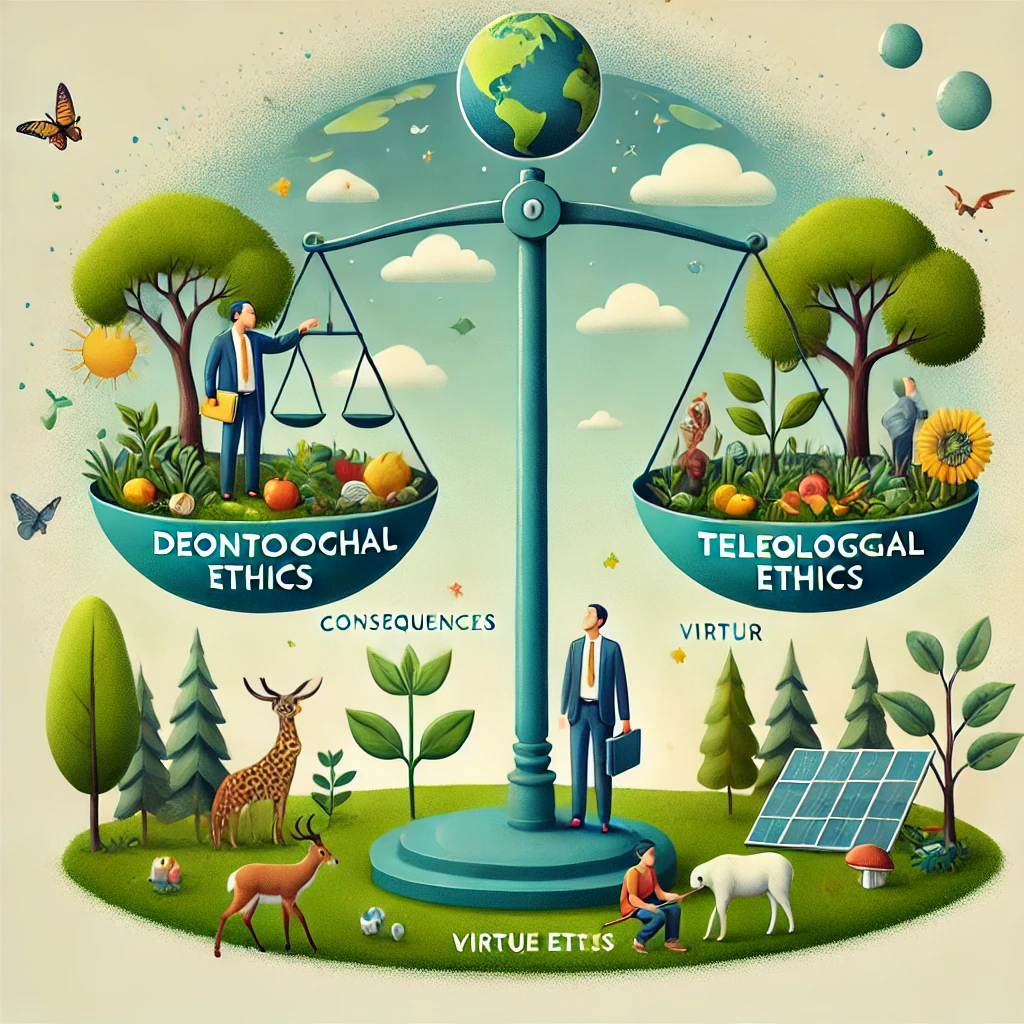
Here is the image illustrating the three ethical approaches (Deontological Ethics, Teleological Ethics, and Virtue Ethics) applied to environmental issues. It visually represents the core ideas of each framework, showing how they influence ethical reasoning in the context of the environment.