The most widely used encryption standard is _
The correct answer and explanation is :
The most widely used encryption standard is AES (Advanced Encryption Standard).
Explanation:
AES is a symmetric encryption algorithm, meaning it uses the same key for both encryption and decryption. It has become the global standard for securing sensitive data due to its robustness, efficiency, and speed. AES replaced the older Data Encryption Standard (DES) in the early 2000s due to DES’s vulnerability to brute-force attacks. AES was established as a Federal Information Processing Standard (FIPS) by the U.S. National Institute of Standards and Technology (NIST) in 2001.
Key Features of AES:
- Key Lengths: AES supports three key sizes: 128-bit, 192-bit, and 256-bit. These correspond to different levels of security, with AES-256 being the most secure.
- Rounds: The number of rounds (repeated transformations) used in AES depends on the key size:
- 10 rounds for AES-128
- 12 rounds for AES-192
- 14 rounds for AES-256
- Security: AES is considered highly secure and resistant to various cryptographic attacks, including brute-force attacks, where an attacker tries all possible keys. The longer the key, the stronger the encryption.
- Performance: AES is fast and efficient, making it suitable for use in environments with limited resources, such as mobile devices and embedded systems.
AES in Practice:
AES is used worldwide in numerous applications, including securing online banking, VPNs, encrypted communication protocols (e.g., HTTPS, TLS), and in protecting sensitive government and military data. Its widespread adoption in both commercial and governmental sectors stems from its combination of high security and operational efficiency.
Here’s a visual representation of AES encryption (showing key expansion and the rounds):
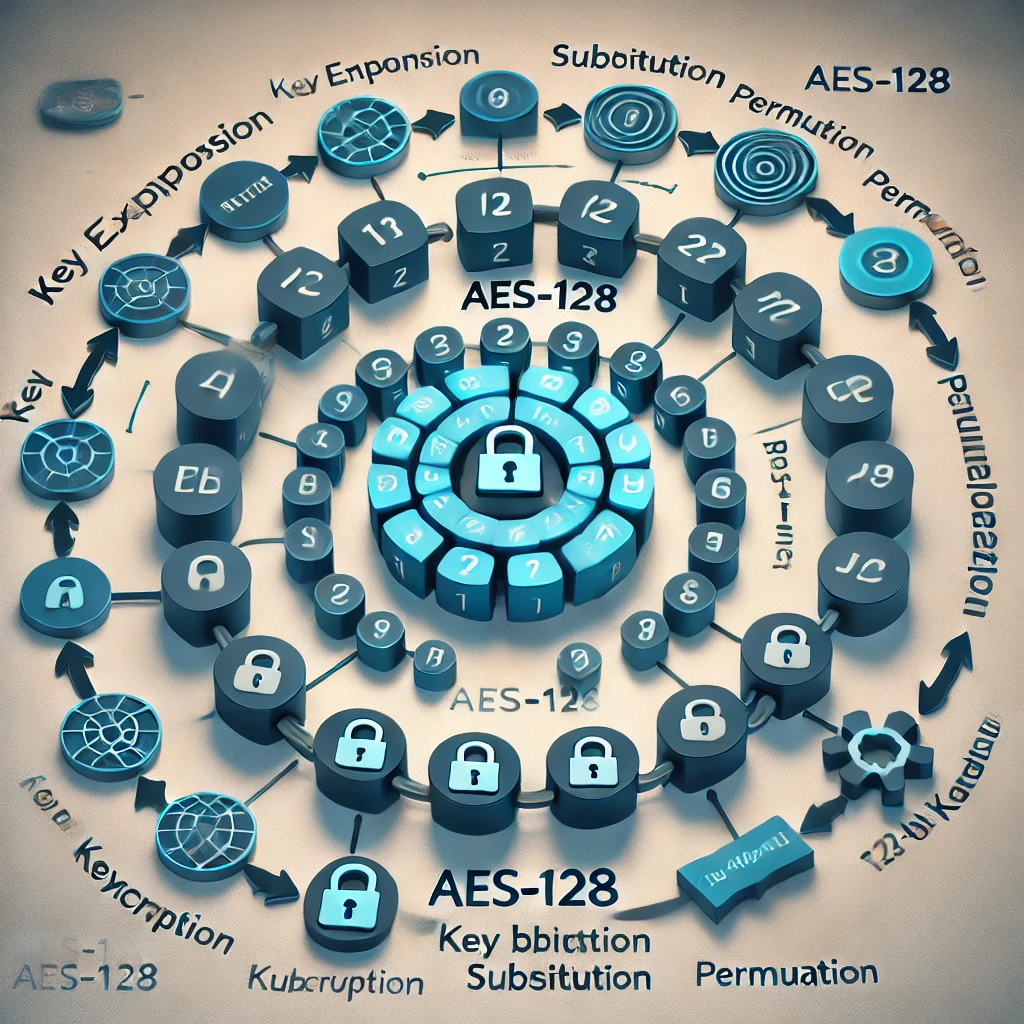
Here is a visual representation of the AES encryption process, showing key expansion and the rounds involved in AES-128. This diagram helps illustrate the different stages, including substitution, permutation, and how the encryption proceeds step by step.