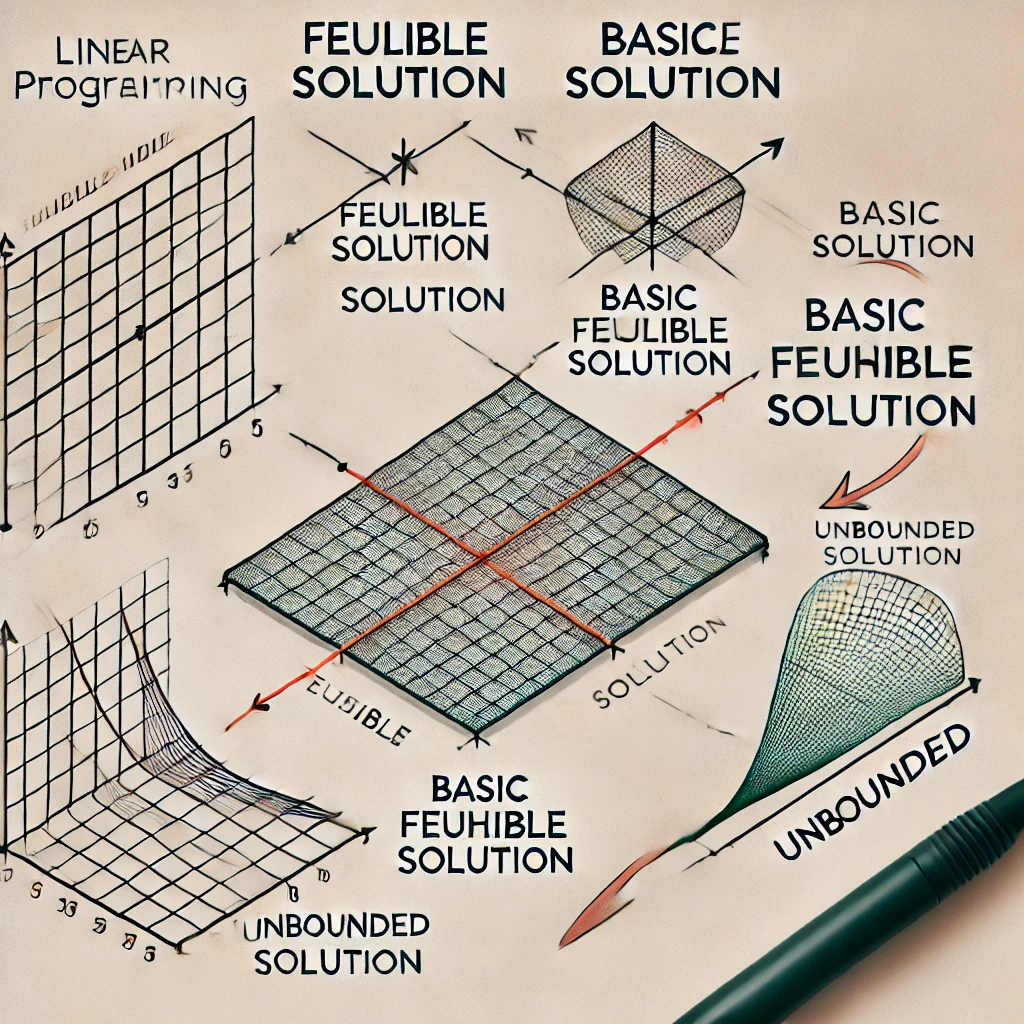
Define
(i) Feasible solution;
(ii) Basic solution;
(iii) Basic feasible solution;
(iv) Unbounded solution.
The correct answer and explanation is :
Definitions:
- Feasible Solution:
A feasible solution is any solution that satisfies all the constraints of a linear programming (LP) problem. These constraints can include inequalities and equalities, but the solution must lie within the feasible region formed by these constraints. In essence, a feasible solution is a point that meets the requirements of the problem, without violating any of the constraints. - Basic Solution:
A basic solution refers to a solution that is obtained by setting a subset of the variables (known as basic variables) to non-zero values, while the remaining variables (known as non-basic variables) are set to zero. For a system of linear equations, a basic solution corresponds to a point where the number of non-zero variables equals the rank of the coefficient matrix, ensuring the solution is well-defined. - Basic Feasible Solution:
A basic feasible solution (BFS) is a basic solution that also satisfies all the constraints of the LP problem. Not all basic solutions are feasible, but a basic feasible solution must lie within the feasible region and satisfy all the inequality constraints. It’s a basic solution where the non-zero variables are selected in such a way that they result in a feasible point. - Unbounded Solution:
An unbounded solution occurs when an LP problem has an objective function that can be improved indefinitely in one direction, without violating any of the constraints. This means that there is no maximum or minimum value for the objective function because it can be increased or decreased without limit. An unbounded solution implies that the feasible region extends infinitely in the direction of optimization.
Explanation:
- Feasible Solution:
A feasible solution is simply a point in the solution space that satisfies the constraints. For example, in a maximization problem, a feasible solution could be a point that maximizes profit while respecting the constraints like production limits or resource availability. - Basic Solution:
A basic solution arises when we solve a system of linear equations by setting some variables (usually equal to the number of constraints) as basic variables, making the rest zero. This solution typically corresponds to a vertex or corner point of the feasible region. - Basic Feasible Solution:
The basic feasible solution is more restrictive, as it must not only be a basic solution but also lie within the feasible region. This is an essential concept in linear programming because feasible solutions that are basic correspond to potential optimal solutions. - Unbounded Solution:
In linear programming, an unbounded solution is a situation where the objective function can be made arbitrarily large or small. This typically happens when the feasible region extends infinitely, allowing the objective function to continue improving indefinitely in one direction.