If you were given another mystery substance, explain the properties you would use in order to identify the unknown as an ionic or covalent compound.
The correct answer and explanation is :
To identify whether a mystery substance is ionic or covalent, we would consider several key properties. Here are the main characteristics to examine:
1. Electronegativity Difference:
The electronegativity difference between atoms in a compound is one of the most significant factors in determining its bonding type. If the difference is large (typically greater than 1.7), the compound is ionic. This occurs because one atom (usually a metal) attracts the electrons much more strongly than the other (usually a non-metal), causing the electrons to transfer, forming charged ions. If the electronegativity difference is small (less than 1.7), the compound is covalent, where electrons are shared between atoms more equally.
2. Melting and Boiling Points:
Ionic compounds generally have high melting and boiling points because the strong electrostatic forces between the oppositely charged ions require a large amount of energy to break. On the other hand, covalent compounds tend to have lower melting and boiling points because the forces between molecules (intermolecular forces) are weaker.
3. Solubility:
Ionic compounds are often soluble in polar solvents like water, as the positive and negative ions can interact with the solvent molecules. Covalent compounds can be soluble in non-polar solvents, as they do not dissociate into ions but rather stay as whole molecules.
4. Electrical Conductivity:
Ionic compounds, when dissolved in water or in molten form, conduct electricity because the ions are free to move. Covalent compounds typically do not conduct electricity in any state, as there are no charged particles.
5. Physical State:
Ionic compounds tend to be solid at room temperature, while covalent compounds can be gases, liquids, or solids depending on their molecular size and intermolecular forces.
Conclusion:
By examining these properties—electronegativity, melting and boiling points, solubility, electrical conductivity, and physical state—you can differentiate between ionic and covalent compounds.
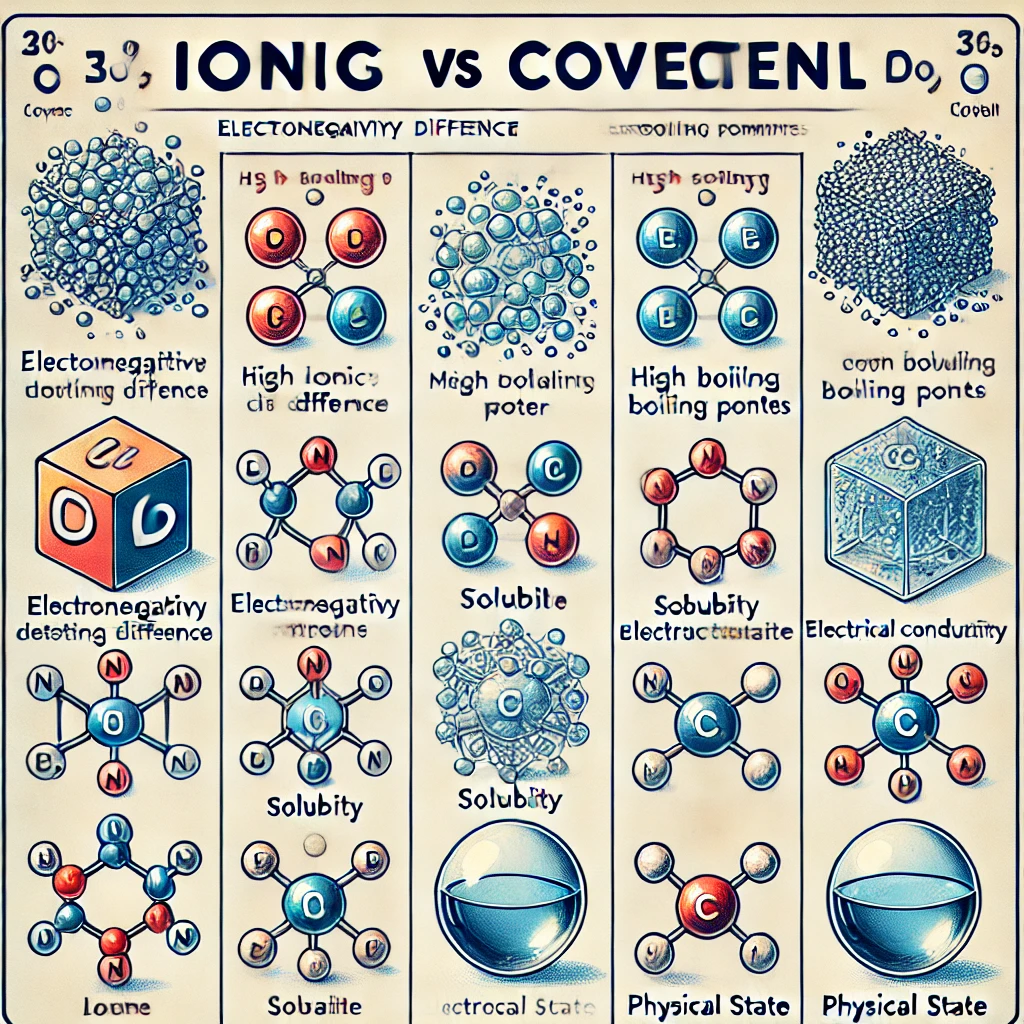
Here is a visual comparison chart that illustrates the key properties of ionic and covalent compounds. This should help further clarify the differences between the two based on characteristics like electronegativity, melting/boiling points, solubility, electrical conductivity, and physical state.