Sulfuric acid, H2SO4, is a common laboratory chemical. Draw the Lewis structure of H, SO, with minimized formal charges. Include lone pairs.
The correct answer and explanation is :
Here is the Lewis structure of sulfuric acid (H₂SO₄), along with an explanation of how it is determined.
Step 1: Count Valence Electrons
- Hydrogen (H) has 1 valence electron (2 atoms × 1 = 2 e⁻).
- Sulfur (S) has 6 valence electrons.
- Oxygen (O) has 6 valence electrons (4 atoms × 6 = 24 e⁻).
- Total valence electrons = 2 + 6 + 24 = 32 electrons.
Step 2: Identify the Central Atom
- Sulfur is less electronegative than oxygen, so it is the central atom.
Step 3: Connect Atoms with Single Bonds
- Attach the four oxygen atoms to sulfur using single bonds.
- Attach two hydrogen atoms to two oxygen atoms (these will be the -OH groups).
Step 4: Distribute Lone Pairs
- Each oxygen must have 8 electrons around it (including bonding pairs).
- The two oxygen atoms bonded to hydrogen (OH groups) will have two lone pairs.
- The two oxygen atoms not bonded to hydrogen will form double bonds with sulfur to minimize formal charges.
- Sulfur expands its octet (as it is in Period 3) and has no lone pairs.
Step 5: Formal Charge Calculation
Formal charge formula: Formal Charge=Valence Electrons−(Lone Pair Electrons + ½ Bonding Electrons)\text{Formal Charge} = \text{Valence Electrons} – \text{(Lone Pair Electrons + ½ Bonding Electrons)}
- Sulfur: 0
- Oxygen in OH groups: 0
- Double-bonded oxygens: 0
This structure ensures minimal formal charges, making it the most stable.
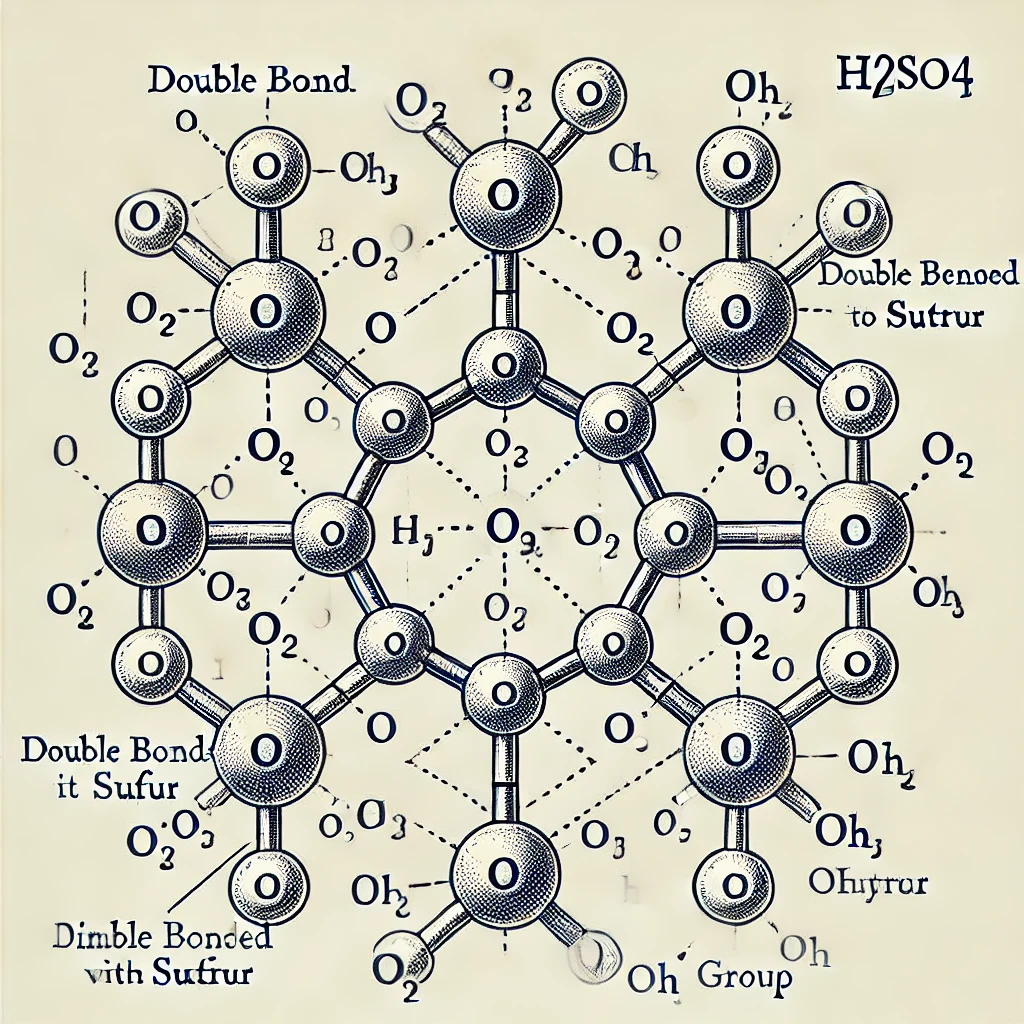
Here is the Lewis structure of sulfuric acid (H₂SO₄) with minimized formal charges.