Which substance has the lowest vapor pressure?
A. H2O
B. C3H8
C. CH3OH
D. H2S
The correct answer and explanation is :
The correct answer is A. H₂O (Water).
Explanation:
Vapor pressure is the pressure exerted by a vapor in equilibrium with its liquid at a given temperature. A substance with stronger intermolecular forces has a lower vapor pressure because its molecules are held together more tightly, making it harder for them to escape into the gas phase.
Comparison of Intermolecular Forces:
- Water (H₂O) – Water has strong hydrogen bonding, the strongest type of dipole-dipole interaction. Each water molecule can form up to four hydrogen bonds, significantly reducing its tendency to evaporate. This leads to a low vapor pressure.
- Methanol (CH₃OH) – Also exhibits hydrogen bonding, but its hydrogen bonding is weaker than water’s due to the presence of only one hydroxyl (-OH) group. This means methanol has a higher vapor pressure than water.
- Hydrogen sulfide (H₂S) – Has dipole-dipole interactions but does not form hydrogen bonds because sulfur is less electronegative than oxygen. This results in higher vapor pressure than both water and methanol.
- Propane (C₃H₈) – A nonpolar molecule that only experiences weak London dispersion forces. Since these forces are much weaker than hydrogen bonding or dipole interactions, propane molecules escape easily into the gas phase, resulting in very high vapor pressure.
Conclusion:
Water (H₂O) has the lowest vapor pressure among the given substances because of its strong hydrogen bonding, which keeps molecules in the liquid state more effectively than the others.
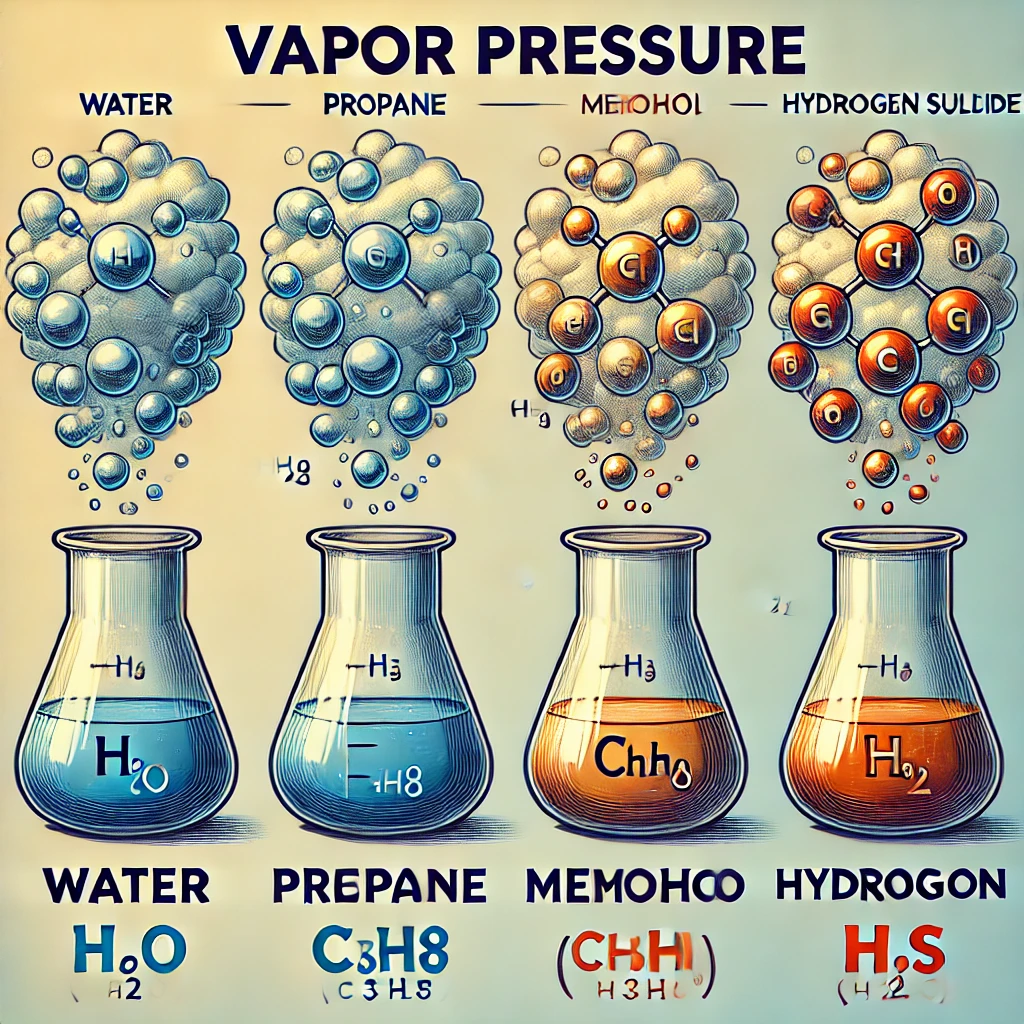
Here is the image comparing the vapor pressure of the four substances: Water (H₂O), Propane (C₃H₈), Methanol (CH₃OH), and Hydrogen Sulfide (H₂S). It visually represents how water has the lowest vapor pressure due to strong hydrogen bonding, while propane has the highest due to weak London dispersion forces.