Market failure refers to a situation in which:
A) markets fail to reach a fair outcome
B) markets establish a high price for necessities.
C) market-determined wages are not high enough to raise all workers above the poverty line.
D) markets fail to reach an efficient outcome
The correct answer and explanation is :
The correct answer is:
D) Markets fail to reach an efficient outcome.
Explanation:
Market failure occurs when the allocation of goods and services by a free market is not efficient, leading to a loss of economic and social welfare. This inefficiency arises when resources are not distributed in a way that maximizes overall societal benefit.
Several factors contribute to market failure:
- Externalities – These occur when a third party is affected by an economic transaction they are not directly involved in. Negative externalities, such as pollution, cause harm to society, while positive externalities, like education, provide benefits that may not be fully captured by market prices.
- Public Goods – Public goods, such as national defense and street lighting, are non-excludable (everyone can use them) and non-rivalrous (one person’s use does not reduce another’s). Since private firms cannot easily charge consumers, they are underprovided in free markets.
- Monopoly Power – When a single firm or a small group controls a market, they can restrict supply and increase prices, leading to inefficiency and loss of consumer welfare.
- Asymmetric Information – When one party in a transaction has more or better information than the other, it can lead to poor decision-making, as seen in cases like used car markets or health insurance.
- Factor Immobility – When labor and capital cannot easily move between industries, resources are not allocated efficiently, leading to unemployment and wasted resources.
To correct market failures, governments often intervene through regulations, taxes, subsidies, or public provision of essential goods and services. However, these interventions must be carefully designed to avoid government failure, where policies create further inefficiencies.
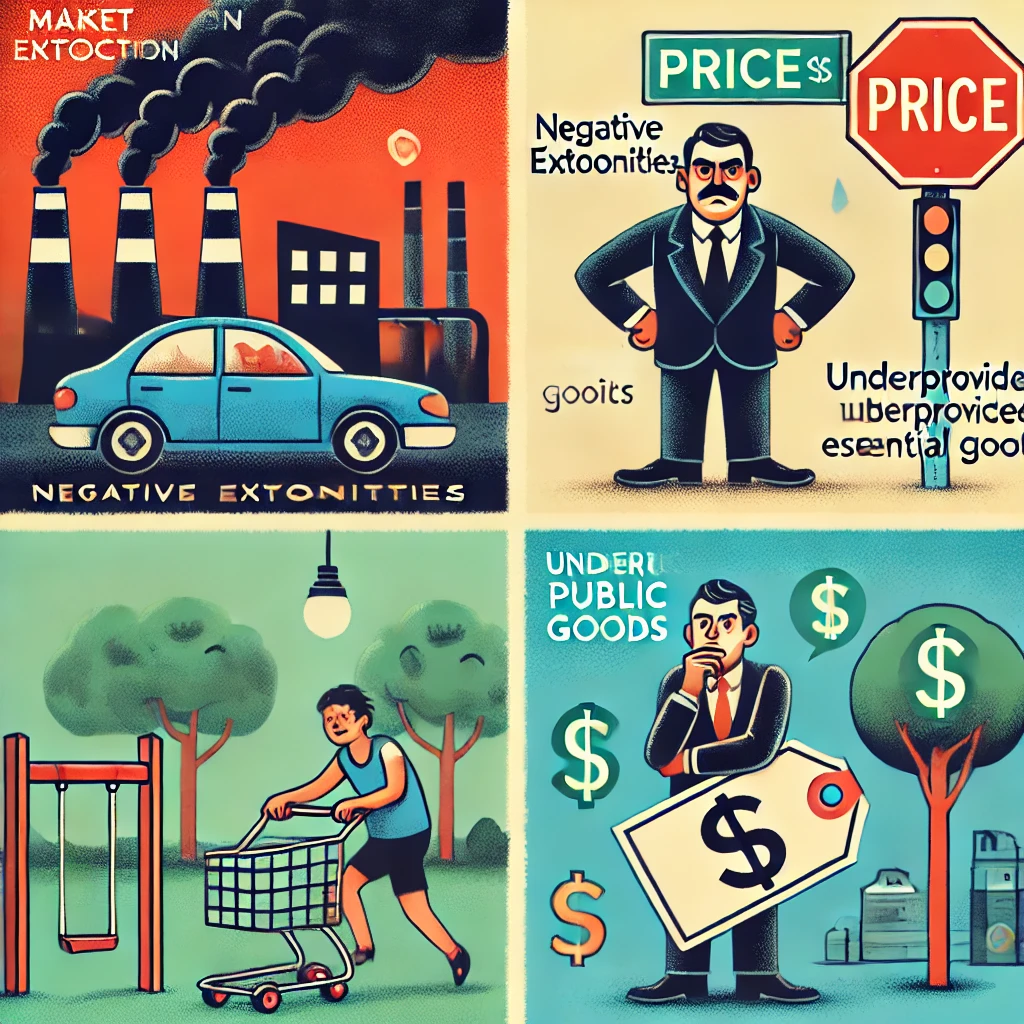
Here is an illustration depicting market failure, showcasing negative externalities, monopoly power, underprovided public goods, and inefficiency in markets.