The radius of a copper (Cu) atom is roughly 1.3 x 10⁻¹⁰ m. How many times can you divide evenly a 10-cm-long piece of copper wire until it is reduced to two separate copper atoms? (Assume there are appropriate tools for this procedure and that copper atoms are lined up in a straight line, in contact with each other. Round off your answer to an integer.)
The correct answer and explanation is :
To determine how many times we can divide a 10 cm (0.1 m) copper wire until we reach two separate copper atoms, we follow these steps:
- Determine the total length of copper atoms lined up
- The radius of a single copper atom is (1.3 \times 10^{-10} ) m.
- The diameter of a copper atom (since atoms are lined up in contact) is:
[
d = 2 \times (1.3 \times 10^{-10}) = 2.6 \times 10^{-10} \text{ m}
] - The number of copper atoms that fit in the 10 cm wire:
[
N = \frac{\text{total wire length}}{\text{diameter of one atom}} = \frac{0.1}{2.6 \times 10^{-10}}
]
[
N \approx 3.85 \times 10^8 \text{ atoms}
]
- Determine the number of divisions required
- Each time we divide, the number of segments doubles.
- The number of times we can divide until we reach two separate atoms is given by:
[
2^n = N
]
Taking the logarithm on both sides:
[
n = \log_2(N) = \log_2(3.85 \times 10^8)
]
Converting using logarithm properties:
[
n = \frac{\log(3.85 \times 10^8)}{\log 2}
]
Using approximate values:
(\log(3.85 \times 10^8) \approx 8.59) and (\log 2 \approx 0.301), [
n \approx \frac{8.59}{0.301} \approx 28.5
]
- Round off the answer
Since we can only divide in whole steps, we round 28.5 to 29.
Final Answer:
**You can evenly divide the 10 cm copper wire *29 times* before reaching two separate copper atoms.**
Explanation:
Each time you cut the wire in half, you reduce its length by half. The process continues until the segment length reaches the atomic scale (i.e., the diameter of a copper atom). The logarithmic calculation determines how many such halvings are needed. Since the number of atoms is large, the division process follows a power of 2 pattern, and logarithms help find the number of required steps.
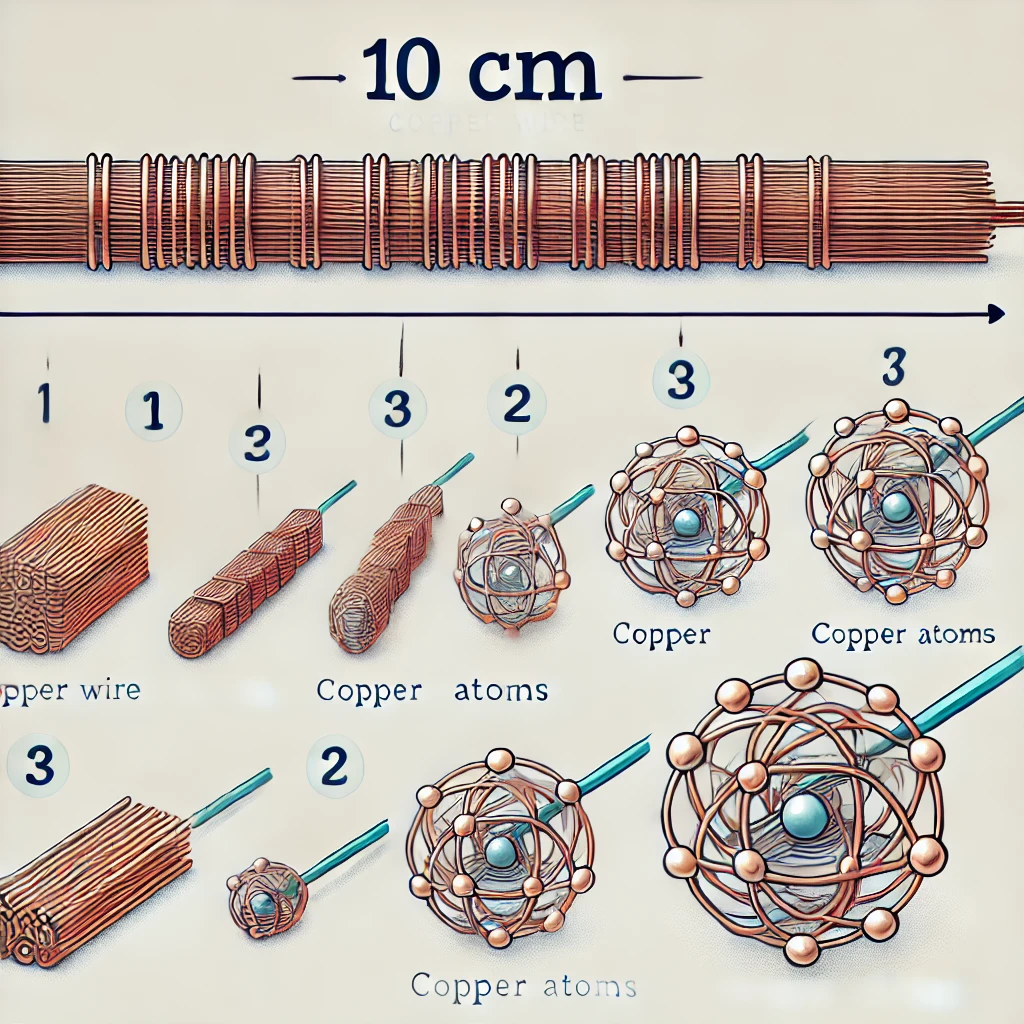
Here is the image illustrating the step-by-step division of a 10 cm copper wire down to individual copper atoms, emphasizing the 29 division steps using a logarithmic scale.