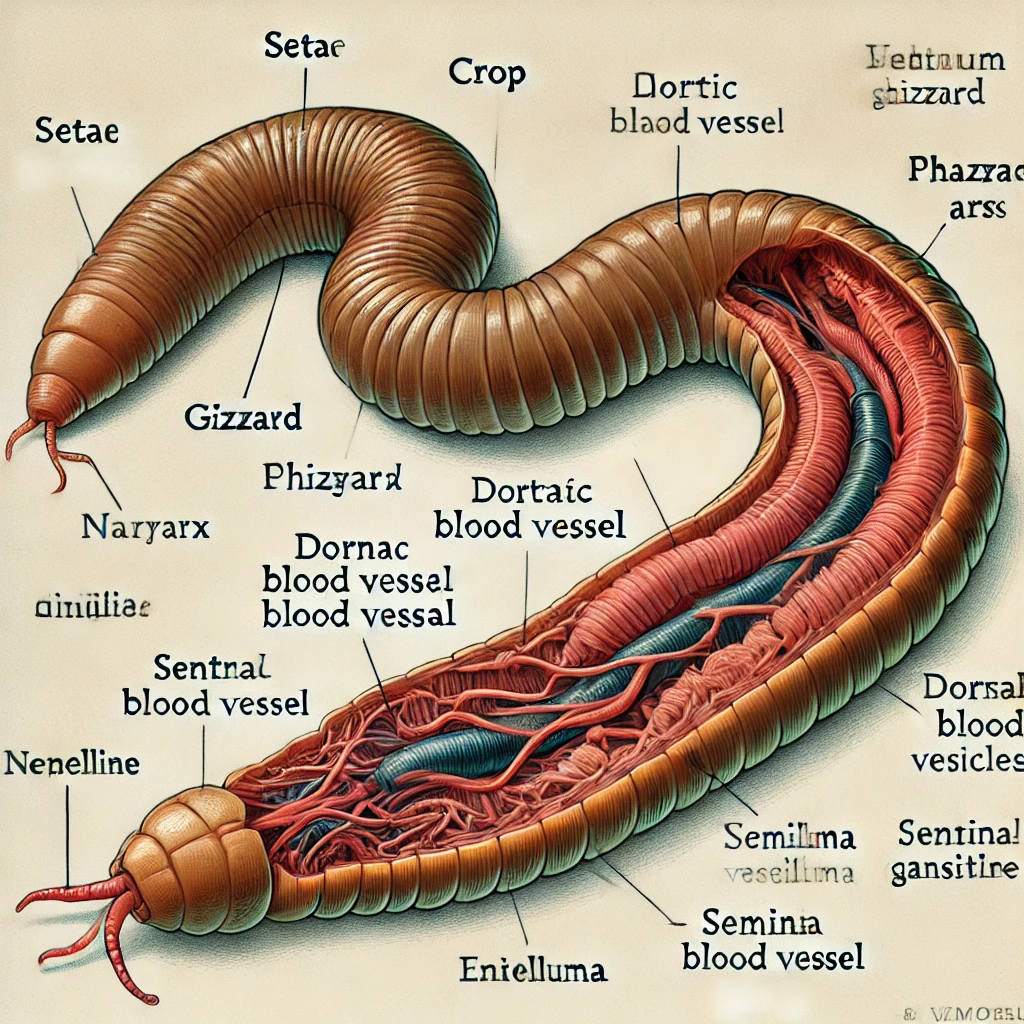
what is the function of the setae?
describe the function of the following organs:
a) crop
b) gizzard
c) pharynx
d) aortic arches
e) dorsal blood vessel
f) ventral blood vessel
g) clitellum
h) nephridia
i) seminal vesicles
j) intestine
k) ganglia
why is it said that the earthworm has a “closed” circulatory system
name and list the characteristics of the earthworms phylum
explain how the gizzard and the inward fold of the intestine help the earthworm digest food
explain how the earthworm reproduces
The correct answer and explanation is :
Function of Setae
Setae are tiny, bristle-like structures found on the ventral side of each segment of an earthworm’s body. Their primary function is to provide grip and traction against the soil, aiding in movement. By anchoring certain body segments while others extend forward, setae help the earthworm crawl through its environment.
Functions of Earthworm Organs
a) Crop – The crop is a storage organ that temporarily holds ingested food before it moves to the gizzard for further processing.
b) Gizzard – The gizzard is a muscular structure responsible for grinding food into smaller particles. It contains small mineral particles and grit, which aid in mechanical digestion.
c) Pharynx – The pharynx is the muscular region behind the mouth that helps in sucking in food and directing it into the esophagus.
d) Aortic Arches – These are five pairs of heart-like structures that pump blood through the worm’s body, helping in circulation.
e) Dorsal Blood Vessel – This blood vessel carries oxygenated blood from the posterior to the anterior part of the worm.
f) Ventral Blood Vessel – This vessel transports blood from the anterior to the posterior part of the worm, distributing nutrients and oxygen.
g) Clitellum – A thick, glandular band near the anterior end of the worm, which secretes mucus during reproduction to form a cocoon for fertilized eggs.
h) Nephridia – These are excretory organs that filter out metabolic waste from the body fluid, functioning like kidneys.
i) Seminal Vesicles – These structures store and mature sperm before they are transferred to another worm during reproduction.
j) Intestine – The intestine absorbs nutrients from digested food and allows for chemical digestion as food moves toward the anus.
k) Ganglia – These are clusters of nerve cells that act as the worm’s simple brain, controlling movement and response to stimuli.
Why Earthworms Have a Closed Circulatory System
An earthworm has a closed circulatory system because its blood is contained within vessels at all times. The blood is pumped by the aortic arches and flows through the dorsal and ventral blood vessels, ensuring efficient transport of nutrients, oxygen, and waste. This system allows for effective circulation and distribution of essential substances throughout the worm’s body.
Phylum of Earthworms and Its Characteristics
Earthworms belong to the phylum Annelida. The defining characteristics of this phylum include:
- Segmented Body – The body is divided into repeating segments.
- Bilateral Symmetry – The left and right sides are mirror images.
- Setae – Small bristles aid in locomotion.
- Closed Circulatory System – Blood flows within vessels.
- Hermaphroditism – They have both male and female reproductive organs.
- Hydrostatic Skeleton – Movement is aided by fluid pressure in body cavities.
- Complete Digestive System – Includes mouth, pharynx, crop, gizzard, intestine, and anus.
How the Gizzard and Intestinal Fold Help Digestion
The gizzard helps mechanically break down food by grinding it with the help of tiny sand particles and grit. This allows for more effective digestion. The typhlosole, an inward fold of the intestine, increases the surface area for absorption, making nutrient extraction more efficient.
Earthworm Reproduction
Earthworms are hermaphrodites, meaning they have both male and female reproductive organs. However, they still require another worm for reproduction.
- Two earthworms align ventrally and exchange sperm, which is stored in seminal receptacles.
- The clitellum secretes a mucus ring that collects eggs and stored sperm.
- The mucus ring slides off the worm’s body, forming a cocoon in which fertilization occurs.
- The fertilized eggs develop inside the cocoon, and juvenile earthworms emerge after a few weeks.
Earthworm reproduction plays a crucial role in soil aeration and fertility. Their burrowing and decomposition of organic material enhance soil health, making them vital to ecosystems.
Earthworm Anatomy Image