Which of the following are principles of proper body mechanics when lifting or carrying objects? (Select all that apply.)
Keep the knees in a locked position.
Bend at the waist to maintain a centre of gravity.
Maintain a wide base of support.
Hold objects away from the body for improved leverage.
Encourage the patient to help as much as possible.
The correct answer and explanation is :
Correct Principles of Proper Body Mechanics When Lifting or Carrying Objects:
- Maintain a wide base of support. ✅
- Encourage the patient to help as much as possible. ✅
Incorrect Principles:
- ❌ Keep the knees in a locked position. (This increases the risk of injury; knees should be slightly bent.)
- ❌ Bend at the waist to maintain a center of gravity. (Always bend at the knees, not the waist, to protect your back.)
- ❌ Hold objects away from the body for improved leverage. (Objects should be held close to the body to reduce strain on muscles and the spine.)
Explanation:
Proper body mechanics are essential for preventing injuries and ensuring safe lifting and carrying of objects. The correct principles include maintaining a wide base of support, which improves balance and stability. This means keeping feet shoulder-width apart to distribute weight evenly.
Another important principle is encouraging the patient to help as much as possible when lifting or transferring them. This reduces the load on the caregiver and allows the patient to contribute to their own movement, promoting independence.
Avoiding common mistakes is also crucial. Locking the knees while lifting increases strain on the lower back and reduces flexibility, which can lead to injury. Instead, keeping knees slightly bent allows for better shock absorption. Bending at the waist instead of the knees places excessive pressure on the spine, increasing the risk of back strain. The proper technique is to squat down by bending at the knees and using leg muscles to lift.
Additionally, holding objects close to the body is key to reducing strain. When an object is held far from the body, the leverage effect increases, making the lift much harder and more taxing on the back.
By following these principles, individuals can reduce their risk of musculoskeletal injuries and maintain good body mechanics in daily tasks.
Illustration of Proper Lifting Technique:
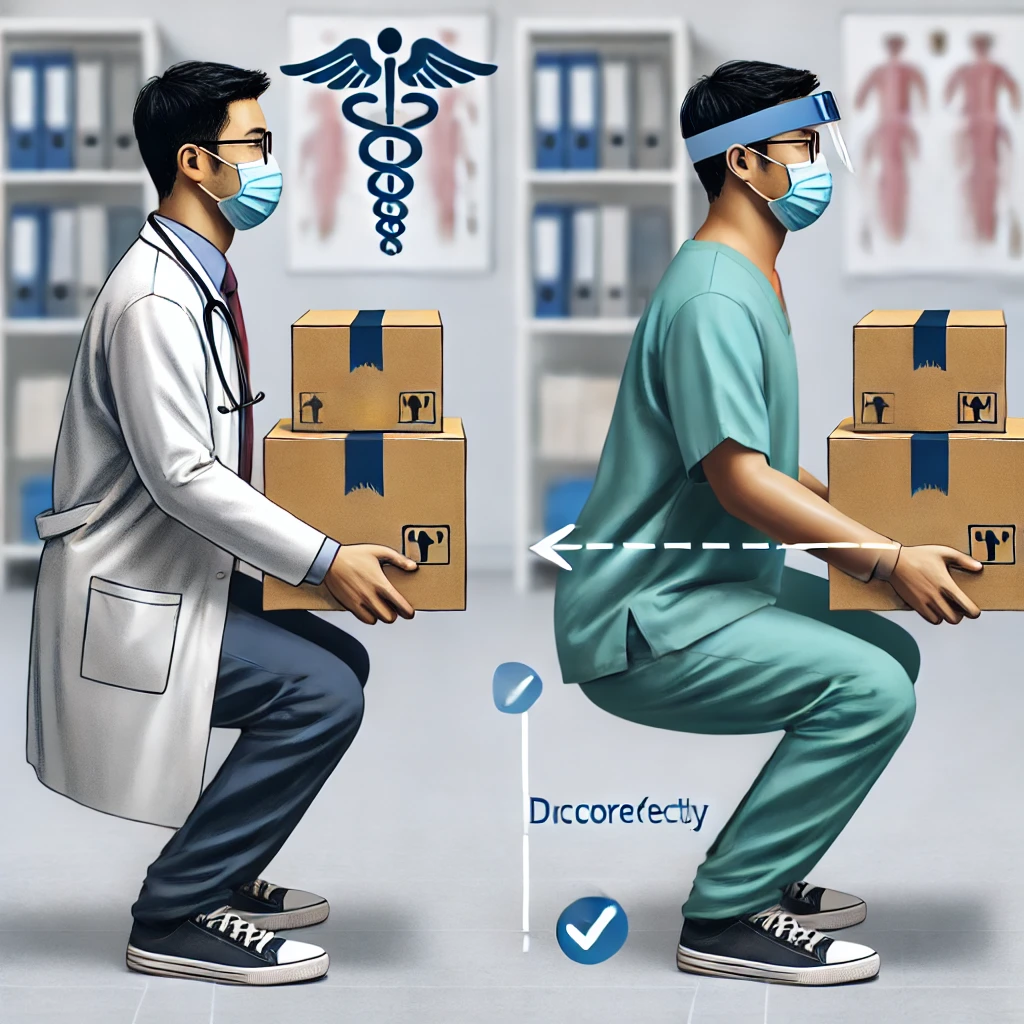
Here is an image demonstrating proper body mechanics while lifting an object. The healthcare worker is shown using correct technique—squatting with bent knees, keeping a straight back, and holding the object close. Meanwhile, another person is depicted incorrectly lifting by bending at the waist with locked knees.