Only one of the following statements is correct. The statements compare perfectly competitive (PC) markets and monopolistically competitive (MC) markets. Which statement is correct?
A) Productive efficiency is achieved in both PC and MC markets. Allocative efficiency is achieved only in MC markets.
B) Allocative efficiency is achieved in both PC and MC markets. Productive efficiency is achieved only in PC markets.
C) Productive efficiency and allocative efficiency are both achieved in PC markets. Neither is achieved in MC markets.
D) Allocative efficiency is achieved only in PC markets. Productive efficiency is achieved only in MC markets.
The correct answer and explanation is :
The correct answer is:
C) Productive efficiency and allocative efficiency are both achieved in PC markets. Neither is achieved in MC markets.
Explanation:
Perfect Competition (PC) and Efficiency
In a perfectly competitive market, firms produce at the lowest possible cost and allocate resources efficiently. This ensures both productive efficiency and allocative efficiency:
- Productive Efficiency: Achieved when firms produce at the lowest possible average total cost (ATC). This occurs in perfect competition because firms operate at the minimum of their ATC curve in the long run, ensuring no wasted resources.
- Allocative Efficiency: Achieved when the price of a good equals its marginal cost (P = MC). This means resources are allocated in a way that maximizes consumer and producer surplus, ensuring that society values the last unit of output as much as it costs to produce.
Monopolistic Competition (MC) and Inefficiency
In monopolistic competition, firms sell differentiated products and have some market power, which leads to inefficiencies:
- Lack of Productive Efficiency: In monopolistic competition, firms do not produce at the lowest point on their ATC curve. Instead, they operate with some excess capacity due to downward-sloping demand curves. This means higher costs compared to perfect competition.
- Lack of Allocative Efficiency: Monopolistically competitive firms set prices above marginal cost (P > MC) due to market power. This leads to deadweight loss, where some consumers who would have bought at a competitive price are priced out. This misallocation of resources means society is not getting the maximum benefit from production.
Thus, only perfect competition achieves both productive and allocative efficiency, while monopolistic competition achieves neither.
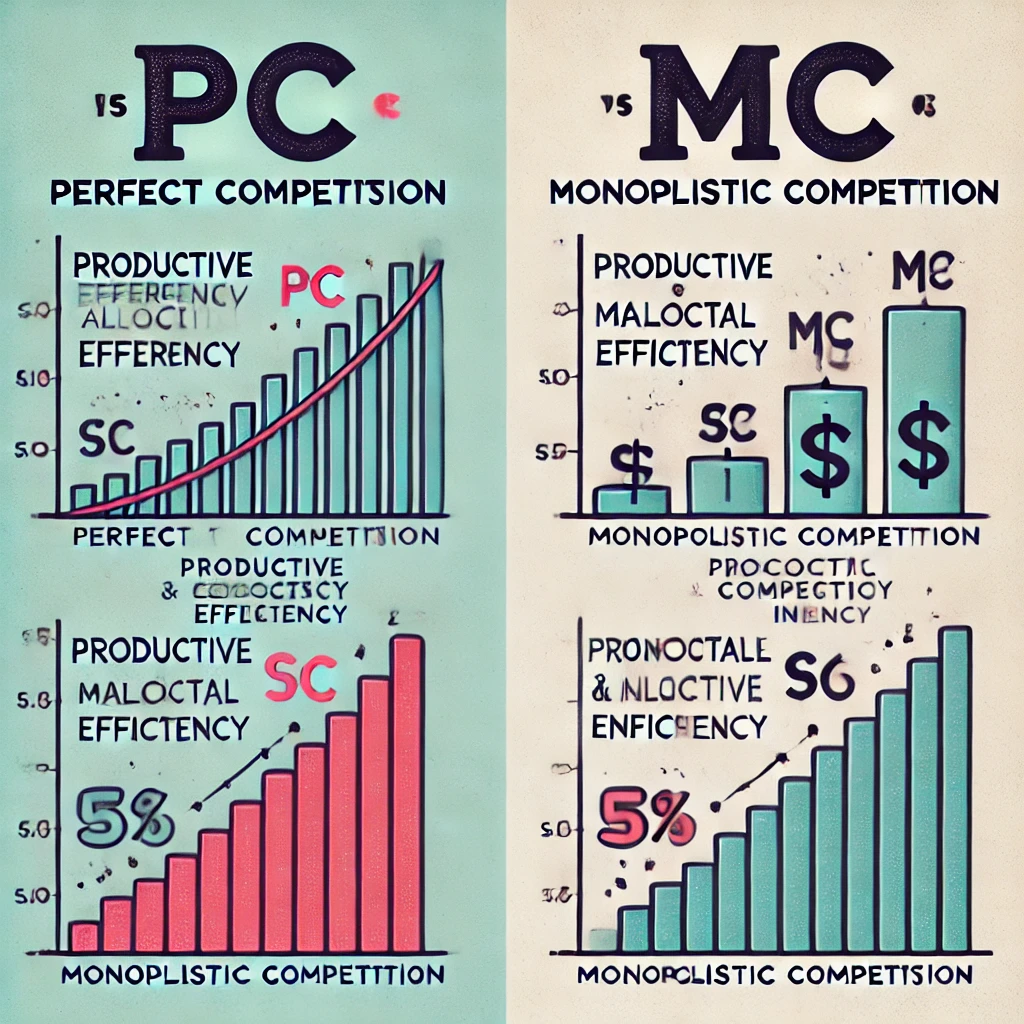
Here is an economic illustration comparing Perfect Competition (PC) and Monopolistic Competition (MC). The image highlights the differences in efficiency between the two market structures.