The complex [Ni(CN)4]
The complex [Ni(CN)4]2- is diamagnetic but [NiCl4]2- is paramagnetic (both d8), with two unpaired electrons. Similarly, [Fe(CN)6]3- has only one unpaired electron, but [Fe(OH2)6]3+ has 5. Explain these experimental observations using:
a) the Valencia Bond Theory.
b) the Crystalline Field Theory.
The correct answer and explanation is :
Explanation of Magnetic Properties Using VBT and CFT
The complexes [Ni(CN)4]²⁻ and [NiCl4]²⁻ exhibit different magnetic properties despite both having d⁸ electronic configurations. Similarly, [Fe(CN)6]³⁻ and [Fe(OH2)6]³⁺ have different numbers of unpaired electrons despite both containing Fe³⁺ (d⁵).
(a) Valence Bond Theory (VBT) Explanation
VBT explains the magnetic properties based on hybridization and electron pairing in the metal’s orbitals.
- [Ni(CN)4]²⁻:
- Nickel is in the +2 oxidation state, meaning it has a d⁸ configuration.
- The strong field ligand CN⁻ forces the low-spin configuration.
- The Ni²⁺ ion undergoes dsp² hybridization, resulting in a square planar structure.
- All electrons pair up, making the complex diamagnetic.
- [NiCl4]²⁻:
- Cl⁻ is a weak field ligand, leading to a high-spin configuration.
- The Ni²⁺ ion undergoes sp³ hybridization, resulting in a tetrahedral structure.
- Two unpaired electrons remain, making it paramagnetic.
- [Fe(CN)6]³⁻:
- Fe³⁺ has a d⁵ configuration.
- CN⁻ is a strong field ligand, causing a low-spin state.
- Electrons pair up, leaving only one unpaired electron (t₂g⁵ in an octahedral field).
- [Fe(OH2)6]³⁺:
- H₂O is a weak field ligand, leading to a high-spin configuration.
- The Fe³⁺ ion retains five unpaired electrons.
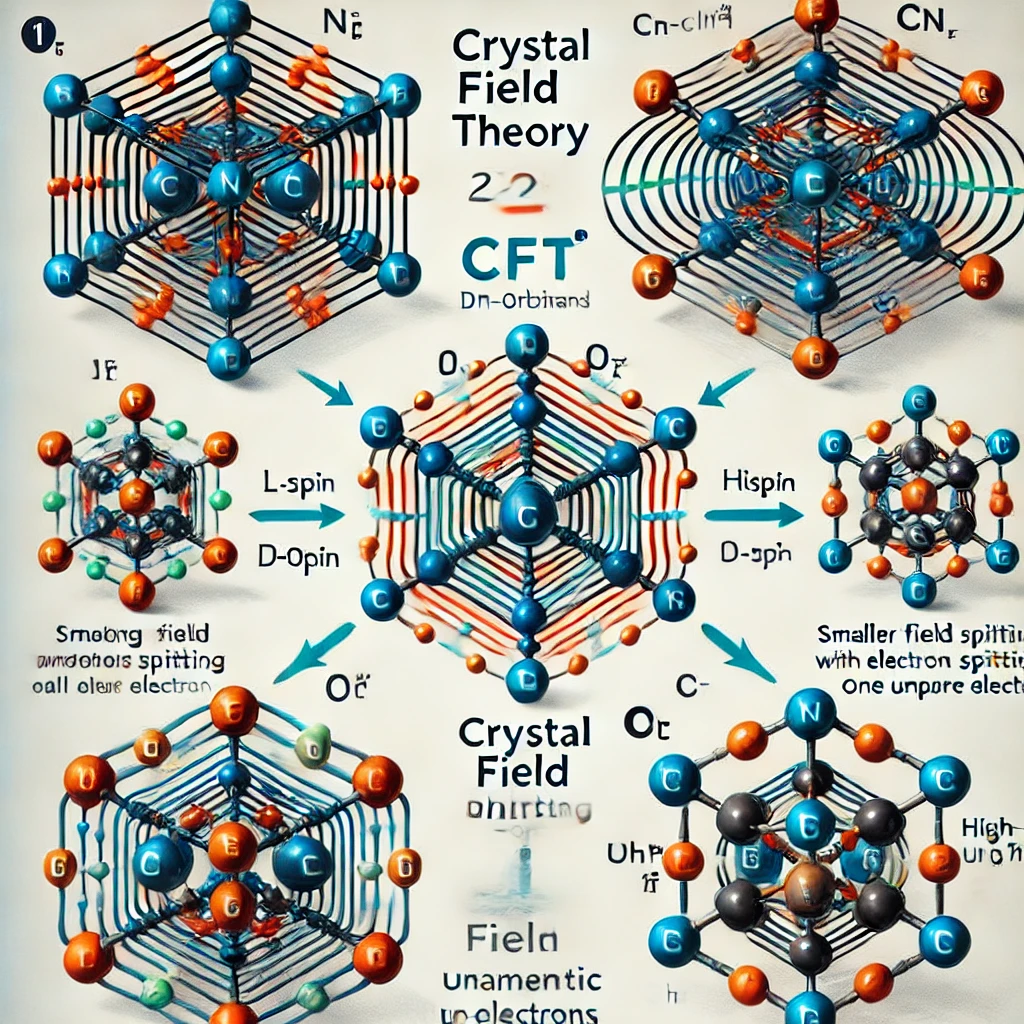
(b) Crystal Field Theory (CFT) Explanation
CFT explains magnetism by considering the splitting of d-orbitals due to ligand interactions.
- [Ni(CN)4]²⁻:
- Square planar structure: The strong field CN⁻ ligand causes a large d-orbital splitting.
- Electrons pair in the lower energy levels, leading to a low-spin, diamagnetic complex.
- [NiCl4]²⁻:
- Tetrahedral structure: The weak field Cl⁻ ligand results in smaller d-orbital splitting.
- High-spin state occurs, leaving two unpaired electrons, making it paramagnetic.
- [Fe(CN)6]³⁻:
- Octahedral field: Strong field CN⁻ ligand causes a large splitting.
- A low-spin configuration (t₂g⁵ eg⁰) forms, leaving only one unpaired electron.
- [Fe(OH2)6]³⁺:
- Octahedral field: Weak field H₂O ligand results in a small splitting.
- A high-spin configuration (t₂g³ eg²) remains, keeping five unpaired electrons.
Conclusion
- Strong field ligands (CN⁻) induce low-spin states, reducing the number of unpaired electrons.
- Weak field ligands (Cl⁻, H₂O) lead to high-spin states, increasing unpaired electrons.
- Square planar (dsp²) hybridization results in diamagnetic behavior, while tetrahedral (sp³) hybridization allows unpaired electrons, leading to paramagnetic behavior.
Diagram for CFT Splitting in Different Complexes