A police officer is called in for accident reconstruction. He measures 11-meter long skid marks and he knows that for that particular tire/pavement combination, the coefficient of kinetic friction is 0.65. He also knows that the car was traveling at 3.5 m/s just before impact (the end of the skid marks). What was the speed of the car before it began the skid? Convert this to miles per hour. (Note: 1 mile = 1609 meters).
The correct answer and explanation is :
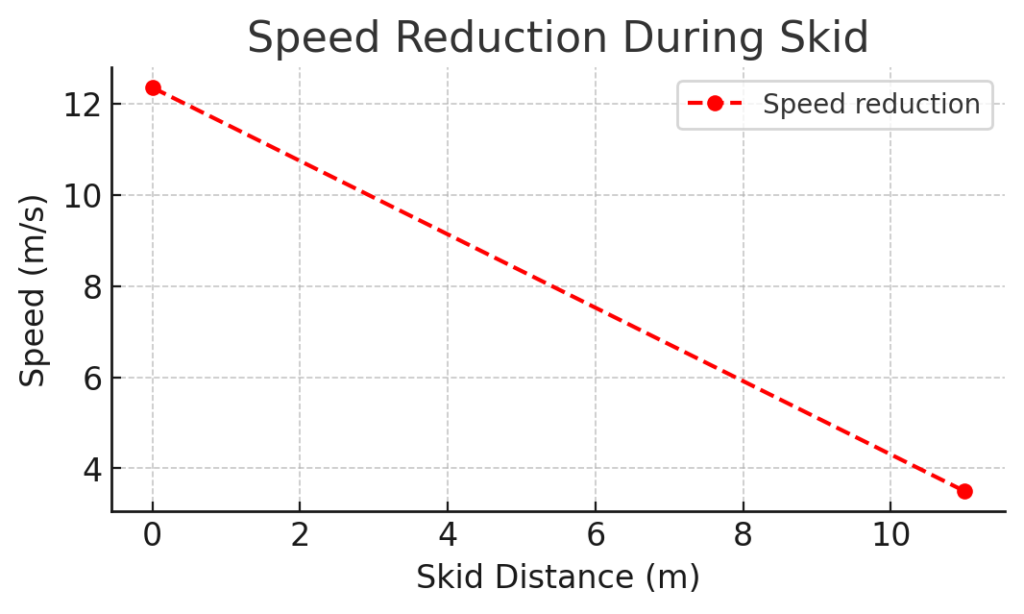
The initial speed of the car before it began to skid was 12.35 m/s, which converts to approximately 27.63 mph.
Explanation:
When a vehicle skids, its speed is reduced due to the force of friction between the tires and the road surface. To determine the initial speed before skidding, we use the kinematic equation:
[
v^2 = u^2 + 2as
]
where:
- ( v = 3.5 ) m/s (final speed, just before impact),
- ( u ) = initial speed before the skid (to be determined),
- ( a = -\mu g ) (deceleration due to friction),
- ( s = 11 ) m (skid mark length),
- ( \mu = 0.65 ) (coefficient of kinetic friction),
- ( g = 9.81 ) m/s² (acceleration due to gravity).
Step-by-step Calculation:
- Compute the deceleration due to friction:
[
a = – (0.65 \times 9.81) = -6.3765 \text{ m/s²}
] - Solve for ( u ):
[
u = \sqrt{v^2 – 2as}
]
[
u = \sqrt{(3.5)^2 – (2 \times (-6.3765) \times 11)}
]
[
u = \sqrt{12.25 + 140.283}
]
[
u = \sqrt{152.533} = 12.35 \text{ m/s}
] - Convert to miles per hour (mph):
[
12.35 \times \frac{3600}{1609} \approx 27.63 \text{ mph}
]
Conclusion:
The car was traveling at approximately 12.35 m/s (27.63 mph) before it began to skid. This analysis helps in accident reconstruction to determine whether the driver was speeding or following traffic regulations.