You are driving in a car at 15 m/s, approaching an intersection that is 8.0 meters long. When you are 35 m away from the beginning of the intersection, the light turns yellow – it will turn red in 2.0 seconds. You must decide if you will hit the gas or the brakes. By hitting the gas, you can accelerate at 3.0 m/s2; by hitting the brakes, you can decelerate at 4.0 m/s2. Assume 0.20 seconds of reaction/decision time. The law (in most states) says you may not enter the intersection when the light is red. What should you do? Is there anything unrealistic about this problem?
The correct answer and explanation is :
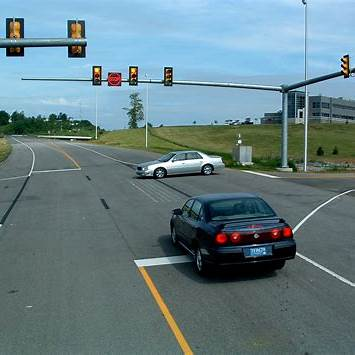
When approaching an intersection 35 meters ahead at a speed of 15 m/s (54 km/h), the traffic light turns yellow and will switch to red in 2.0 seconds. Considering a reaction time of 0.20 seconds, you must decide whether to accelerate or brake to comply with traffic laws prohibiting entering the intersection on a red light.
Option 1: Braking
- Reaction Distance: During the 0.20-second reaction time, the car travels:
- Distance = speed × time = 15 m/s × 0.20 s = 3 meters.
- Braking Distance: After reacting, the car decelerates at 4.0 m/s² from 15 m/s to 0 m/s. Using the formula ( v^2 = u^2 + 2as ):
- ( 0 = (15)^2 + 2(-4)s )
- Solving for ( s ): ( s = \frac{(15)^2}{2 × 4} = 28.125 ) meters.
- Total Stopping Distance: Reaction distance + braking distance = 3 m + 28.125 m = 31.125 meters.
Since 31.125 meters is less than the 35 meters to the intersection, braking allows you to stop safely before entering the intersection.
Option 2: Accelerating
- Reaction Distance: As before, during the 0.20-second reaction time, the car travels 3 meters.
- Time to Red Light: After the reaction time, 2.0 s – 0.20 s = 1.8 seconds remain before the light turns red.
- Acceleration Distance: Using the formula ( s = ut + \frac{1}{2}at^2 ) with initial speed ( u = 15 ) m/s, acceleration ( a = 3 ) m/s², and time ( t = 1.8 ) s:
- ( s = 15 × 1.8 + \frac{1}{2} × 3 × (1.8)^2 )
- ( s = 27 + 4.86 = 31.86 ) meters.
- Total Distance Covered: Reaction distance + acceleration distance = 3 m + 31.86 m = 34.86 meters.
Since 34.86 meters is less than the 35 meters to the intersection, you would not reach the intersection before the light turns red.
Conclusion: Braking is the appropriate action, as it allows you to stop safely before the intersection, complying with traffic laws.
Unrealistic Aspects:
- Reaction Time: A reaction time of 0.20 seconds is shorter than the average human reaction time, typically around 1.5 seconds.
- Acceleration Assumption: Assuming a constant acceleration of 3.0 m/s² may not account for real-world factors like engine response and road conditions.
- Intersection Length: The problem doesn’t account for the time required to clear the 8-meter intersection, which could affect the decision.
These simplifications may not accurately reflect real-world driving scenarios.