You are driving in a car at 15 m/s, approaching an intersection that is 8.0 meters long. When you are 35 m away from the beginning of the intersection, the light turns yellow – it will turn red in 2.0 seconds. You must decide if you will hit the gas or the brakes. By hitting the gas, you can accelerate at 3.0 m/s2; by hitting the brakes, you can decelerate at 4.0 m/s2. Assume 0.20 seconds of reaction/decision time. The law (in most states) says you may not enter the intersection when the light is red. What should you do? Is there anything unrealistic about this problem?
The correct answer and explanation is :
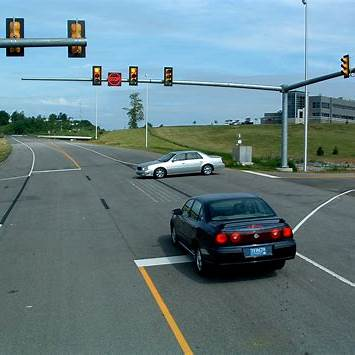
When approaching an intersection under the given conditions, it’s crucial to determine whether to accelerate or brake to comply with traffic laws and ensure safety. Let’s analyze both scenarios:
Braking Scenario:
- Reaction Distance: During the 0.20-second reaction time, the car travels: [ \text{Distance} = \text{Speed} \times \text{Time} = 15\, \text{m/s} \times 0.20\, \text{s} = 3\, \text{m} ]
- Braking Distance: After reacting, the car decelerates at 4.0 m/s² from 15 m/s to a stop. Using the kinematic equation: [ v^2 = u^2 + 2a s ] Setting final velocity ( v = 0 ), initial velocity ( u = 15\, \text{m/s} ), and acceleration ( a = -4.0\, \text{m/s}^2 ): [ 0 = (15\, \text{m/s})^2 + 2 \times (-4.0\, \text{m/s}^2) \times s ] Solving for ( s ): [ s = \frac{(15\, \text{m/s})^2}{2 \times 4.0\, \text{m/s}^2} = \frac{225\, \text{m}^2/\text{s}^2}{8\, \text{m/s}^2} = 28.125\, \text{m} ]
- Total Stopping Distance: Sum of reaction and braking distances: [ 3\, \text{m} + 28.125\, \text{m} = 31.125\, \text{m} ]
Since the car is 35 m from the intersection, braking will stop the car approximately 3.875 m before the intersection, ensuring compliance with traffic laws.
Accelerating Scenario:
- Time to React and Accelerate: Total available time before the light turns red: [ 2.0\, \text{s} – 0.20\, \text{s} = 1.8\, \text{s} ]
- Distance Covered During Acceleration: Using the equation: [ s = ut + \frac{1}{2} a t^2 ] With ( u = 15\, \text{m/s} ), ( a = 3.0\, \text{m/s}^2 ), and ( t = 1.8\, \text{s} ): [ s = (15\, \text{m/s} \times 1.8\, \text{s}) + \frac{1}{2} \times 3.0\, \text{m/s}^2 \times (1.8\, \text{s})^2 ] Calculating: [ s = 27\, \text{m} + \frac{1}{2} \times 3.0\, \text{m/s}^2 \times 3.24\, \text{s}^2 ] [ s = 27\, \text{m} + 4.86\, \text{m} = 31.86\, \text{m} ]
The car needs to cover 35 m to reach the intersection plus 8 m to clear it, totaling 43 m. Covering only 31.86 m means the car won’t clear the intersection before the light turns red.
Decision:
Braking is the safer and legally compliant choice, as it stops the car before the intersection.
Unrealistic Aspects:
- Reaction Time: A 0.20-second reaction time is shorter than the average human reaction time, typically around 1.5 seconds.
- Acceleration/Deceleration Rates: The given rates (3.0 m/s² acceleration and 4.0 m/s² deceleration) are higher than typical values for standard vehicles, which usually have acceleration around 2.0 m/s² and deceleration around 3.0 m/s².
- Yellow Light Duration: A 2.0-second yellow light is shorter than standard durations, which are typically 3 to 6 seconds, depending on the road speed.
These assumptions may not reflect real-world driving conditions, affecting the accuracy of the analysis.