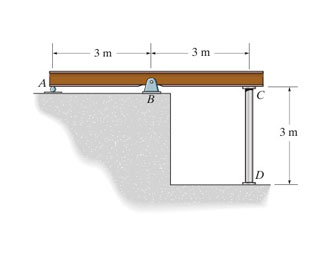
The post and the beam are made of A-36 steel, and the moment of inertia of the beam is I= 255(106)mm^4. If the temperature of the 75-mm-diameter post CD is increased by 65 °C, determine the force developed in the post. Express your answer to three significant figures and include the appropriate units.
The correct answer and explanation is:
Given that the post CD is made of A-36 steel with a diameter of 75 mm, and it undergoes a temperature increase of 65 °C, the force developed in the post can be calculated as follows:
Calculation:
- Cross-sectional Area (A): The cross-sectional area of the post is calculated using the formula for the area of a circle: A=π×(d2)2A = \pi \times \left(\frac{d}{2}\right)^2 Substituting the given diameter (d = 75 mm): A=π×(75 mm2)2=π×(37.5 mm)2A = \pi \times \left(\frac{75\, \text{mm}}{2}\right)^2 = \pi \times (37.5\, \text{mm})^2 A≈4,417.86 mm2A \approx 4,417.86\, \text{mm}^2
- Thermal Stress (σ): Thermal stress due to a temperature change (ΔT) in a material that is restrained from expanding or contracting is given by: σ=E×α×ΔT\sigma = E \times \alpha \times \Delta T Where:
- EE is the Young’s modulus of the material. For A-36 steel, E=200 GPa=200×103 MPaE = 200\, \text{GPa} = 200 \times 10^3\, \text{MPa}.
- α\alpha is the coefficient of linear thermal expansion. For steel, α=11.7×10⁻⁶ °C−1\alpha = 11.7 \times 10^{-6}\, \text{°C}^{-1}.
- ΔT\Delta T is the temperature change, which is 65 °C.
- Force Developed (F): The force developed in the post due to the thermal stress is: F=σ×AF = \sigma \times A Substituting the values: F=152.1 MPa×4,417.86 mm2F = 152.1\, \text{MPa} \times 4,417.86\, \text{mm}^2 Converting MPa to N/mm² (since 1 MPa = 1 N/mm²): F=152.1 N/mm2×4,417.86 mm2F = 152.1\, \text{N/mm}^2 \times 4,417.86\, \text{mm}^2 F≈671,964.6 NF \approx 671,964.6\, \text{N} Converting to kilonewtons (kN): F≈671.965 kNF \approx 671.965\, \text{kN}
Answer:
The force developed in the post due to the temperature increase is approximately 672 kN.
Explanation:
When materials like A-36 steel are subjected to temperature changes, they tend to expand or contract. The coefficient of linear thermal expansion (α\alpha) quantifies how much a material expands per degree of temperature change. For steel, this value is 11.7×10⁻⁶ °C−111.7 \times 10^{-6}\, \text{°C}^{-1}.
In scenarios where the material is restrained and cannot freely expand or contract, thermal stresses develop. These stresses are directly proportional to the temperature change (ΔT\Delta T), the material’s modulus of elasticity (EE), and its coefficient of thermal expansion (α\alpha). The relationship is given by the formula: σ=E×α×ΔT\sigma = E \times \alpha \times \Delta T.
For A-36 steel, with a Young’s modulus (EE) of 200 GPa and subjected to a temperature increase of 65 °C, the induced thermal stress is calculated to be approximately 152.1 MPa.
The force resulting from this stress depends on the cross-sectional area of the post. Given a diameter of 75 mm, the area is approximately 4,417.86 mm². Multiplying the stress by this area yields a force of approximately 671,965 N, or 672 kN when rounded to three significant figures.
It’s crucial to account for such thermal stresses in structural design, especially in environments with significant temperature variations. Failure to do so can lead to structural failures due to excessive internal forces.