Round 298, 596 to ten-thousands?
The correct answer and explanation is :
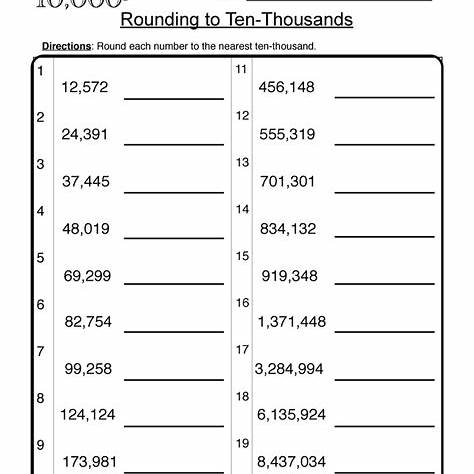
To round the number 298,596 to the nearest ten thousand, we follow these steps:
- Identify the ten-thousands place: In 298,596, the digit in the ten-thousands place is 9.
- Examine the digit to the immediate right (thousands place): The digit in the thousands place is 8.
- Apply rounding rules:
- If the thousands digit is 5 or greater, increase the ten-thousands digit by 1.
- If the thousands digit is less than 5, keep the ten-thousands digit unchanged.
Since the thousands digit is 8 (which is greater than 5), we increase the ten-thousands digit (9) by 1, resulting in 10. This changes the hundred-thousands digit from 2 to 3, and the ten-thousands digit becomes 0. All digits to the right are replaced with zeros.
Therefore, 298,596 rounded to the nearest ten thousand is 300,000.
Explanation:
Rounding is a mathematical technique used to simplify numbers, making them easier to work with by reducing the number of significant digits while maintaining a value close to the original. The process involves adjusting a number to a specified place value based on specific rules.
Steps to Round to the Nearest Ten Thousand:
- Identify the Ten-Thousands Place:
- Locate the digit in the ten-thousands position. For 298,596, this digit is 9.
- Examine the Thousands Digit:
- Look at the digit immediately to the right of the ten-thousands place. Here, it’s 8.
- Apply Rounding Rules:
- If the thousands digit is 5 or greater, increment the ten-thousands digit by 1.
- If it’s less than 5, retain the ten-thousands digit as is.
- Adjust Remaining Digits:
- After modifying the ten-thousands digit, set all subsequent digits (those to the right) to zero.
Detailed Application:
- Original Number: 298,596
- Ten-Thousands Digit: 9
- Thousands Digit: 8
Since the thousands digit (8) is greater than 5, we increase the ten-thousands digit by 1:
- New Ten-Thousands Digit: 9 + 1 = 10
However, a single digit cannot be 10. This increment causes a carry-over:
- Hundred-Thousands Digit: 2 (original) + 1 (carry-over) = 3
- Ten-Thousands Digit: 0 (after accounting for the carry-over)
All digits to the right become zeros:
- Result: 300,000
Conceptual Understanding:
Rounding to the nearest ten thousand means finding the multiple of 10,000 closest to the original number. The number line between 290,000 and 300,000 has a midpoint at 295,000:
- Numbers from 290,000 to 294,999 round down to 290,000.
- Numbers from 295,000 to 299,999 round up to 300,000.
Given that 298,596 falls between 295,000 and 300,000, it rounds up to 300,000.
Practical Significance:
Rounding simplifies complex numbers, facilitating easier estimation and mental calculations. For instance, in financial contexts, rounding can help quickly approximate totals or budgets without delving into exact figures.
Visual Representation:
To further illustrate, consider a number line:
- 290,000 | … | 295,000 | … | 298,596 | … | 300,000
Here, 298,596 is closer to 300,000 than to 290,000, reinforcing the rounding decision.