An airplane flying horizontally with a speed of 500 km/h at a height of 950 m fires a projectile horizontally in its direction of motion at a speed of 265 m/s relative to the plane. (Calculate the following answers relative to the ground.)
(a) How far in front of the release point does the projectile hit the ground (in m)?
(b) What is its speed when it hits the ground (in m/s)? m/s
The correct answer and explanation is :
Answers:
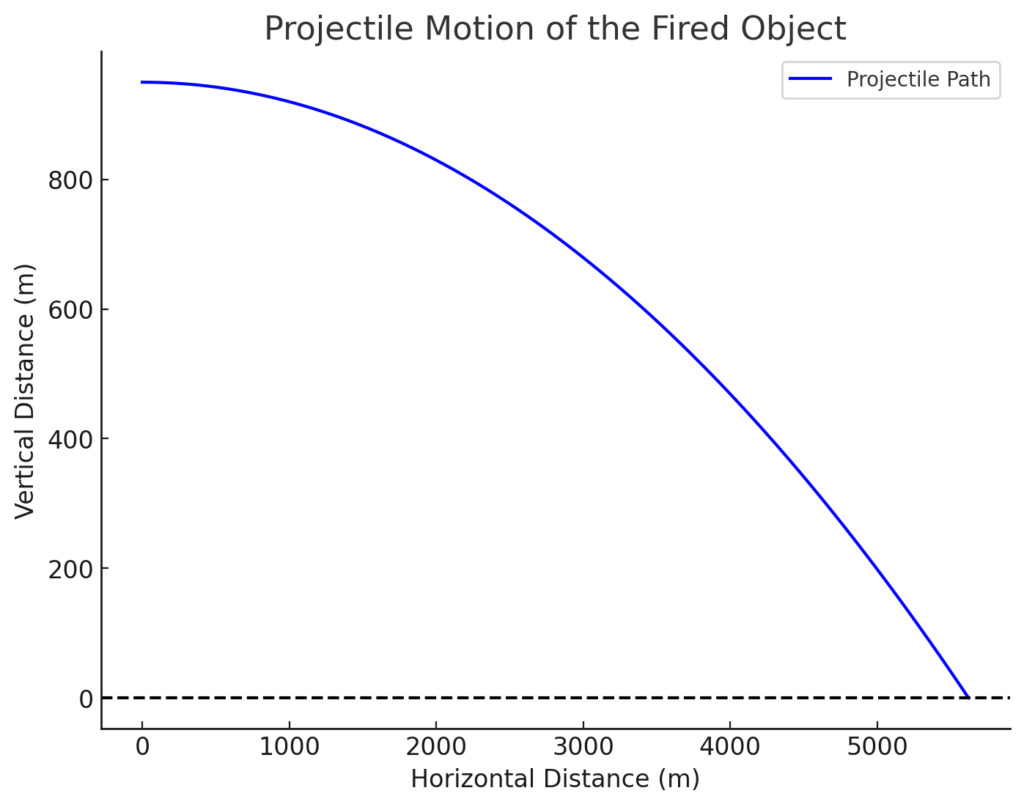
(a) The projectile hits the ground 5,620.88 meters in front of the release point.
(b) The projectile’s speed when it hits the ground is 426.34 m/s.
Explanation:
- Understanding the Motion: The projectile is released from an airplane flying at 500 km/h (138.89 m/s) at an altitude of 950 meters. It is fired horizontally with an additional speed of 265 m/s relative to the plane, making its total horizontal speed 403.89 m/s.
- Time to Hit the Ground: The vertical motion is independent of the horizontal motion and follows free fall due to gravity ((g = 9.81 \text{ m/s}^2)). The time to fall can be found using the kinematic equation:
[
t = \sqrt{\frac{2h}{g}} = \sqrt{\frac{2 \times 950}{9.81}} \approx 13.92 \text{ seconds}
] - Horizontal Distance (Range): Since there is no horizontal acceleration, the horizontal distance covered is:
[
x = v_x \cdot t = 403.89 \times 13.92 \approx 5,620.88 \text{ meters}
] - Final Speed at Impact: The projectile gains downward velocity due to gravity. The vertical velocity at impact is:
[
v_y = g \cdot t = 9.81 \times 13.92 \approx 136.49 \text{ m/s}
]
The total speed is found using the Pythagorean theorem:
[
v = \sqrt{v_x^2 + v_y^2} = \sqrt{(403.89)^2 + (136.49)^2} \approx 426.34 \text{ m/s}
]
Thus, the projectile travels about 5.62 km forward and hits the ground at 426.34 m/s.