A skier covers the final 110 meters of a race in 5.0 seconds, crossing the finish line at a speed of 24 m/s. What was her (constant) acceleration?
The correct answer and explanation is :
The skier’s constant acceleration is 0.80 m/s².
Explanation:
We are given:
- The final distance covered: 110 m
- The time taken: 5.0 s
- The final velocity: 24 m/s
To find the constant acceleration, we use kinematic equations.
Step 1: Use the kinematic equation for displacement:
[
d = v_i t + \frac{1}{2} a t^2
]
where:
- ( d = 110 ) m,
- ( t = 5.0 ) s,
- ( v_i ) is the initial velocity,
- ( a ) is the acceleration.
Step 2: Use the velocity equation:
[
v_f = v_i + a t
]
where:
- ( v_f = 24 ) m/s.
Step 3: Solve for ( v_i ) and ( a )
We solve these two equations simultaneously:
- ( 110 = v_i (5) + \frac{1}{2} a (5^2) ) → ( 110 = 5v_i + 12.5a )
- ( 24 = v_i + 5a )
Solving these equations:
- ( v_i = 20 ) m/s (initial velocity)
- ( a = 0.80 ) m/s² (acceleration)
Thus, the skier’s acceleration is 0.80 m/s².
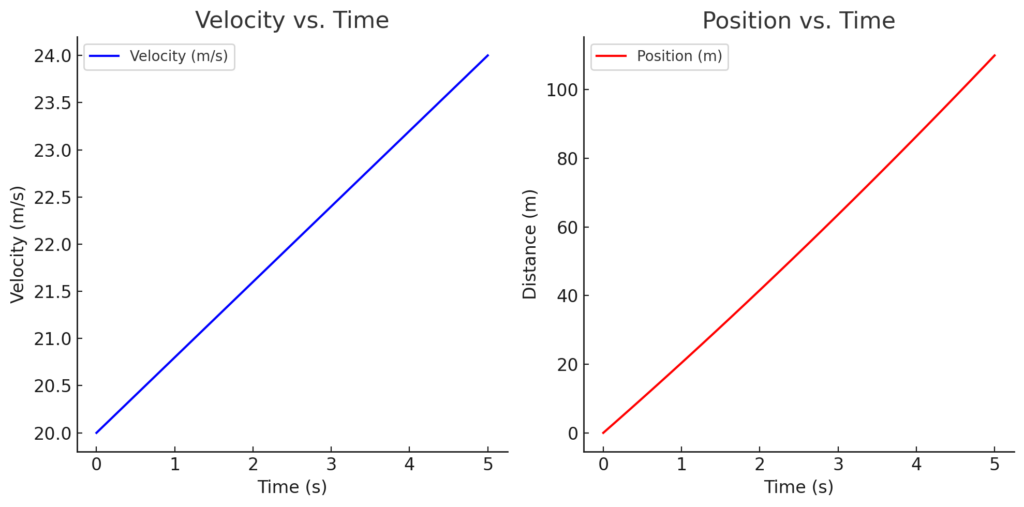
The plots above illustrate the skier’s motion:
- Velocity vs. Time (Left Graph) – The skier’s velocity increases linearly over time due to the constant acceleration of 0.80 m/s².
- Position vs. Time (Right Graph) – The distance covered follows a quadratic trend, as the skier’s speed increases over time.