A chloride of silicon contains 79.1 mass % Cl.
(a) What is the empirical formula of the chloride? __
(b) If the molar mass is 269 g/mol, what is the molecular formula? __
The correct answer and explanation is :
Let’s go through both parts of the question step-by-step.
(a) Determining the Empirical Formula
Given that the mass percent of chlorine (Cl) in the compound is 79.1%, it means that the remaining 20.9% is silicon (Si).
The empirical formula represents the simplest ratio of atoms of each element in the compound.
- Calculate the moles of each element: First, we need to assume we have 100 grams of the compound. So:
- Mass of Cl = 79.1 g
- Mass of Si = 100 g – 79.1 g = 20.9 g
- Calculate the number of moles of Cl and Si:
- Moles of Cl = ( \frac{79.1 \, \text{g}}{35.45 \, \text{g/mol}} = 2.23 \, \text{mol} )
- Moles of Si = ( \frac{20.9 \, \text{g}}{28.09 \, \text{g/mol}} = 0.743 \, \text{mol} )
- Find the ratio of moles:
- The ratio of Cl to Si = ( \frac{2.23}{0.743} \approx 3 )
Thus, the empirical formula is SiCl₃.
(b) Determining the Molecular Formula
To find the molecular formula, we need the molar mass of the compound, which is given as 269 g/mol. We have already determined the empirical formula as SiCl₃, so now we need to calculate the molar mass of the empirical formula and compare it with the given molar mass.
- Calculate the molar mass of SiCl₃:
- Molar mass of Si = 28.09 g/mol
- Molar mass of Cl = 35.45 g/mol
- Molar mass of SiCl₃ = 28.09 g/mol + 3(35.45 g/mol) = 28.09 g/mol + 106.35 g/mol = 134.44 g/mol
- Determine how many times the empirical formula fits into the molecular formula:
- ( \frac{269 \, \text{g/mol}}{134.44 \, \text{g/mol}} \approx 2 )
Thus, the molecular formula is Si₂Cl₆ (which is two times the empirical formula).
Conclusion:
- (a) The empirical formula is SiCl₃.
- (b) The molecular formula is Si₂Cl₆.
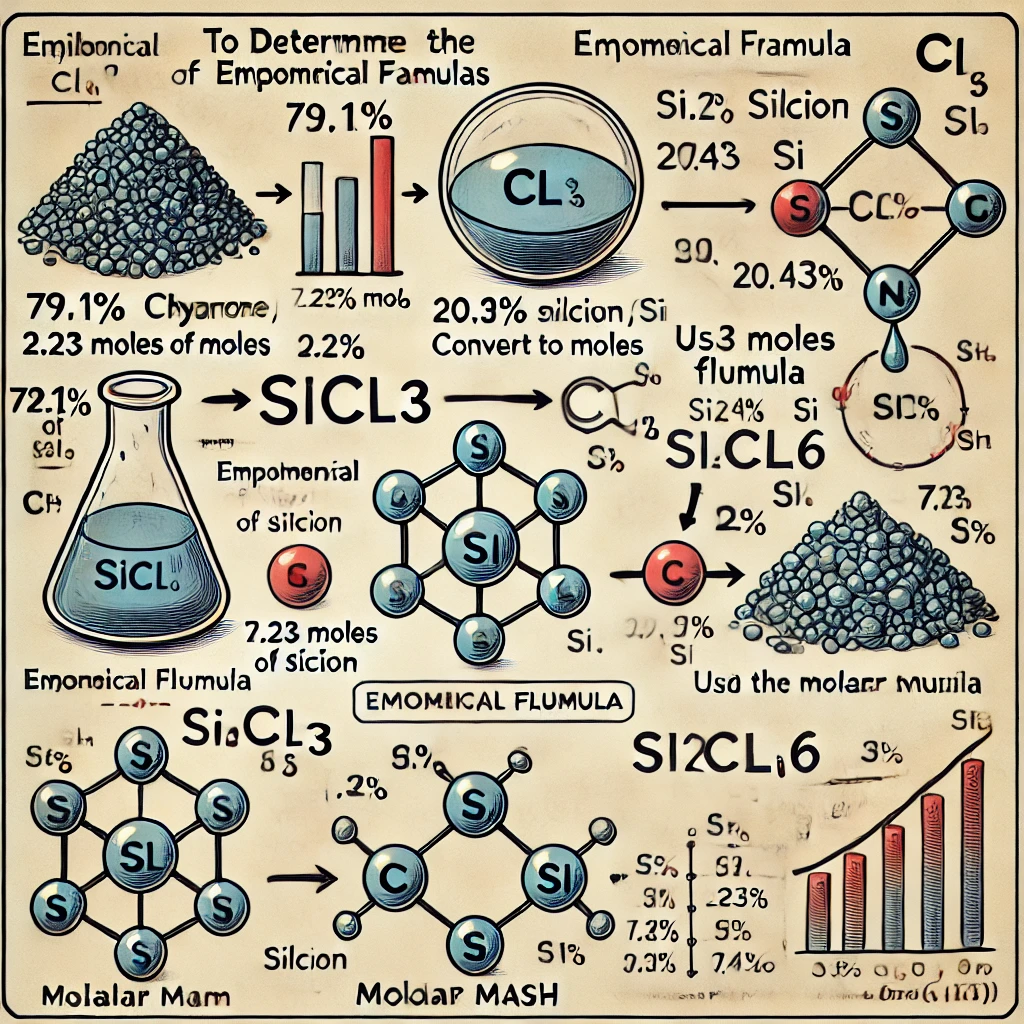
Here is the diagram showing the steps to determine the empirical and molecular formulas of the silicon chloride compound. T