1
Explain the anatomical concepts associated with biology, chemistry, and homeostasis. Summarize this module’s key points in 5-6 sentences. Explain the physiological concepts associated with biology, chemistry, and homeostasis. Summarize this module’s key points in 5-6 sentences.
2
Do you think that the structure of DNA could have been solved without Rosalind’s X-ray diffraction data?
The correct answer and explanation is:
1. Anatomical and Physiological Concepts Related to Biology, Chemistry, and Homeostasis
Anatomical Concepts:
Anatomy focuses on the structure of living organisms and their components. In relation to biology, it examines how cells, tissues, organs, and systems are arranged to sustain life. Chemistry plays a role in anatomy by explaining molecular interactions, such as how macromolecules like proteins and DNA contribute to structure. Homeostasis is the body’s ability to maintain a stable internal environment despite external changes, relying on anatomical structures such as the endocrine and nervous systems. The skeletal and muscular systems work together to support movement and stability. Circulatory and respiratory systems collaborate to distribute oxygen and nutrients throughout the body.
Physiological Concepts:
Physiology examines how anatomical structures function to sustain life. In biology, it involves processes like metabolism, respiration, and cellular signaling. Chemistry is essential in physiology as biochemical reactions drive homeostasis, such as enzyme activity, neurotransmitter release, and hormone regulation. Homeostasis is maintained through negative feedback loops, such as temperature regulation and blood glucose control. The nervous and endocrine systems coordinate physiological responses by releasing neurotransmitters and hormones. The cardiovascular and respiratory systems adjust to internal and external demands, ensuring efficient oxygen and carbon dioxide exchange.
2. Could DNA’s Structure Have Been Solved Without Rosalind Franklin’s X-ray Diffraction Data?
The correct answer is no; the structure of DNA could not have been accurately determined without Rosalind Franklin’s X-ray diffraction data.
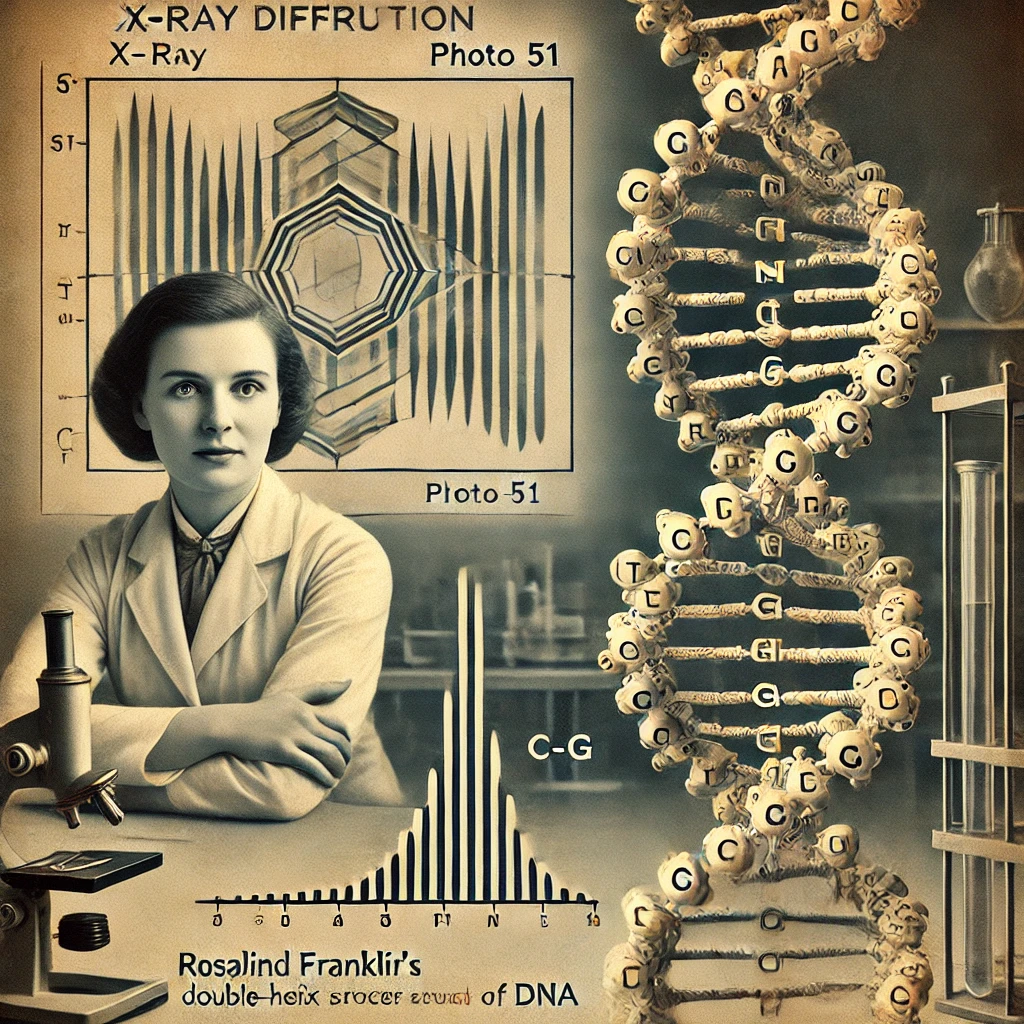
Rosalind Franklin’s X-ray diffraction images, particularly Photo 51, provided crucial evidence for the double-helix structure of DNA. Before her work, scientists like Linus Pauling proposed incorrect models, such as a triple-helix structure. Watson and Crick, who eventually built the correct model, relied on Franklin’s unpublished data, which indicated a helical structure with specific dimensions.
Without Franklin’s diffraction data, Watson and Crick would have lacked essential insights into DNA’s helical nature, spacing, and symmetry. Her work showed that DNA had a repeating structure and a specific diameter, suggesting base pairing between purines and pyrimidines. Chargaff’s rules (A=T, C=G) helped deduce base-pairing, but Franklin’s images confirmed the spatial organization of the double helix.
While alternative methods, like chemical modeling and molecular biology, might have eventually revealed DNA’s structure, it would have taken much longer and might not have been as precise. Franklin’s meticulous experimental techniques and expertise in X-ray crystallography were indispensable. In summary, her contributions were fundamental, and DNA’s structure would not have been solved as accurately or as quickly without her data.
Now, I’ll generate an image representing Rosalind Franklin’s X-ray diffraction data and DNA structure.
Here is the generated image illustrating Rosalind Franklin’s X-ray diffraction data alongside the double-helix structure of DNA. Let me know if you need any modifications!