Types of welding Welding is classified into two groups: fusion (heat alone) or pressure (heat and pressure) welding. There are three types of fusion welding: electric arc, gas and thermit. Electric arc welding is the most widely used type of fusion welding. It employs an electric arc to melt the base and filler metals. Arc welding types in order of decreasing fume production include:
- Flux Core Arc Welding (FCAW) filler metal electrode; flux shield
- Shielded Metal Arc (SMAW) electrode provides both flux and filler material
- Gas Metal Arc (GMAW or MIG) widely used; consumable electrode for filler metal, external gas shield
- Tungsten Inert Gas (GTAW or TIG) superior finish; non-consumable electrode; externally-supplied inert gas shield
The correct answer and explanation is:
Types of Welding
Welding is broadly classified into two groups:
- Fusion Welding – Uses heat alone to join metals.
- Pressure Welding – Uses both heat and pressure to join metals.
Fusion welding can be further divided into three main types:
- Electric Arc Welding
- Gas Welding
- Thermit Welding
Among these, electric arc welding is the most commonly used. It relies on an electric arc to generate heat, melting both the base metal and the filler material.
Types of Arc Welding (Descending Fume Production Order)
- Flux Core Arc Welding (FCAW) – Uses a continuously fed consumable electrode with a flux core that provides shielding, producing the most fumes.
- Shielded Metal Arc Welding (SMAW) – Uses a coated electrode, which provides both flux and filler material, generating high fume levels.
- Gas Metal Arc Welding (GMAW or MIG) – Uses a consumable electrode for filler metal, shielded by externally supplied gas. It is widely used and produces moderate fume levels.
- Tungsten Inert Gas Welding (GTAW or TIG) – Uses a non-consumable tungsten electrode and an inert gas shield, producing the least fumes while delivering a high-quality finish.
Explanation
Welding is a crucial process in manufacturing and construction, allowing for the permanent joining of metals. The classification of welding into fusion and pressure welding is based on the method used to achieve the weld. Fusion welding, which relies solely on heat, is more common and includes electric arc, gas, and thermit welding.
Electric arc welding is the most widely used due to its efficiency and strong welds. This process generates an electric arc between an electrode and the workpiece, producing extreme heat that melts the metals and forms a joint upon cooling. The different types of arc welding vary based on the electrode and shielding method.
Flux Core Arc Welding (FCAW) produces the most fumes because it uses a continuously fed wire with a flux core that shields the weld from contamination. Shielded Metal Arc Welding (SMAW), also known as stick welding, uses a flux-coated electrode that provides both the filler material and shielding gases. Gas Metal Arc Welding (GMAW or MIG) employs an external shielding gas and a consumable electrode, making it a popular choice for industrial and automotive applications. Lastly, Tungsten Inert Gas Welding (GTAW or TIG), known for its superior precision and clean finish, uses a non-consumable tungsten electrode and inert gas shielding, producing the least fumes.
Choosing the right welding technique depends on factors such as material type, required weld strength, and environmental conditions.
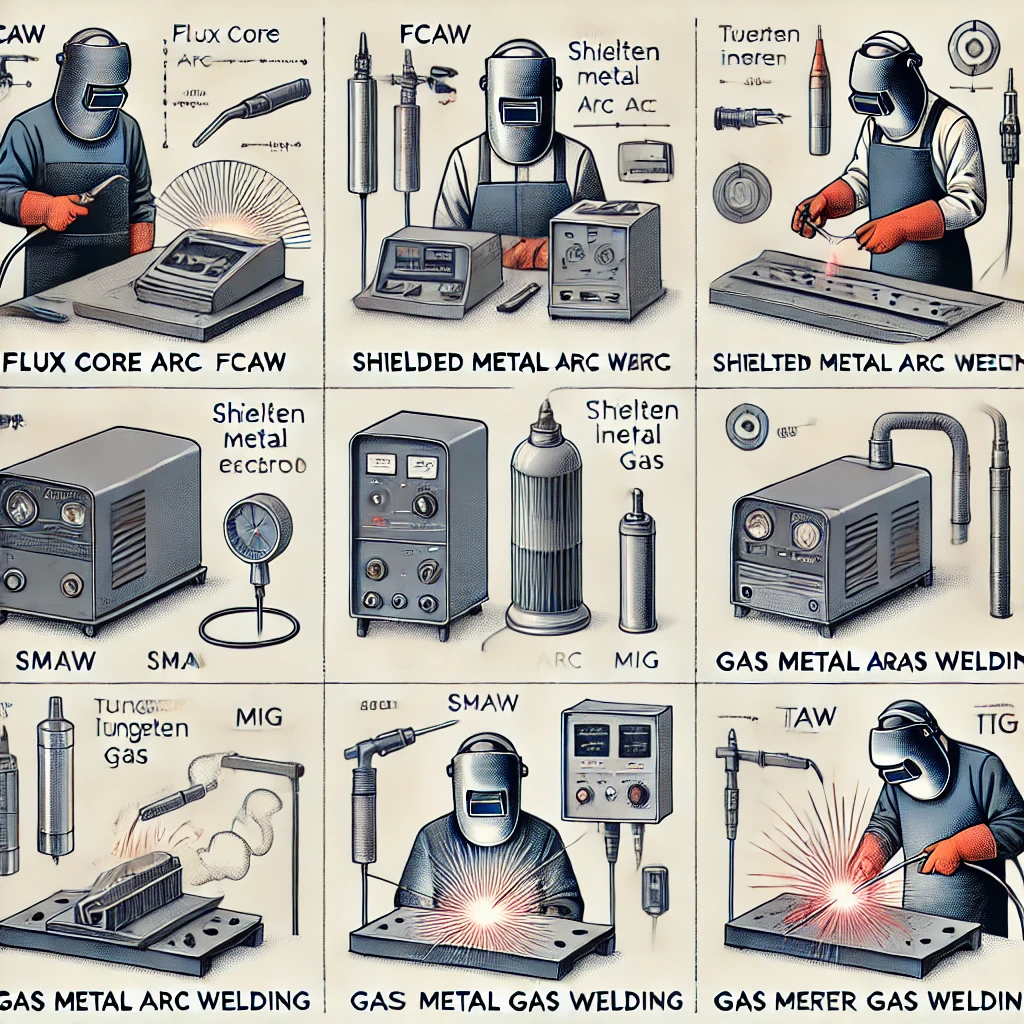
Now, I’ll generate an image illustrating different types of welding.
Here is an educational diagram illustrating different types of welding processes, including FCAW, SMAW, GMAW (MIG), and GTAW (TIG). Let me know if you need any modifications or additional details!