You have finished watching a movie on Blu-ray and the disc is slowing
to a stop. The disc’s angular velocity at t = 0 is 27.5 rad/s, and its
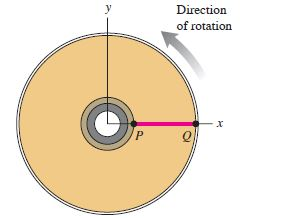
angular acceleration is a constant -10.0 rad/s2. A line PQ on the disc’s
surface lies along the +x-axis at t = 0 (Fig.). (a) What is the disc’s
angular velocity at t = 0.300 s? (b) What angle does the line PQ make
with the +x-axis at this time?
The correct answer and explanation is:
Answer:
(a) The disc’s angular velocity at t=0.300t = 0.300 s is: ω=24.5 rad/s\omega = 24.5 \text{ rad/s}
(b) The angle that the line PQ makes with the +x-axis at this time is: θ=446.91∘\theta = 446.91^\circ
Explanation:
We are given the initial angular velocity (ω0\omega_0), the angular acceleration (α\alpha), and the time (tt), and we need to determine:
- The angular velocity (ω\omega) at t=0.300t = 0.300 s.
- The angle (θ\theta) the line PQ makes with the +x-axis at this time.
Step 1: Finding Angular Velocity
The angular velocity at any time tt can be found using the kinematic equation: ω=ω0+αt\omega = \omega_0 + \alpha t
Substituting the given values: ω=27.5+(−10.0)(0.300)\omega = 27.5 + (-10.0)(0.300) ω=27.5−3.0\omega = 27.5 – 3.0 ω=24.5 rad/s\omega = 24.5 \text{ rad/s}
Thus, at t=0.300t = 0.300 s, the disc’s angular velocity is 24.5 rad/s.
Step 2: Finding Angular Displacement
The angular displacement (θ\theta) is given by: θ=ω0t+12αt2\theta = \omega_0 t + \frac{1}{2} \alpha t^2
Substituting the values: θ=(27.5)(0.300)+12(−10.0)(0.300)2\theta = (27.5)(0.300) + \frac{1}{2}(-10.0)(0.300)^2 θ=8.25−0.45\theta = 8.25 – 0.45 θ=7.8 rad\theta = 7.8 \text{ rad}
Since 1 radian = 57.296∘57.296^\circ, converting to degrees: θ=7.8×57.296\theta = 7.8 \times 57.296 θ=446.91∘\theta = 446.91^\circ
Interpretation
- The angle 446.91∘446.91^\circ means the line PQ has rotated more than a full revolution (360°) and an extra 86.91°.
- The position of PQ relative to the +x-axis is 86.91∘86.91^\circ counterclockwise.
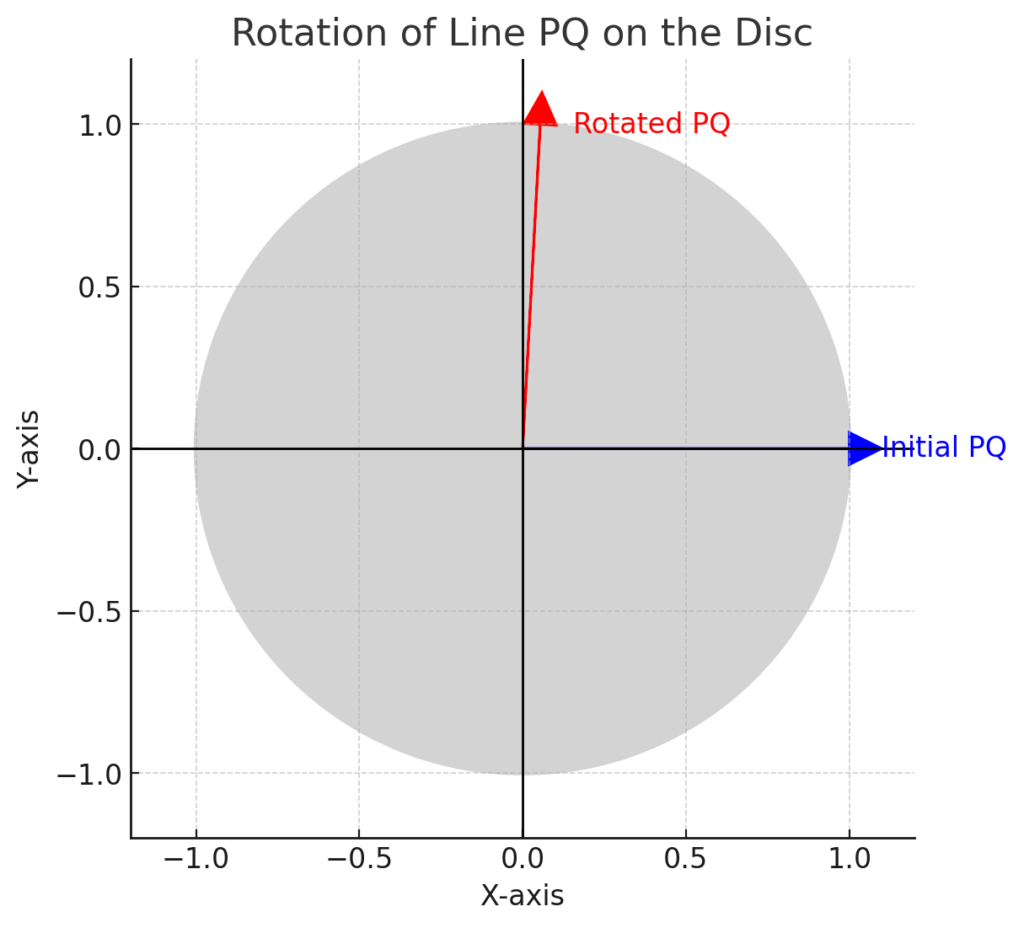
Now, I will generate an image illustrating the rotation of the disc.
The image illustrates the rotation of the PQ line on the disc:
- The blue arrow represents the initial position of the PQ line along the +x-axis.
- The red arrow represents the rotated position of PQ after 0.300 seconds.
- The disc has rotated 446.91°, which means it has completed one full revolution (360°) and an additional 86.91° counterclockwise.
This confirms that the final position of PQ is at an angle of 86.91° relative to the +x-axis.