Construct a food web in an estuarine ecosystem.
The correct answer and explanation is :
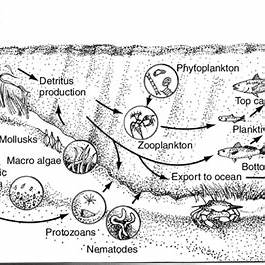
An estuarine food web illustrates the intricate feeding relationships among organisms in estuaries, where freshwater from rivers meets and mixes with seawater. This confluence creates nutrient-rich environments that support diverse biological communities.
Primary Producers
At the base of the estuarine food web are primary producers, organisms that synthesize their own food through photosynthesis:
- Phytoplankton: Microscopic algae that float in the water column, converting sunlight and nutrients into organic matter.
- Macrophytes: Larger aquatic plants such as seagrasses, mangroves, and saltmarsh vegetation that stabilize sediments and provide habitats.
Primary Consumers
Primary consumers are herbivores that feed directly on primary producers:
- Zooplankton: Tiny animals that consume phytoplankton.
- Filter feeders: Organisms like mussels, oysters, and certain worms that strain suspended particles, including plankton, from the water.
Secondary Consumers
These are carnivores that prey on primary consumers:
- Small fish: Species such as anchovies and juvenile stages of larger fish that feed on zooplankton.
- Crustaceans: Crabs and shrimp that consume a variety of smaller organisms.
Tertiary Consumers
Tertiary consumers are higher-level predators:
- Larger fish: Species like snapper and flounder that prey on smaller fish and invertebrates.
- Birds: Wading birds and waterfowl that feed on fish, crustaceans, and mollusks.
Decomposers
Decomposers play a crucial role in recycling nutrients:
- Bacteria and fungi: Microorganisms that break down dead organic matter, returning nutrients to the ecosystem.
Detritus
Detritus, composed of dead plant and animal material, is a significant food source in estuaries. Detritivores, such as certain worms and snails, consume detritus, further breaking it down and facilitating nutrient cycling.
Food Web Dynamics
The estuarine food web is complex and interconnected:
- Energy Flow: Sunlight is harnessed by primary producers to create organic matter, forming the energy foundation for the ecosystem.
- Trophic Interactions: Energy and nutrients pass through various trophic levels as organisms consume one another.
- Nutrient Recycling: Decomposers break down dead organisms, releasing nutrients back into the environment, supporting new primary production.
Significance of Estuarine Food Webs
Estuarine food webs are vital for several reasons:
- Biodiversity Support: They sustain diverse species, many of which are commercially important.
- Nursery Grounds: Estuaries provide breeding and nursery habitats for numerous marine species.
- Ecosystem Services: Functions such as water filtration, shoreline stabilization, and nutrient cycling are maintained through these food webs.
Human Impacts
Human activities can disrupt estuarine food webs:
- Pollution: Introduction of contaminants can harm organisms and alter food web dynamics.
- Habitat Destruction: Land development and dredging can degrade critical habitats.
- Overfishing: Removing key species can have cascading effects throughout the food web.
Understanding estuarine food webs is essential for effective conservation and management, ensuring the health and productivity of these vital ecosystems.
Note: This overview is based on general ecological principles of estuarine ecosystems.