Which of the following is true regarding the blood-testis barrier?
Select one:
- a. It prevents heat loss from the testes.
- b. It prevents blood from getting to the testes.
- c. It maintains testis temperature at 37°.
- d. It maintains testis temperature at 35°.
- e. It prevents antibodies in the blood from getting to the reproductive cells.
The correct answer and explanation is:
Correct Answer:
e. It prevents antibodies in the blood from getting to the reproductive cells.
Explanation:
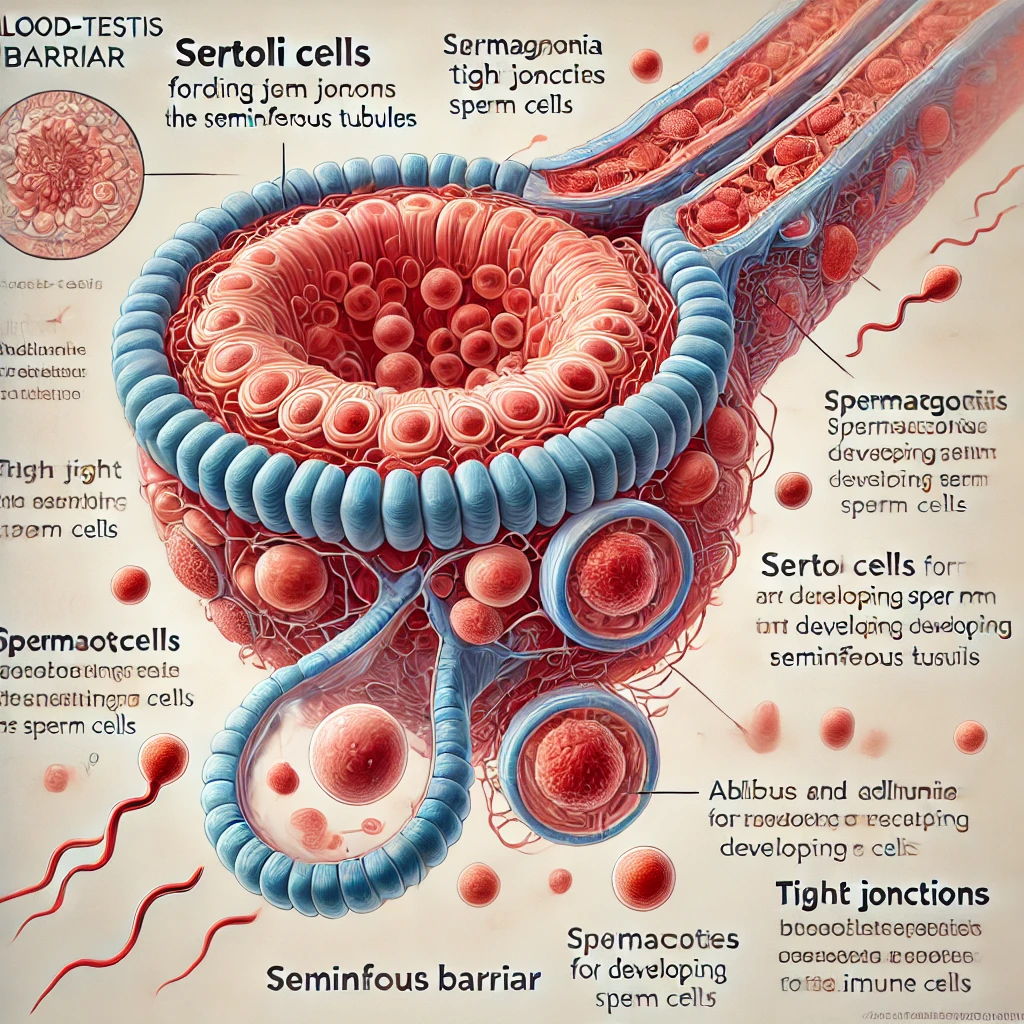
The blood-testis barrier (BTB) is a physical and physiological barrier formed by Sertoli cells within the seminiferous tubules of the testes. Its primary function is to protect developing sperm cells (spermatocytes and spermatids) from the immune system by preventing harmful substances, including antibodies and toxins, from entering the seminiferous tubules.
Functions of the Blood-Testis Barrier:
- Immunological Protection:
The body’s immune system recognizes “foreign” cells and attacks them. Since sperm cells undergo meiosis and express unique surface proteins that the immune system may see as threats, the BTB prevents immune cells and antibodies from attacking developing sperm. - Selective Transport:
The BTB controls which molecules can pass from the bloodstream into the testes. This helps provide the necessary nutrients for sperm development while keeping out harmful substances. - Creating a Unique Microenvironment:
The BTB separates the seminiferous tubules into two compartments:- The basal compartment, where early spermatogenesis occurs.
- The adluminal compartment, where later stages of sperm development take place.
This separation is crucial for sperm maturation.
- Protecting Against Toxins and Infections:
The BTB prevents toxins, drugs, and infectious agents from entering the seminiferous tubules, helping to ensure healthy sperm production.
Why Other Options Are Incorrect:
- Option A: The BTB does not regulate heat loss. The scrotum and pampiniform plexus help maintain testicular temperature.
- Option B: Blood still reaches the testes through the testicular arteries; the BTB only controls what enters the seminiferous tubules.
- Option C & D: The BTB does not maintain testicular temperature. The testicles are typically around 34-35°C, but temperature regulation is handled by the cremaster muscle and pampiniform plexus, not the BTB.
Now, I’ll generate an image illustrating the blood-testis barrier and its functions. Stay tuned! 🎨
Here is the medical illustration of the blood-testis barrier, showing its structure and function. Let me know if you need any modifications or further explanations! 😊