What conditions are required for a lunar eclipse?
The phase of the Moon must be full, and the nodes of the Moon’s orbit must be nearly aligned with Earth and the Sun.
The phase of the Moon must be new, and the nodes of the Moon’s orbit must be nearly aligned with Earth and the Sun.
The phase of the Moon can be new or full, and the nodes of the Moon’s orbit must be nearly aligned with Earth and the Sun.
The phase of the Moon must be new, and the Moon’s orbital plane must lie in the ecliptic.
The correct answer and explanation is:
Correct Answer:
The phase of the Moon must be full, and the nodes of the Moon’s orbit must be nearly aligned with Earth and the Sun.
Explanation:
A lunar eclipse occurs when the Earth comes directly between the Sun and the Moon, casting its shadow on the Moon. This can only happen during a full Moon because, at this phase, the Moon is on the opposite side of Earth relative to the Sun.
However, a full Moon alone is not enough to cause a lunar eclipse. The Moon’s orbit around Earth is tilted by about 5 degrees relative to the Earth’s orbital plane (the ecliptic). This means that most of the time, the Moon either passes above or below Earth’s shadow, preventing an eclipse.
For a lunar eclipse to occur, two conditions must be met:
- The Moon must be in the full Moon phase. This is necessary because the Earth needs to be directly between the Moon and the Sun for its shadow to be cast on the Moon.
- The Moon must be near one of its orbital nodes. Nodes are the two points where the Moon’s tilted orbit crosses the Earth’s orbital plane. If the full Moon happens when it is close to a node, the Sun, Earth, and Moon align closely enough for Earth’s shadow to fall on the Moon, resulting in a lunar eclipse.
There are three types of lunar eclipses:
- Total Lunar Eclipse: The entire Moon passes through Earth’s umbra (darkest shadow).
- Partial Lunar Eclipse: Only part of the Moon enters the umbra.
- Penumbral Lunar Eclipse: The Moon passes through Earth’s outer shadow (penumbra), causing a subtle dimming.
Lunar eclipses are visible from anywhere on Earth where the Moon is above the horizon at the time of the eclipse. Unlike solar eclipses, they are safe to view with the naked eye.
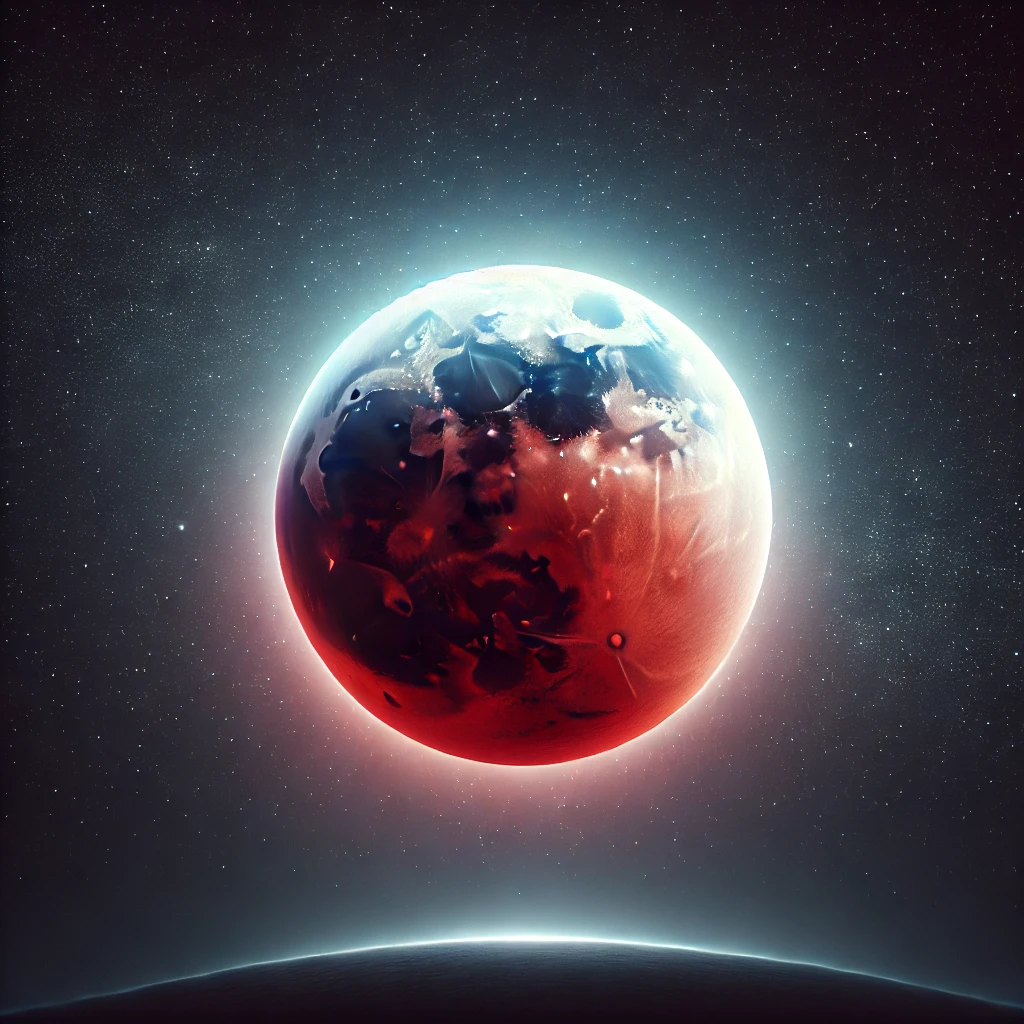
Now, I’ll generate an image representing a lunar eclipse.
Here is an image of a total lunar eclipse, showing the Earth’s shadow covering the Moon, giving it a deep red hue (Blood Moon). Let me know if you need any modifications!