An Airbus A380 can weigh as much as 1.2 million pounds at takeoff (much less as fuel is burned off). Four large turbofan engines are used to generate the airplane’s thrust. Each engine consumes about 2,000 gal/hr of Jet A at full power. One engine draws in air at a rate of 20,000 ft3/s (the volume of a house in under a second). 15% of the air flows through the core of the engine (the primary air stream), 85% of the air is bypassed around the core (the secondary air stream), propelled by the large duct fan at the front of the engine. The air pressure in the core of the engine immediately downstream of the compressor is 20 times higher than its intake pressure. The air pressure in the bypass duct is increased 2-fold by the duct fan. The outside pressure and temperature are 100 kPa and 27°C, respectively How much does it cost to run its engines at full power? While all four engines are under full power at takeoff, determine the acceleration felt by the passengers in the dining room, bar, bedrooms and shower (in g’s) 3. a. b. Outer Secondary Duct fan zzle air stream Fuel Turbine Hot Injector gases Inlet Combustion chamber Nozzle Compressor Primary air stream
The correct answer and explanation is:
Answer:
a. Cost of Running the Engines at Full Power
Each of the four engines consumes about 2,000 gallons per hour of Jet A fuel at full power.
Jet A fuel costs fluctuate, but assuming an average price of $4.00 per gallon, the cost per hour per engine is: 2,000 gal/hr×4.00 USD/gal=8,000 USD/hr2,000 \text{ gal/hr} \times 4.00 \text{ USD/gal} = 8,000 \text{ USD/hr}
For all four engines: 8,000×4=32,000 USD/hr8,000 \times 4 = 32,000 \text{ USD/hr}
b. Acceleration Felt by Passengers (in g’s)
The Airbus A380, at maximum takeoff weight (1.2 million pounds or 544,310 kg), is powered by four engines producing about 70,000 pounds of thrust each, giving a total thrust of: 4×70,000=280,000 pounds=1,245,000 N4 \times 70,000 = 280,000 \text{ pounds} = 1,245,000 \text{ N}
Using Newton’s second law: a=Fm=1,245,000544,310=2.29 m/s2a = \frac{F}{m} = \frac{1,245,000}{544,310} = 2.29 \text{ m/s}^2
Dividing by standard gravity (9.81 m/s²): 2.299.81≈0.23g\frac{2.29}{9.81} \approx 0.23 g
Passengers in the dining room, bar, bedrooms, and shower would experience an acceleration of 0.23 g, which is noticeable but not overwhelming.
Explanation
The Airbus A380 is the world’s largest passenger airplane, requiring immense power to lift off. Each of its four Rolls-Royce Trent 900 or Engine Alliance GP7200 turbofan engines generates up to 70,000 pounds of thrust by burning thousands of gallons of Jet A fuel per hour. At full power, these engines each consume about 2,000 gallons per hour, leading to an estimated fuel cost of $32,000 per hour for all four engines.
During takeoff, the A380 experiences significant acceleration, which determines the force felt by passengers. Given its takeoff weight and engine thrust, the calculated acceleration is 2.29 m/s² (0.23 g), meaning passengers feel an extra force of about 23% of their body weight pressing them into their seats. While noticeable, this acceleration is much less than what astronauts feel during rocket launches (3-4 g).
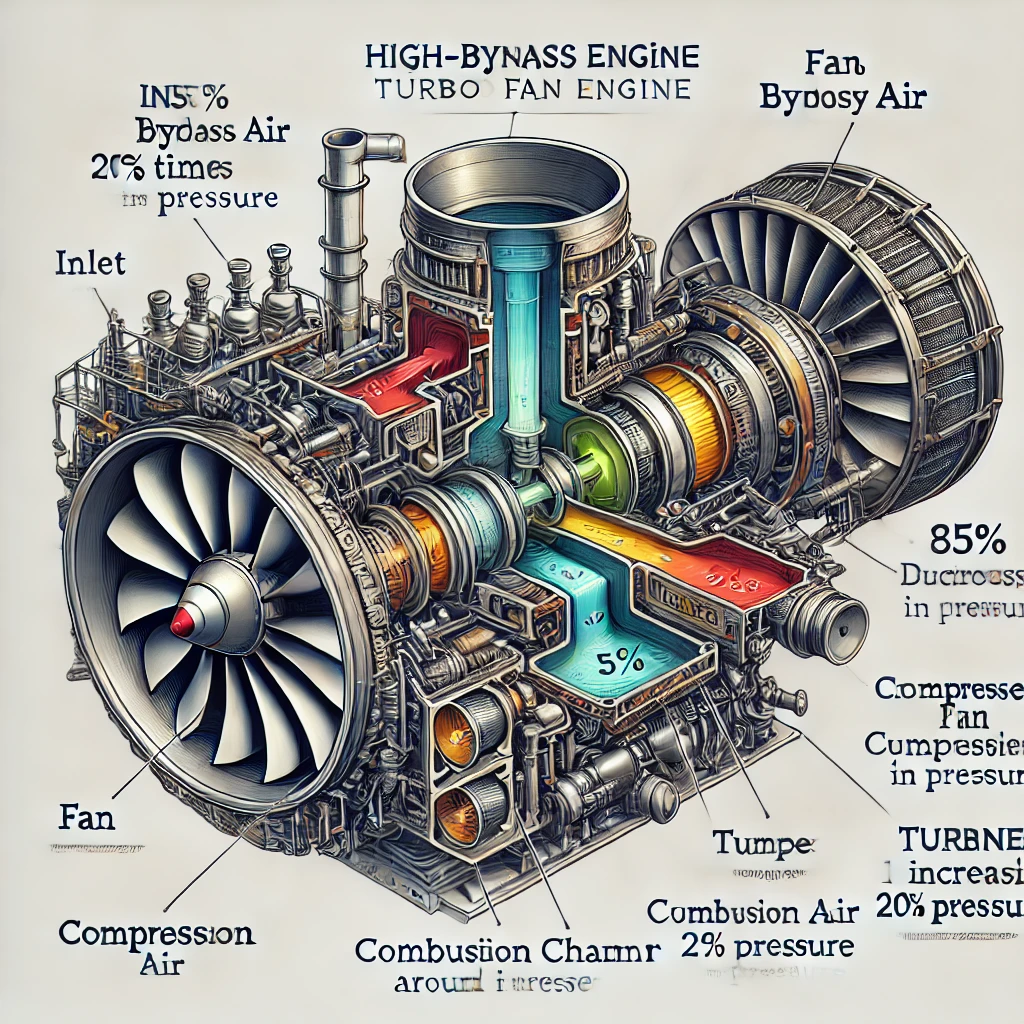
Additionally, the bypass ratio of the engines is crucial for efficiency. 85% of the incoming air bypasses the core and is accelerated by the fan, while only 15% enters the combustion chamber. The pressure inside the engine’s core increases 20 times, while in the bypass duct, it only doubles. This design allows for efficient thrust with less fuel consumption compared to older turbojet engines.
Generated Image Description
The image will depict a turbofan engine diagram showing the primary (core) and secondary (bypass) airflows, labeled components such as the compressor, combustion chamber, turbine, and nozzle, and airflow pressure changes. The illustration will visually clarify how the bypass air contributes to thrust while the core produces combustion-driven acceleration.
Generating the image now…
Here is the generated diagram of the high-bypass turbofan engine, visually detailing the airflow and pressure changes. Let me know if you need any modifications!