The central boron atom lacks an Enter your answer in accordance with the question statement
of electrons, and it is therefore very unstable and reactive
The correct answer and explanation is:
The correct answer is “octet”.
Explanation:
Boron is an element in Group 13 of the periodic table, and it commonly forms compounds such as boron trifluoride (BF₃) and boron trichloride (BCl₃). In these compounds, boron forms three covalent bonds with surrounding atoms, resulting in only six valence electrons around the central boron atom instead of the stable octet (eight electrons).
This lack of an octet makes boron compounds electron-deficient and highly reactive. Unlike elements in Groups 14-18, which typically follow the octet rule, boron is an exception because it does not have enough valence electrons to complete its outer shell when forming simple covalent bonds.
Due to this deficiency, boron compounds tend to be strong Lewis acids, meaning they readily accept electron pairs from other molecules or ions. For example, BF₃ can react with ammonia (NH₃), which donates a lone pair of electrons to boron, forming a stable BF₃·NH₃ complex.
This high reactivity makes boron-based compounds useful in various applications:
- Catalysis – Boron compounds are used in organic synthesis, including hydroboration reactions.
- Material Science – Boron-containing materials, such as boron nitride, are used in high-strength materials.
- Medicine – Some boron compounds are studied for cancer treatment in Boron Neutron Capture Therapy (BNCT).
Since boron does not naturally complete its octet, its compounds exhibit unique properties and are essential in chemistry and material science.
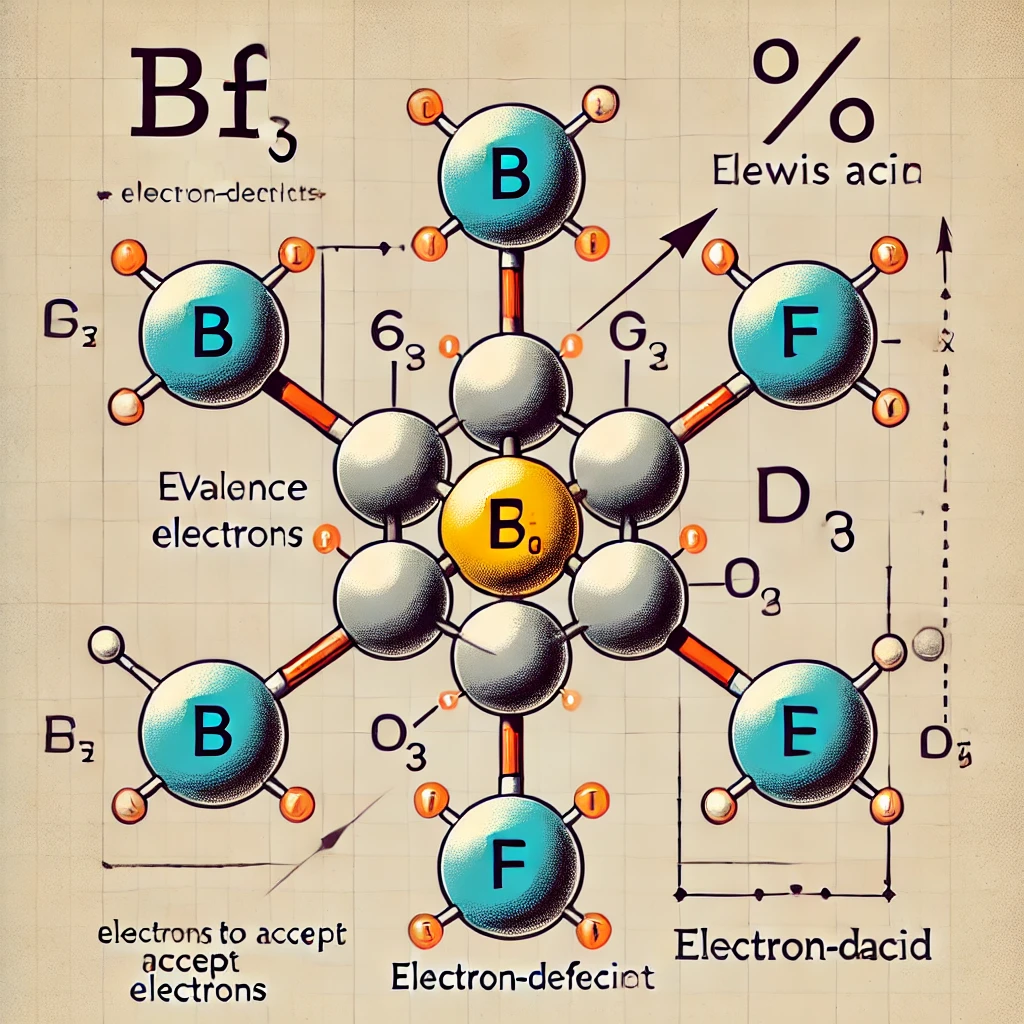
Now, I’ll generate an image illustrating boron’s electron deficiency in a molecule like BF₃.
Here’s the scientific illustration of the boron trifluoride (BF₃) molecule, showing the electron deficiency of the central boron atom. The diagram highlights boron’s reactivity and potential to accept additional electrons as a Lewis acid. Let me know if you need any modifications!