Question 5 Which of the following best approximates a pure monopoly? O the foreign exchange market O the only grocery store in a small isolated town O the Kansas City wheat market O the soft drink market
QUESTION Pg Price Pal PA Demand 0 Q, Q, Q, Quantity Marginal Revenue The firm described in the accompanying diagram is selling in O an imperfectly competitive market. O a market in which there are an extremely large number of other firms producing the same product O a market in which demand is elastic at all prices O a purely competitive market.
The correct answer and explanation is:
Answer:
- The only grocery store in a small isolated town best approximates a pure monopoly.
- An imperfectly competitive market is the correct answer for the second question.
Explanation:
Question 5: Identifying a Pure Monopoly
A pure monopoly exists when a single firm is the only provider of a product or service in a particular market, with no close substitutes. Among the given options, the best example is “the only grocery store in a small isolated town.”
- Foreign exchange market: This market is highly competitive, with multiple participants (banks, financial institutions, and individuals) trading currencies worldwide. It is not a monopoly.
- Kansas City wheat market: The wheat market is part of a perfectly competitive agricultural sector where numerous farmers sell wheat. No single firm controls the price, ruling out monopoly.
- Soft drink market: While large companies like Coca-Cola and Pepsi dominate the industry, they do not have complete control. There are many alternatives (store brands, juices, energy drinks), making this an oligopoly, not a monopoly.
A small isolated town with a single grocery store is a local monopoly because residents have no alternative options. The store can set prices and control supply without immediate competition.
Market Structure in the Diagram
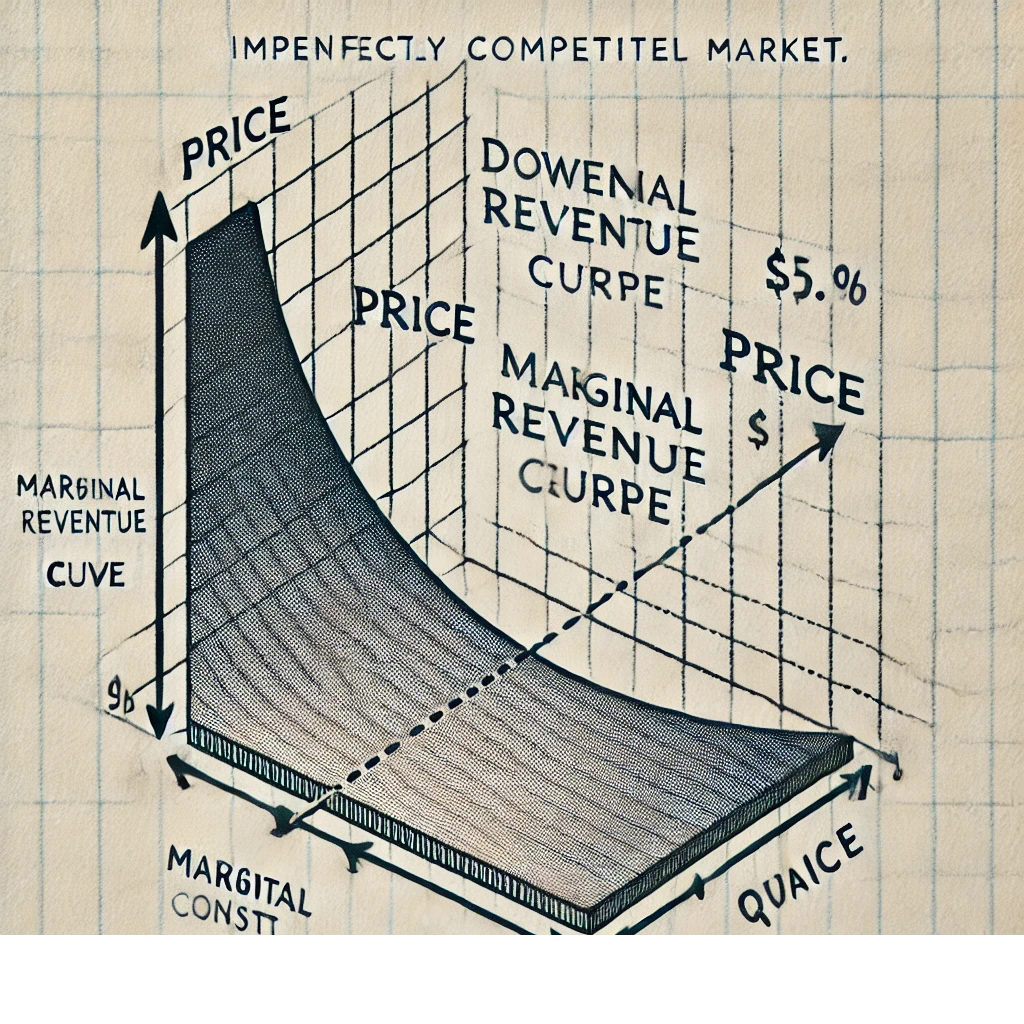
The firm in the accompanying diagram operates in an imperfectly competitive market, as it faces a downward-sloping demand curve and has some pricing power.
- Not purely competitive: In a purely competitive market, firms are price takers (they must accept market prices). The diagram suggests the firm can influence price, ruling out pure competition.
- Not extremely large number of firms: If there were countless firms selling identical products, the demand curve would be perfectly elastic.
- Not always elastic demand: In an imperfectly competitive market, demand is not perfectly elastic at all prices, meaning the firm can raise prices without immediately losing all customers.
This describes monopolistic competition or oligopoly, both forms of imperfect competition where firms have some control over pricing due to brand differentiation or limited competitors.
Now, I’ll generate an image illustrating the market structure.
Here’s an economic diagram representing a firm in an imperfectly competitive market. It includes a downward-sloping demand curve, a marginal revenue curve below the demand curve, and price levels above marginal cost. Let me know if you need any modifications!