Identify the true and false statements about the five-factor theory.
True Statement(s)
- Big Five traits are only visible in adults.
- Hans Eysenck was the creator of the five-factor theory.
- People’s scores on the Big Five traits can predict their behavior.
- For each of the five factors, people’s personality traits will either be high or low.
- People’s scores on the Big Five traits can predict satisfaction with their marriages.
False Statement(s)
- Drag appropriate answer(s) here
The correct answer and explanation is:
True Statements:
- People’s scores on the Big Five traits can predict their behavior.
- People’s scores on the Big Five traits can predict satisfaction with their marriages.
False Statements:
- Big Five traits are only visible in adults. (False – The Big Five traits can be observed in children and even animals, though they may change over time.)
- Hans Eysenck was the creator of the five-factor theory. (False – The Five-Factor Theory was primarily developed by Robert McCrae and Paul Costa.)
- For each of the five factors, people’s personality traits will either be high or low. (False – Personality traits exist on a spectrum, meaning individuals can fall anywhere between high and low on each trait.)
Explanation
The Five-Factor Theory (or Big Five Personality Traits) is a widely accepted model that describes human personality through five major traits: Openness, Conscientiousness, Extraversion, Agreeableness, and Neuroticism (OCEAN). Research has shown that these traits are relatively stable over time and can predict various life outcomes.
One true statement is that people’s scores on the Big Five traits can predict their behavior. For instance, individuals high in Conscientiousness tend to be more organized and responsible, while those high in Extraversion are more sociable. Another true statement is that Big Five traits can predict marital satisfaction. Partners who are high in Agreeableness and low in Neuroticism tend to have more stable and satisfying marriages.
However, some false statements need correction. The claim that Big Five traits are only visible in adults is incorrect because personality traits develop early in life and can be observed in children. Another false claim is that Hans Eysenck created the five-factor theory; instead, it was developed by Robert McCrae and Paul Costa. Additionally, saying that personality traits are either high or low is misleading, as they exist on a continuum, meaning people can have moderate levels of a trait.
The Five-Factor Theory remains a key framework in psychology, influencing areas like career success, mental health, and interpersonal relationships.
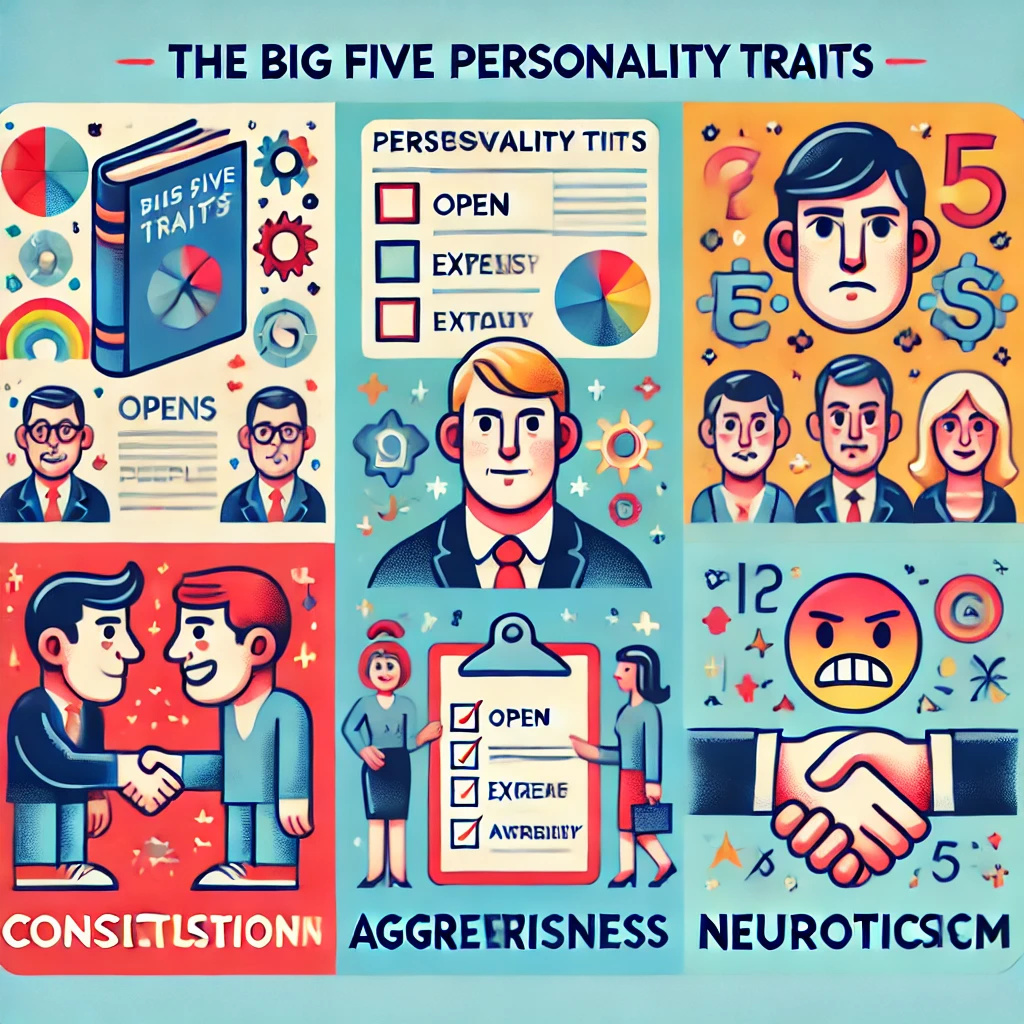
Image Idea:
A colorful infographic illustrating the Big Five traits (OCEAN) with visual icons representing each trait (e.g., a book for Openness, a checklist for Conscientiousness, a group of people for Extraversion, a handshake for Agreeableness, and a worried face for Neuroticism).
Here is an infographic illustrating the Big Five personality traits (OCEAN) with visual icons representing each trait. Let me know if you need any modifications!