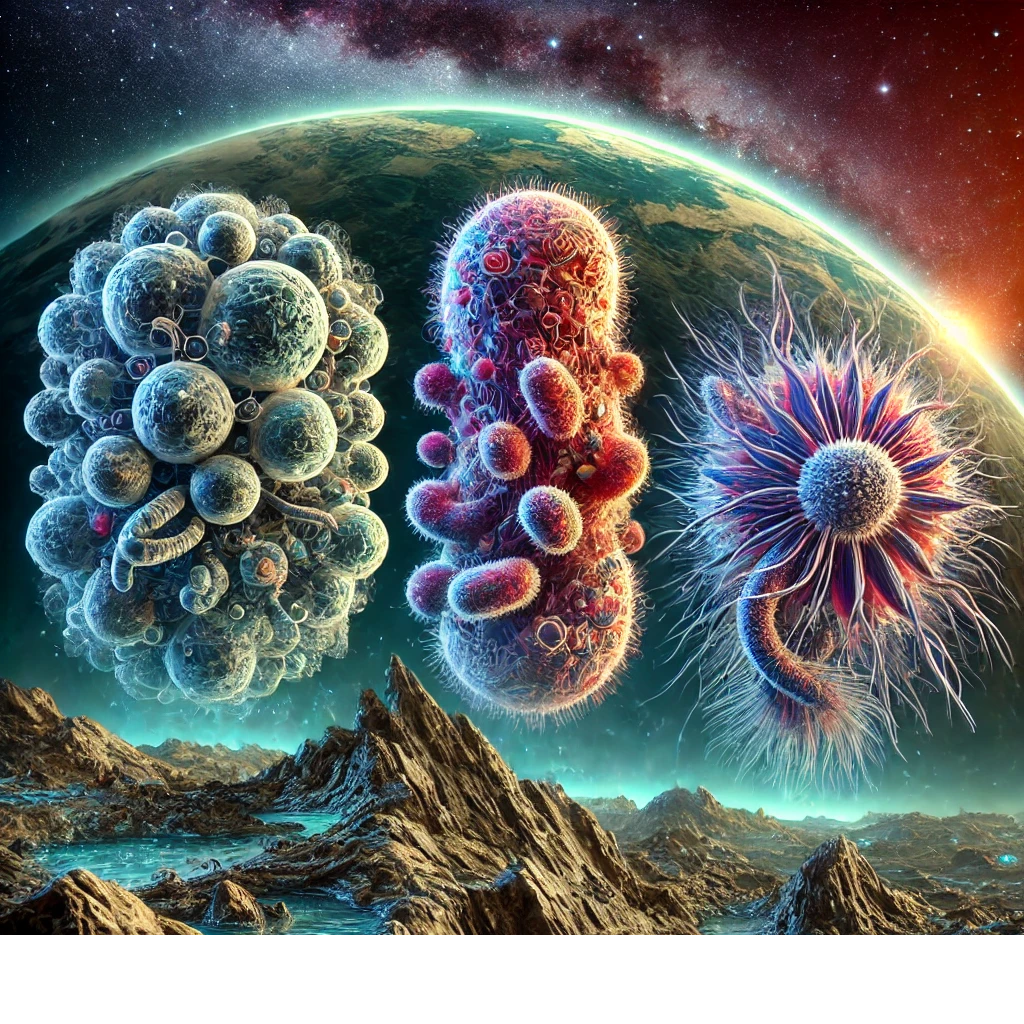
Imagine that you discover three different bacterial species on a meteorite. Each species contains genetic material that is not DNA, but the genetic material of each species contains four bases. Each species has a different number of amino acids. Use the total number of amino acids per species to determine the minimum codon length for each species.
Species A: 2 amino acids
Codon length?
Species B: 56 amino acids
Codon length?
Species C: 162 amino acids
Codon length?
The correct answer and explanation is:
To determine the minimum codon length for each species, we use the following logic:
Each codon consists of a certain number of bases, and since the genetic material has four different bases, the number of possible codons for a given codon length (n) is: 4n4^n
This number must be at least as large as the total number of amino acids for each species.
- Species A (2 amino acids)
- Smallest nn where 4n≥24^n \geq 2
- 41=44^1 = 4 (which is greater than 2)
- Minimum codon length: 1
- Species B (56 amino acids)
- Smallest nn where 4n≥564^n \geq 56
- 41=44^1 = 4 (too small)
- 42=164^2 = 16 (too small)
- 43=644^3 = 64 (sufficient)
- Minimum codon length: 3
- Species C (162 amino acids)
- Smallest nn where 4n≥1624^n \geq 162
- 41=44^1 = 4 (too small)
- 42=164^2 = 16 (too small)
- 43=644^3 = 64 (too small)
- 44=2564^4 = 256 (sufficient)
- Minimum codon length: 4
Explanation
The discovery of three bacterial species on a meteorite presents an exciting opportunity to study alien genetics. Unlike life on Earth, which primarily relies on DNA, these species possess a different genetic material that still follows a four-base system. However, the number of amino acids in their proteins varies. To determine the minimum codon length required for each species, we use the mathematical principle that each codon must encode at least as many unique amino acids as the species needs.
A codon is a sequence of bases that codes for a single amino acid. In a four-base system, the number of possible codons is given by 4n4^n, where nn is the codon length. To ensure that all amino acids in a species can be uniquely coded, 4n4^n must be at least as large as the total number of amino acids.
For Species A, which has only 2 amino acids, even the smallest codon length (n=1n=1) is sufficient, as 41=44^1 = 4 covers both amino acids.
For Species B, which has 56 amino acids, we find that 43=644^3 = 64 is the smallest power that meets or exceeds 56. Thus, a three-base codon is the minimum requirement.
For Species C, which requires 162 amino acids, a three-base codon (43=644^3 = 64) is too small, but 44=2564^4 = 256 is sufficient, meaning the minimum codon length is 4.
This analysis highlights how the number of amino acids in an organism dictates the complexity of its genetic coding system, even in an extraterrestrial context.
Now, let’s generate an image of these alien bacteria!
Here is the generated illustration of the three alien bacterial species found on the meteorite, each with unique appearances. Let me know if you need any modifications!