What is the difference between a load and a control? What other diagrams are similar to point-to-point diagrams?
Why are relay coils and contacts not shown in the same place on a schematic diagram?
The correct answer and explanation is:
Difference Between a Load and a Control
A load is any electrical component or device that consumes power in a circuit to perform work, such as a light bulb, motor, or heater. A control, on the other hand, is a component that regulates or directs the operation of the circuit, such as a switch, relay, or sensor. While loads convert electrical energy into another form (e.g., mechanical, thermal, or light energy), controls manage the flow of electricity to ensure proper circuit operation.
Diagrams Similar to Point-to-Point Diagrams
Point-to-point diagrams show direct wire connections between components and are used for troubleshooting or assembly. Other similar diagrams include:
- Schematic Diagrams – Show symbolic representations of electrical circuits, focusing on function rather than physical layout.
- Wiring Diagrams – Depict actual wire paths and connections for physical assembly.
- Ladder Diagrams – Used in industrial automation, resembling rungs on a ladder to represent control logic.
- Block Diagrams – Provide a high-level view of system components and their relationships.
Why Relay Coils and Contacts Are Separated in Schematics
Relay coils and contacts are placed separately in schematic diagrams for clarity and ease of troubleshooting. A relay consists of a coil (electromagnetic switch) and one or more sets of contacts that open or close when the coil is energized. Since contacts may control different parts of the circuit, they are placed at relevant locations within the schematic rather than next to the coil. This allows the viewer to see the function of each contact within different parts of the system while still identifying them as part of the same relay.
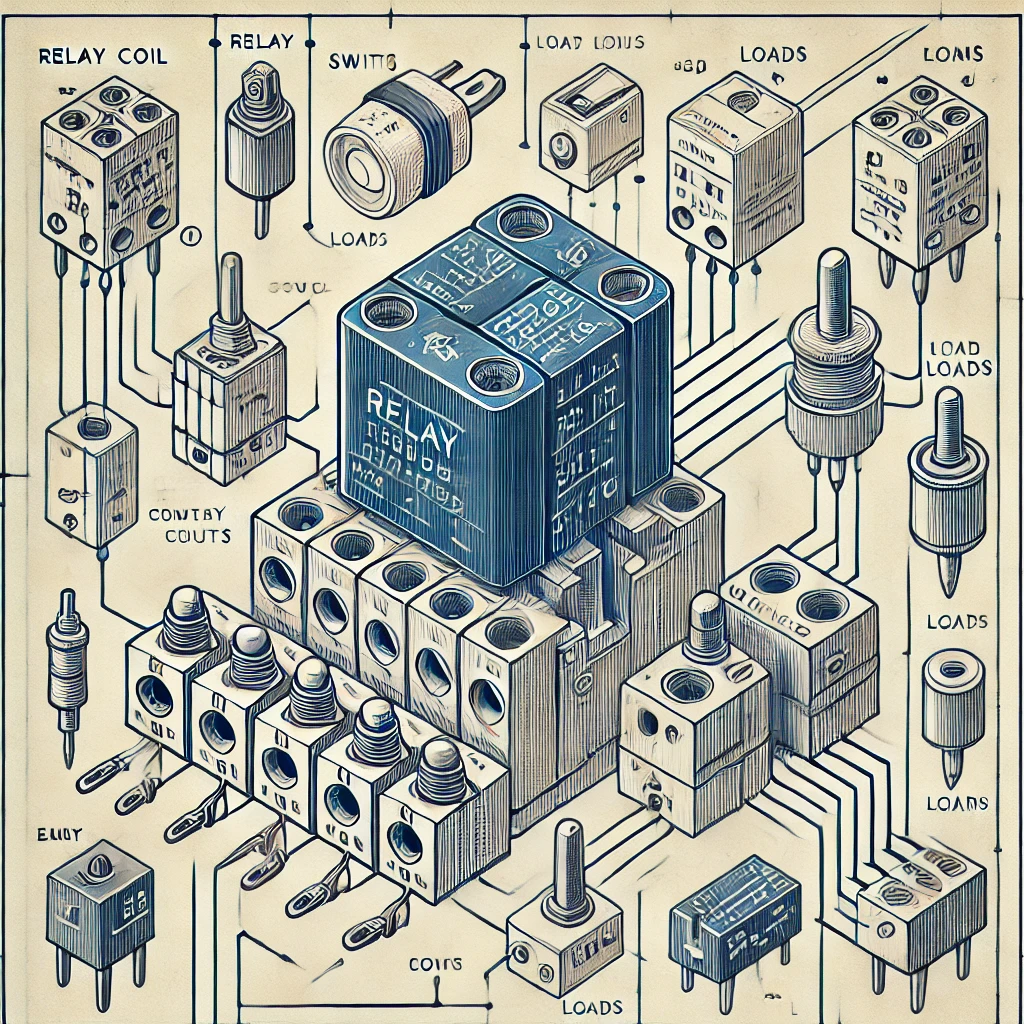
Now, I’ll generate an image representing a schematic diagram with relay coils and contacts separated.
Here is a generated electrical schematic diagram illustrating a relay circuit. The relay coil is shown separately from its contacts, which are distributed across different parts of the schematic for clarity. Let me know if you need any modifications!