A hydrolysis reaction results in which two of the following?
- Water is split apart.
- Two molecules are split apart.
- Water is formed.
- Two molecules are combined.
The correct answer and explanation is:
Correct Answer:
- Water is split apart.
- Two molecules are split apart.
Explanation:
A hydrolysis reaction is a chemical process where a molecule is broken down into smaller components by the addition of water. The term “hydrolysis” comes from the Greek words “hydro” (water) and “lysis” (to break apart), meaning that water is used to break chemical bonds.
In hydrolysis, a water molecule (H₂O) is split into a hydrogen ion (H⁺) and a hydroxyl ion (OH⁻), which then interact with the molecule being broken down. This reaction is essential in many biological and chemical processes.
Examples of Hydrolysis Reactions:
- Digestion of Food
- Large macromolecules like carbohydrates, proteins, and lipids are broken down into smaller units with the help of hydrolysis. For example, starch undergoes hydrolysis to form glucose, and proteins undergo hydrolysis to form amino acids.
- ATP Hydrolysis (Energy Release)
- ATP (adenosine triphosphate), the energy currency of the cell, undergoes hydrolysis to form ADP (adenosine diphosphate) and an inorganic phosphate, releasing energy needed for cellular activities.
- Saponification (Soap Formation)
- The hydrolysis of fats (triglycerides) with a strong base results in glycerol and fatty acid salts, which are used to make soap.
Why the Other Options Are Incorrect:
- “Water is formed” – This is incorrect because hydrolysis uses water instead of forming it.
- “Two molecules are combined” – This describes a condensation or dehydration synthesis reaction, which is the opposite of hydrolysis.
Conclusion:
Hydrolysis is a crucial reaction in nature and industry, helping break down substances by using water. It plays a key role in metabolism, energy production, and material degradation.
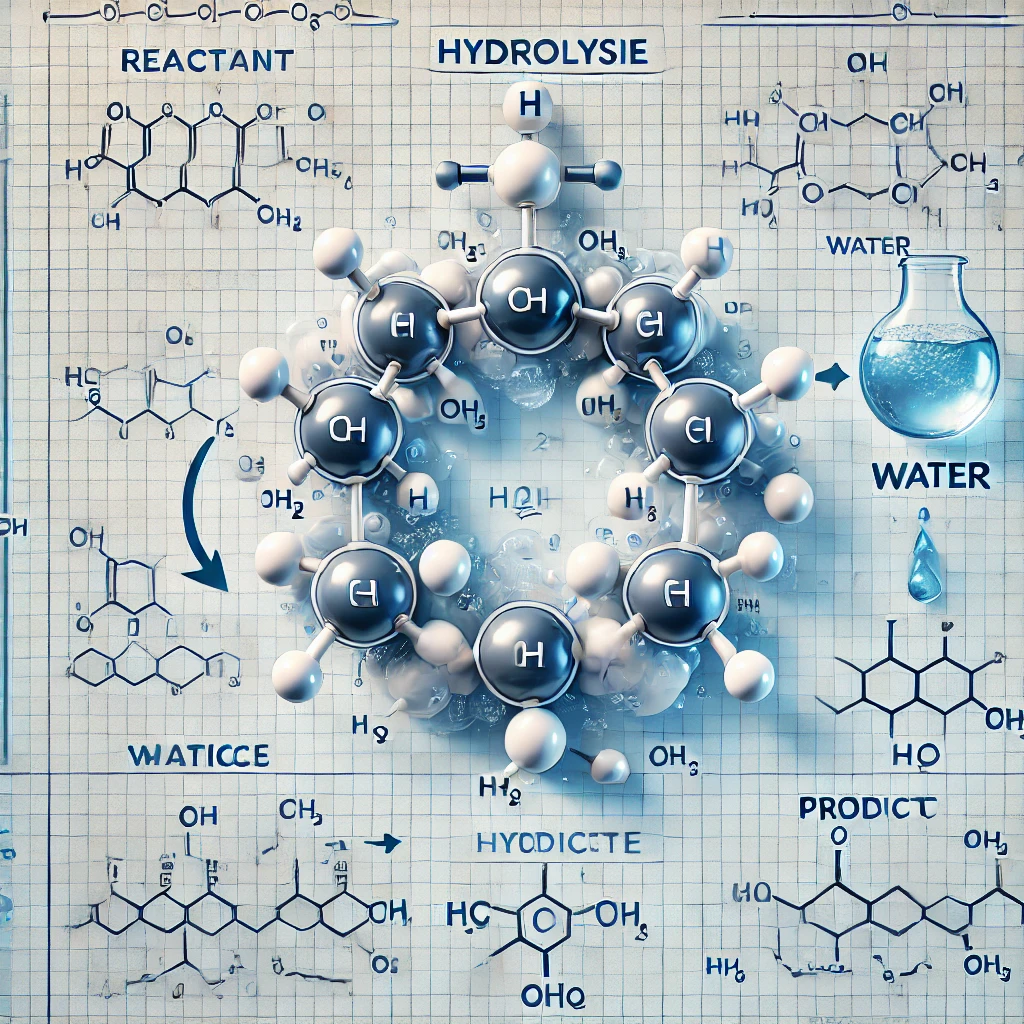
Here is an educational diagram illustrating a hydrolysis reaction. It visually represents how a large molecule is split into two smaller molecules with the addition of water. Let me know if you need any modifications!