How are the scala tympani, scala media, and scala vestibuli arranged with respect to each other?
The correct answer and explanation is :
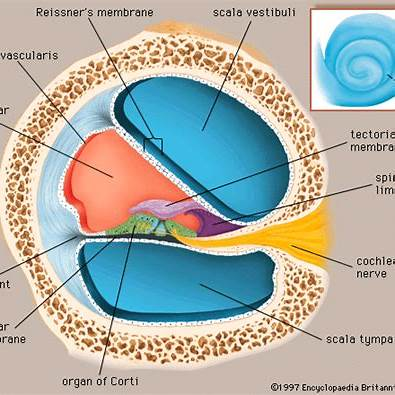
The cochlea, a spiral-shaped organ within the inner ear, is essential for converting sound vibrations into electrical signals that the brain can interpret. It comprises three parallel, fluid-filled chambers: the scala vestibuli, scala media, and scala tympani. These chambers are intricately arranged to facilitate the process of hearing.
Arrangement of the Chambers:
- Scala Vestibuli: This upper chamber starts near the oval window, where the stapes bone of the middle ear transmits sound vibrations. It spirals from the base to the apex of the cochlea and is filled with perilymph fluid, which is similar in composition to extracellular fluid.
- Scala Tympani: Located below the scala media, the scala tympani also contains perilymph fluid. It extends from the apex of the cochlea back down to the round window, which acts as a pressure release valve for the fluid movements within the cochlea.
- Scala Media (Cochlear Duct): Situated between the scala vestibuli and scala tympani, the scala media is filled with endolymph fluid, which has a unique ionic composition crucial for normal auditory function. This middle chamber houses the organ of Corti, the sensory organ responsible for detecting sound vibrations and converting them into electrical signals.
Separating Membranes:
- Reissner’s Membrane: This thin membrane separates the scala vestibuli from the scala media. It helps maintain the distinct ionic compositions of the perilymph and endolymph fluids in their respective chambers.
- Basilar Membrane: Located between the scala media and scala tympani, the basilar membrane supports the organ of Corti. Its varying stiffness and width along its length enable it to respond to different frequencies of sound, a property essential for the process of auditory transduction.
Function in Hearing:
When sound waves enter the ear, they cause the tympanic membrane (eardrum) to vibrate. These vibrations are transmitted through the ossicles (middle ear bones) to the oval window, creating pressure waves in the perilymph of the scala vestibuli. These waves travel through the perilymph, causing the basilar membrane to move. The movement of the basilar membrane stimulates hair cells within the organ of Corti, converting mechanical vibrations into electrical signals that are sent to the brain via the auditory nerve.
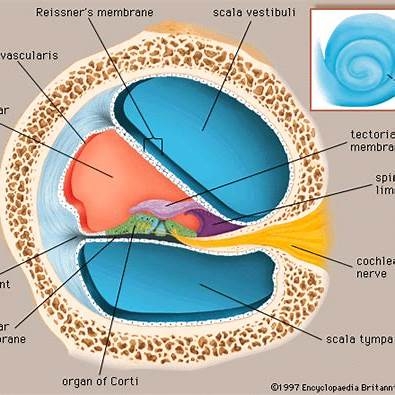
This diagram illustrates the relative positions of the scala vestibuli, scala media, and scala tympani within the cochlea, as well as the separating membranes and the organ of Corti.
Understanding the precise arrangement of these chambers and their functions is crucial for comprehending how we perceive sound and how various factors can affect hearing.