Which of the following statements correctly describes osmosis?
A) In osmosis, water moves across a membrane from areas of lower solute concentration to areas of higher solute concentration.
B) in osmosis, solutes move across a membrane from areas of lower water concentration to areas of higher water concentration.
C) Osmosis only takes place in white blood cells.
D) Osmosis is an energy-demanding or “active” process.
The correct answer and explanation is :
The correct answer is:
A) In osmosis, water moves across a membrane from areas of lower solute concentration to areas of higher solute concentration.
Explanation:
Osmosis is a fundamental biological process that involves the movement of water molecules through a selectively permeable membrane. It occurs when there is a difference in solute concentration between two sides of a membrane. Water naturally moves from the side with lower solute concentration (higher water concentration) to the side with higher solute concentration (lower water concentration). This movement continues until equilibrium is reached.
Why A is Correct:
Water moves toward the region with a higher solute concentration because solutes attract water molecules, reducing the number of free water molecules available. This process does not require energy and is driven purely by concentration differences (a passive process).
Why the Other Options Are Incorrect:
- B is incorrect because osmosis involves the movement of water, not solutes. Solutes typically move via diffusion or active transport.
- C is incorrect because osmosis occurs in all cells, not just white blood cells. It is essential for maintaining hydration and cell function in plants, animals, and even microorganisms.
- D is incorrect because osmosis is a passive process that does not require cellular energy (ATP). Unlike active transport, osmosis happens naturally due to concentration gradients.
Importance of Osmosis:
Osmosis plays a vital role in biological systems, such as:
- Regulating cell volume: Prevents cells from shrinking or bursting due to water imbalances.
- Maintaining blood pressure and hydration: Water movement in blood and tissues depends on osmosis.
- Plant water uptake: Root cells absorb water through osmosis, helping plants stay turgid and upright.
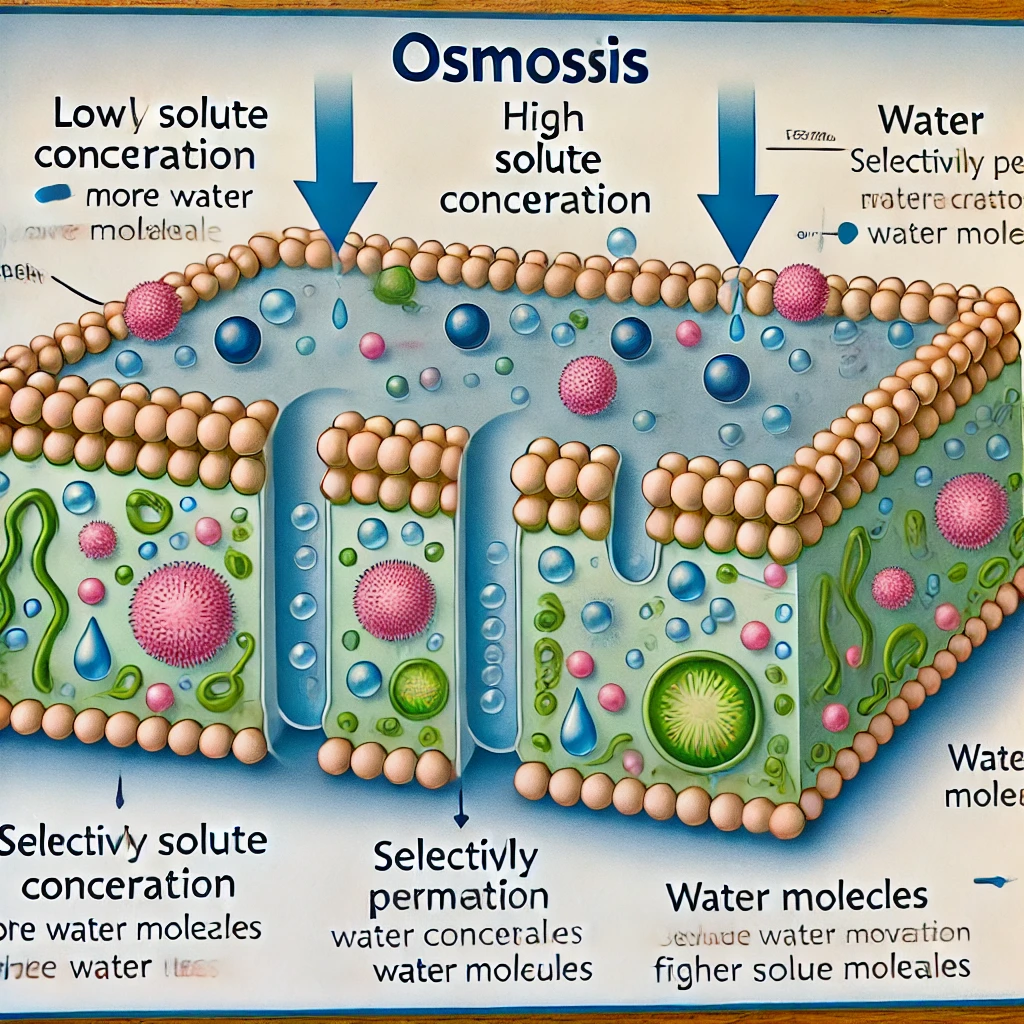
Here is an educational diagram illustrating osmosis. It visually represents how water moves across a selectively permeable membrane from an area of lower solute concentration to an area of higher solute concentration.