Which of the following statements correctly describes osmosis?
A) In osmosis, water moves across a membrane from areas of lower solute concentration to areas of higher solute concentration.
B) in osmosis, solutes move across a membrane from areas of lower water concentration to areas of higher water concentration.
C) Osmosis only takes place in white blood cells.
D) Osmosis is an energy-demanding or “active” process.
The correct answer and explanation is :
The correct statement describing osmosis is:
A) In osmosis, water moves across a membrane from areas of lower solute concentration to areas of higher solute concentration.
Explanation:
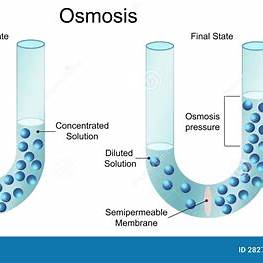
Osmosis is a fundamental biological process where water molecules move across a selectively permeable membrane from a region of lower solute concentration (hypotonic solution) to a region of higher solute concentration (hypertonic solution). This movement aims to equalize solute concentrations on both sides of the membrane, thereby achieving equilibrium.
Key Points:
- Passive Transport: Osmosis is a type of passive transport, meaning it does not require cellular energy (ATP). Instead, it relies on the inherent kinetic energy of water molecules moving down their concentration gradient.
- Selectively Permeable Membrane: The process occurs across a selectively permeable membrane, which allows the passage of water molecules but restricts most solutes. This selective permeability is crucial for maintaining cellular homeostasis.
- Direction of Water Movement: Water moves from an area with a lower concentration of solutes (higher water potential) to an area with a higher concentration of solutes (lower water potential). This movement continues until the solute concentrations on both sides of the membrane are equal.
Addressing the Other Statements:
- B) In osmosis, solutes move across a membrane from areas of lower water concentration to areas of higher water concentration. This statement is incorrect. Osmosis specifically refers to the movement of water, not solutes. Solute molecules may move across membranes through other processes such as diffusion or active transport, but not via osmosis.
- C) Osmosis only takes place in white blood cells. This statement is false. Osmosis occurs in all living cells, not just white blood cells. It is a universal process essential for maintaining cellular integrity and function across all forms of life.
- D) Osmosis is an energy-demanding or “active” process. This statement is incorrect. Osmosis is a passive process that does not require energy input from the cell. It relies on the natural movement of water molecules down their concentration gradient.