Which of the following statements describes the first law of thermodynamics?
A) Energy cannot be created or destroyed.
B) Energy cannot be transferred or transformed.
C) The entropy of the universe is decreasing.
D) The entropy of the universe is constant.
The correct answer and explanation is :
The correct answer is:
A) Energy cannot be created or destroyed.
Explanation:
The First Law of Thermodynamics, also known as the Law of Energy Conservation, states that energy cannot be created or destroyed in an isolated system. Instead, energy can only be transferred or transformed from one form to another. Mathematically, this is expressed as:
[
\Delta U = Q – W
]
Where:
- ( \Delta U ) is the change in internal energy of the system,
- ( Q ) is the heat added to the system,
- ( W ) is the work done by the system.
This principle implies that the total energy of an isolated system remains constant. For example, in a heat engine, chemical energy from fuel is converted into heat and work, but the total energy before and after remains the same.
Why the Other Options Are Incorrect:
- B) Energy cannot be transferred or transformed.
- This is incorrect because energy can be transferred and transformed between different forms, such as kinetic energy, thermal energy, and electrical energy.
- C) The entropy of the universe is decreasing.
- This contradicts the Second Law of Thermodynamics, which states that entropy (disorder) in the universe tends to increase over time.
- D) The entropy of the universe is constant.
- This is also incorrect because the entropy of the universe is always increasing, not constant.
Real-World Example:
When you boil water, electrical energy is transformed into heat energy, increasing the temperature of the water. The total energy remains the same, demonstrating the First Law of Thermodynamics.
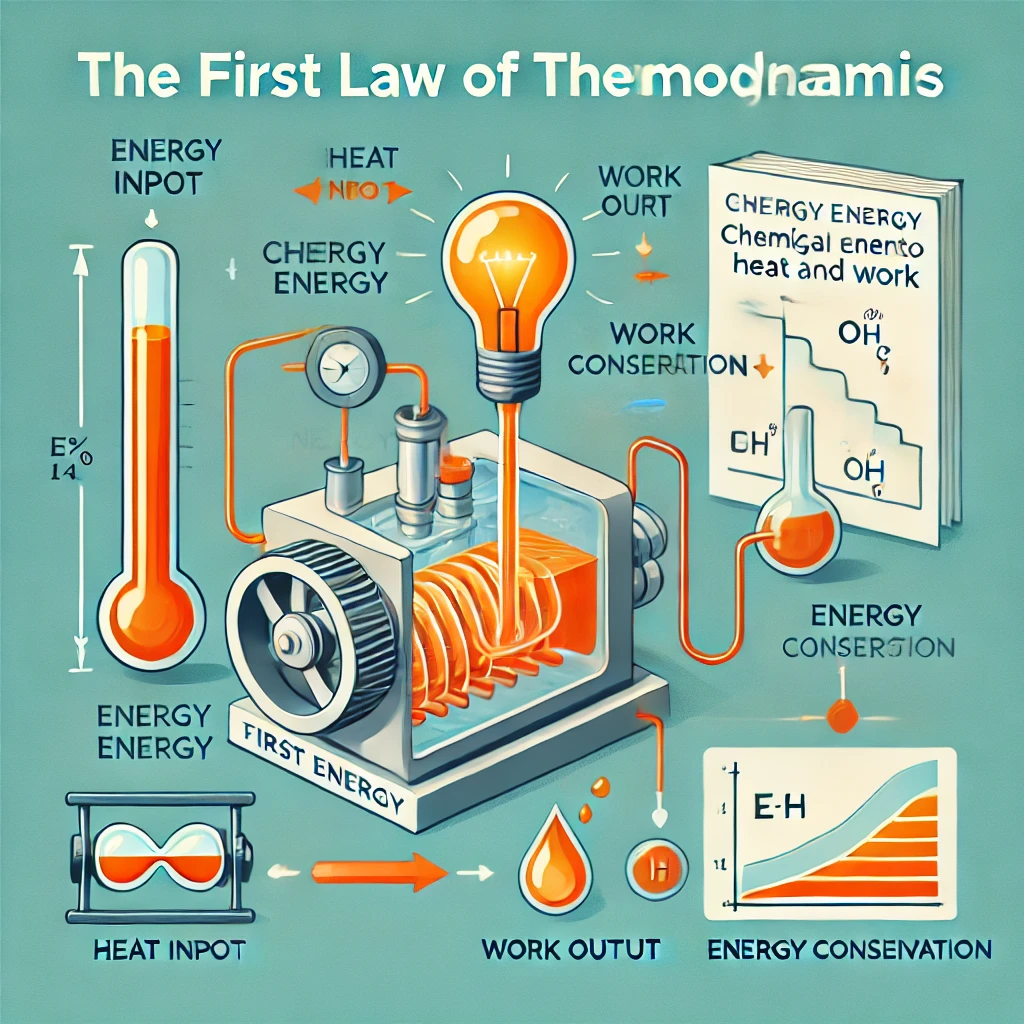
Here is an image illustrating the First Law of Thermodynamics. It visually represents energy transformation in a heat engine, showing how energy is conserved.