A spaceship is designed to support animal life for a multiyear voyage to the outer planets of the solar system. Plants will be grown to provide oxygen and to recycle carbon dioxide. Since the spaceship will be too far from the sun for photosynthesis, an artificial light source will be needed. Suppose a plant has a unique photosynthetic pigment and the leaves of this plant appear to be reddish yellow. What wavelengths of visible light are absorbed by this pigment?
A) blue and violet
B) green and red
C) red and yellow
D) green and yellow.
The correct answer and explanation is :
The correct answer is A) blue and violet.
In photosynthesis, pigments absorb specific wavelengths of light to harness energy. The color we perceive in plant leaves results from the wavelengths of light that are reflected or transmitted, not absorbed. When a plant’s leaves appear reddish-yellow, it indicates that these colors are being reflected, and the complementary colors—primarily blue and violet—are being absorbed.
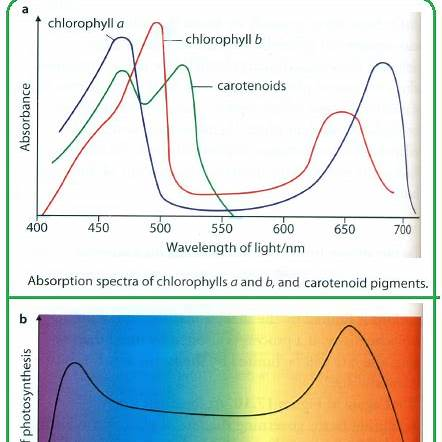
Visible light spans wavelengths from approximately 400 to 700 nanometers (nm), with violet and blue light occupying the 400–500 nm range. Photosynthetic pigments, such as chlorophylls and carotenoids, have distinct absorption spectra:
- Chlorophylls: Chlorophyll a absorbs light mainly in the blue-violet (around 430–450 nm) and red (around 640–680 nm) regions, while chlorophyll b absorbs primarily in the blue (around 450–500 nm) and red-orange (around 600–650 nm) regions.
- Carotenoids: These pigments absorb light in the blue (400–500 nm) range and reflect yellow, orange, and red wavelengths, contributing to the reddish-yellow appearance of certain leaves.
In the case of a plant with reddish-yellow leaves, the unique photosynthetic pigment likely absorbs light in the blue and violet regions (400–500 nm). This absorption pattern allows the plant to utilize these wavelengths for photosynthesis while reflecting the longer wavelengths corresponding to red and yellow hues, which we perceive as the leaf color.
Understanding the absorption characteristics of photosynthetic pigments is crucial for optimizing artificial lighting in environments where natural sunlight is unavailable, such as in a spaceship designed for long-duration space travel. Providing light sources that emit wavelengths corresponding to the absorption peaks of these pigments ensures efficient photosynthesis, supporting plant growth and oxygen production in such closed systems.