The ‘capacity for emergency management and response personnel to interact and work well together’ describes which of the key communications and information systems principles?
A. Resilience and Redundancy
B. Interoperability
C. Security
D. Reliability, Scalability, and Portability
The jurisdiction receiving mutual aid can resources if they do not meet its needs.
A. Disregard
B. Decline
C. Store
D. Redirect
ICS provides a standardized approach to the command, control, and coordination of emergency personnel.
A. On-scene
B. Off-site
C. non-activated
D. EOC
Which NIMS structure makes cooperative multi-agency decisions?
A. Emergency Operations Center (EOC)
B. Joint Information System (JIS)
C. Incident Command System
D. MAC Groups
When an incident occurs or threatens, local emergency personnel manage response using NIMS principles and ICS.
If the incident is or becomes large or complex,
A. Mutual Aid Agreements are executed.
B. A Unified Command is established.
C. Local EOCs activate.
D. Federal authorities assist.
26. When only certain EOC team members or organizations are activated to monitor a credible threat, which Activation Level has been implemented?
A. Level 3 – Normal Operations/Steady-State
B. Level 2 – Enhanced Steady-State
C. Level 4- No EOC is required
D. Level 1 – Full Activation
The correct answer and explanation is:
Correct Answers:
- B. Interoperability
- B. Decline
- A. On-scene
- D. MAC Groups
- B. A Unified Command is established.
- B. Level 2 – Enhanced Steady-State
Explanation:
- Interoperability:
Interoperability refers to the ability of emergency management and response personnel to work well together, communicate effectively, and coordinate their actions seamlessly. It ensures that different agencies, jurisdictions, and organizations can share information and resources efficiently during emergencies. This principle is crucial in large-scale disasters where multiple entities must collaborate. - Decline:
When a jurisdiction receives mutual aid resources that do not meet its needs, it has the right to decline them. This is essential to ensure that only appropriate and useful resources are utilized, preventing logistical complications and inefficiencies in disaster response efforts. - On-scene:
The Incident Command System (ICS) is a standardized framework that helps manage emergency personnel and resources at the scene of an incident. It provides clear roles, responsibilities, and coordination mechanisms to enhance efficiency and effectiveness in disaster response. - MAC Groups:
Multiagency Coordination (MAC) Groups facilitate decision-making among multiple agencies involved in emergency response. They help prioritize resources, establish policy direction, and ensure interagency cooperation. Unlike the ICS, which focuses on direct incident management, MAC Groups operate at a broader level to coordinate strategic decisions. - A Unified Command is established:
When an incident becomes large or complex, a Unified Command (UC) is set up to integrate multiple responding agencies under a single management structure. This ensures coordinated decision-making, resource allocation, and unified strategic planning, minimizing confusion and redundancy. - Level 2 – Enhanced Steady-State:
In this activation level, only certain Emergency Operations Center (EOC) team members or organizations are activated to monitor a credible threat. This level allows for heightened preparedness without fully mobilizing all response personnel, ensuring a swift yet efficient response to evolving situations.
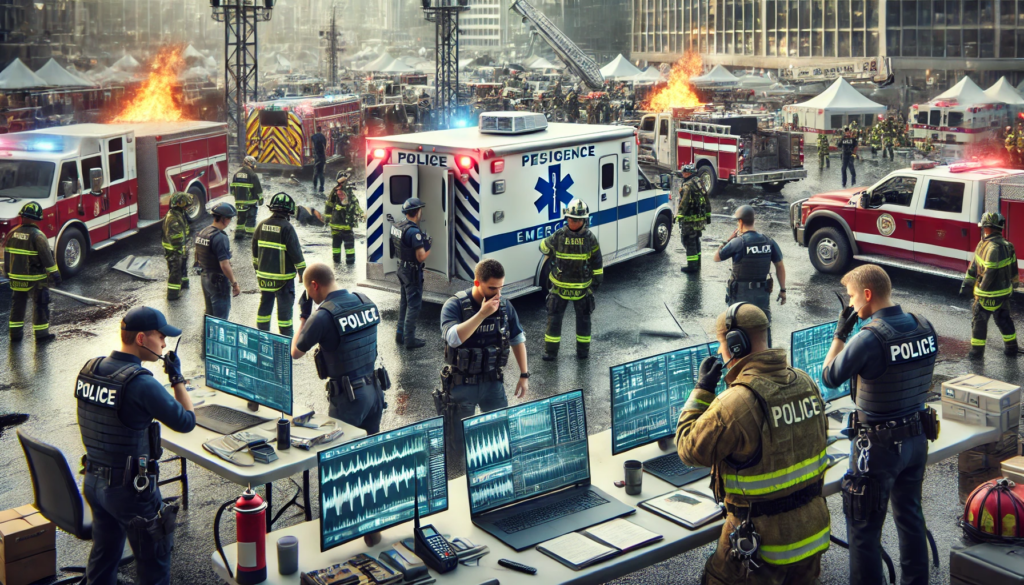
Now, generating the requested image.
Here is the generated image depicting emergency management personnel from different agencies working together in a coordinated response. Let me know if you need any modifications or additional details!