Explain the units: Kbps, Mbps and Gbps. As part of your explanation, detail where you are likely to come across the different rates and how to convert between them (i.e. provide some examples).
The correct answer and explanation is :
Understanding Kbps, Mbps, and Gbps
Kbps, Mbps, and Gbps are units used to measure data transfer rates, particularly in networking and telecommunications. They indicate how fast data moves from one point to another.
- Kbps (Kilobits per second) – 1 Kbps = 1,000 bits per second
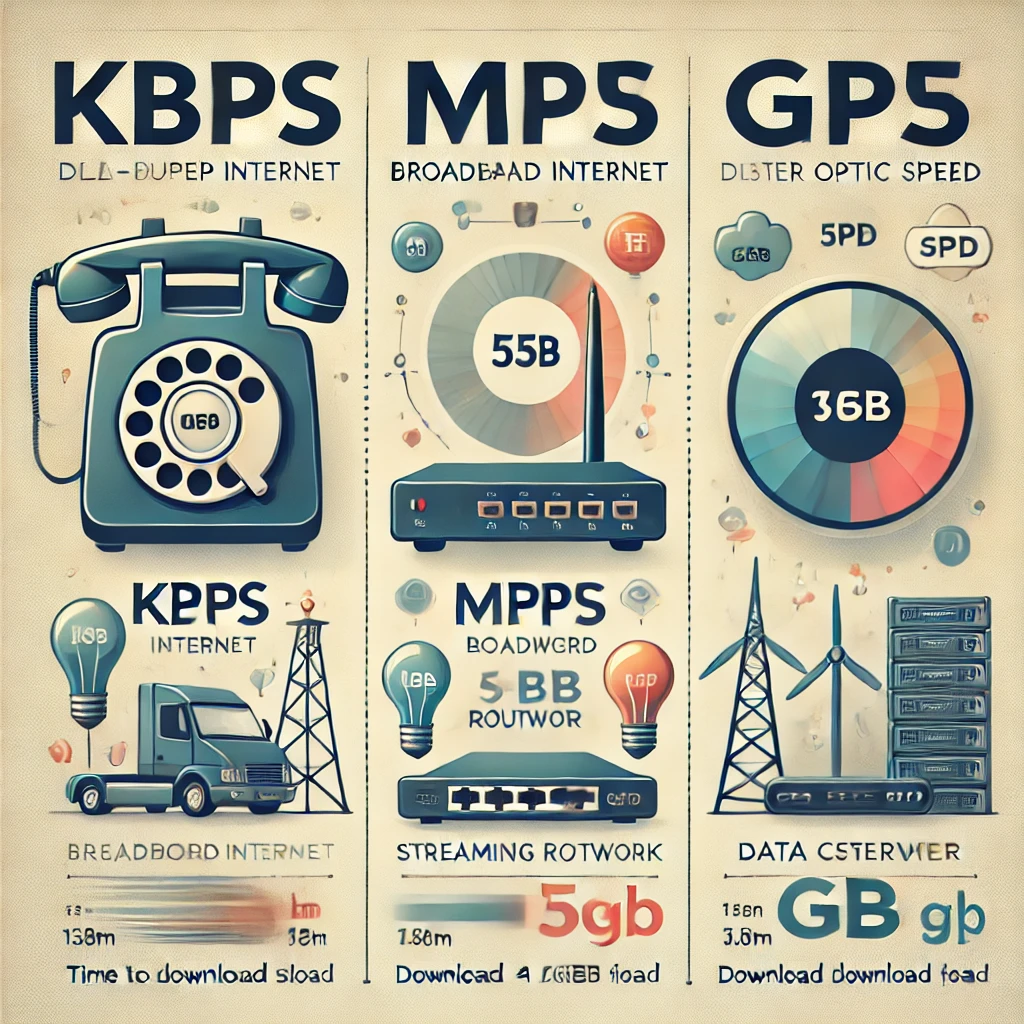
- Common Usage: Found in old dial-up internet connections (e.g., 56 Kbps) and low-bandwidth IoT (Internet of Things) devices.
- Mbps (Megabits per second) – 1 Mbps = 1,000 Kbps = 1,000,000 bits per second
- Common Usage: Standard broadband speeds, streaming services (e.g., Netflix recommends at least 5 Mbps for HD streaming), and gaming. Most home internet plans are measured in Mbps (e.g., 100 Mbps, 500 Mbps).
- Gbps (Gigabits per second) – 1 Gbps = 1,000 Mbps = 1,000,000 Kbps = 1,000,000,000 bits per second
- Common Usage: Ultra-fast fiber-optic internet connections, data centers, and enterprise-level networks. High-speed fiber-optic providers offer 1 Gbps, 2 Gbps, or even 10 Gbps for commercial and professional use.
Conversions Between Units
- 1 Gbps = 1,000 Mbps
- 1 Mbps = 1,000 Kbps
- 50 Mbps = 50,000 Kbps
- 2 Gbps = 2,000 Mbps = 2,000,000 Kbps
Example Scenarios
- A 100 Mbps internet connection can download a 1 GB file in about 80 seconds.
- A 1 Gbps connection can download the same 1 GB file in 8 seconds.