What is a ventilation-perfusion coupling?
The correct answer and explanation is :
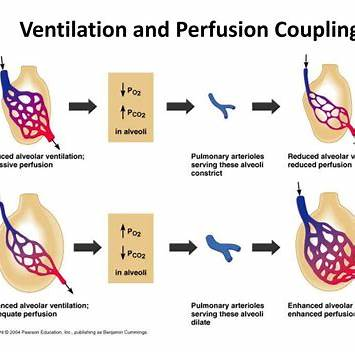
Ventilation-perfusion coupling refers to the physiological relationship between the air reaching the alveoli (ventilation) and the blood flowing through the pulmonary capillaries (perfusion). This coupling ensures efficient gas exchange, allowing oxygen to enter the blood and carbon dioxide to be expelled from the body.
In the lungs, ventilation introduces oxygen-rich air into the alveoli, while perfusion delivers carbon dioxide-laden blood from the body to the alveolar capillaries. The effectiveness of gas exchange depends on the matching of these two processes. An optimal ventilation-perfusion ratio (V/Q ratio) is approximately 0.8, indicating that perfusion slightly exceeds ventilation under normal conditions. This ratio can vary within different regions of the lungs due to gravitational effects; for instance, the lung apex has a higher V/Q ratio (~3.3) because ventilation exceeds perfusion, whereas the lung base has a lower V/Q ratio (~0.63) due to greater perfusion relative to ventilation.
The body employs local regulatory mechanisms to maintain ventilation-perfusion matching. When alveolar oxygen levels (pO₂) are low, pulmonary arterioles constrict, reducing blood flow to poorly ventilated areas and redirecting it to regions with better ventilation. Conversely, high pO₂ levels cause arterioles to dilate, increasing blood flow to well-ventilated areas. Similarly, elevated carbon dioxide levels (pCO₂) in the alveoli lead to bronchodilation, enhancing airflow to expel CO₂ more effectively, while low pCO₂ causes bronchoconstriction, reducing airflow to areas with less metabolic demand.
Disruptions in ventilation-perfusion coupling can result in a mismatch, leading to inadequate oxygenation of blood and inefficient removal of carbon dioxide. Conditions such as pneumonia, asthma, chronic obstructive pulmonary disease (COPD), and pulmonary embolism can impair ventilation or perfusion, causing hypoxia (low blood oxygen levels) and, in severe cases, hypercapnia (elevated blood CO₂ levels). For example, in pneumonia, alveoli may fill with fluid, hindering ventilation and leading to a decreased V/Q ratio. In contrast, a pulmonary embolism can obstruct blood flow to a lung region, resulting in a high V/Q ratio due to ventilation without adequate perfusion.
Understanding and maintaining proper ventilation-perfusion coupling is crucial for respiratory health, as it ensures that the body’s tissues receive sufficient oxygen and that carbon dioxide is effectively removed, maintaining the delicate balance required for optimal physiological function.