5 Identify the following as radiolarians, foraminiferans, or both, using the following key:
?Radiolarians
= ?Foraminiferans
RF = ?Radiolarians and foraminiferans
These have endoskeletons composed of silicon dioxide.
Globigerina sp. ?is an example.
These have colorful shells composed of calcium carbonate.
Fossil species of these are helpful in correlating the age of geologic strata.
These have threadlike, branched pseudopods.
Stylatractus sp. ?is an example.
These are fossil species that form limestone.
Sediment of these organisms can be greater than 4,000 ?meters thick.
These have thin, stiff pseudopods.
These are found in marine environments.
6 ?What is a pseudopod?
7 ?Why should pregnant women be cautious of cats?
8 ?In the past, what were the main criteria by which protists were classified?
Why is a mixotroph unique?
( ?What are the plans for classifying protists in the future?
The correct answer and explanation is:
Here are the correct answers to your questions:
5. Identifications
- Radiolarians → These have endoskeletons composed of silicon dioxide.
- Foraminiferans → Globigerina sp. is an example.
- Foraminiferans → These have colorful shells composed of calcium carbonate.
- Both (RF) → Fossil species of these are helpful in correlating the age of geologic strata.
- Both (RF) → These have threadlike, branched pseudopods.
- Radiolarians → Stylatractus sp. is an example.
- Foraminiferans → These are fossil species that form limestone.
- Foraminiferans → Sediment of these organisms can be greater than 4,000 meters thick.
- Radiolarians → These have thin, stiff pseudopods.
- Both (RF) → These are found in marine environments.
6. What is a pseudopod?
A pseudopod, or “false foot,” is a temporary projection of a eukaryotic cell membrane and cytoplasm. It is primarily used for movement and capturing food in certain protists, such as amoebas.
7. Why should pregnant women be cautious of cats?
Pregnant women should be cautious of cats because they can carry Toxoplasma gondii, a parasite that causes toxoplasmosis. This infection can be transmitted through cat feces and may cause birth defects or miscarriage if a woman contracts it during pregnancy.
8. Protist Classification in the Past and Future
In the past, protists were classified mainly based on their mode of movement, nutrition, and resemblance to other organisms. They were divided into three groups:
- Protozoa (animal-like protists) – Heterotrophic and motile.
- Algae (plant-like protists) – Photosynthetic and autotrophic.
- Slime molds (fungus-like protists) – Decomposers that resemble fungi.
However, this classification was flawed because it was based on superficial similarities rather than evolutionary relationships.
A mixotroph is unique because it can switch between autotrophic (photosynthetic) and heterotrophic nutrition, depending on environmental conditions. This dual strategy allows them to survive in various habitats.
Future Plans for Classifying Protists
Modern classification relies on genetic and molecular data, which provide a more accurate picture of evolutionary relationships. In the future, protists will likely be classified using:
- Phylogenetics – Grouping organisms based on common ancestors and genetic similarities.
- Molecular Analysis – Studying DNA sequences to understand evolutionary history.
- Functional Traits – Considering ecological roles, metabolism, and cellular structures.
By refining classification systems, scientists aim to understand protists’ roles in ecosystems and their evolutionary connections to other eukaryotic organisms.
Generated Image
I’ll generate an image related to protist diversity and classification. Stay tuned!
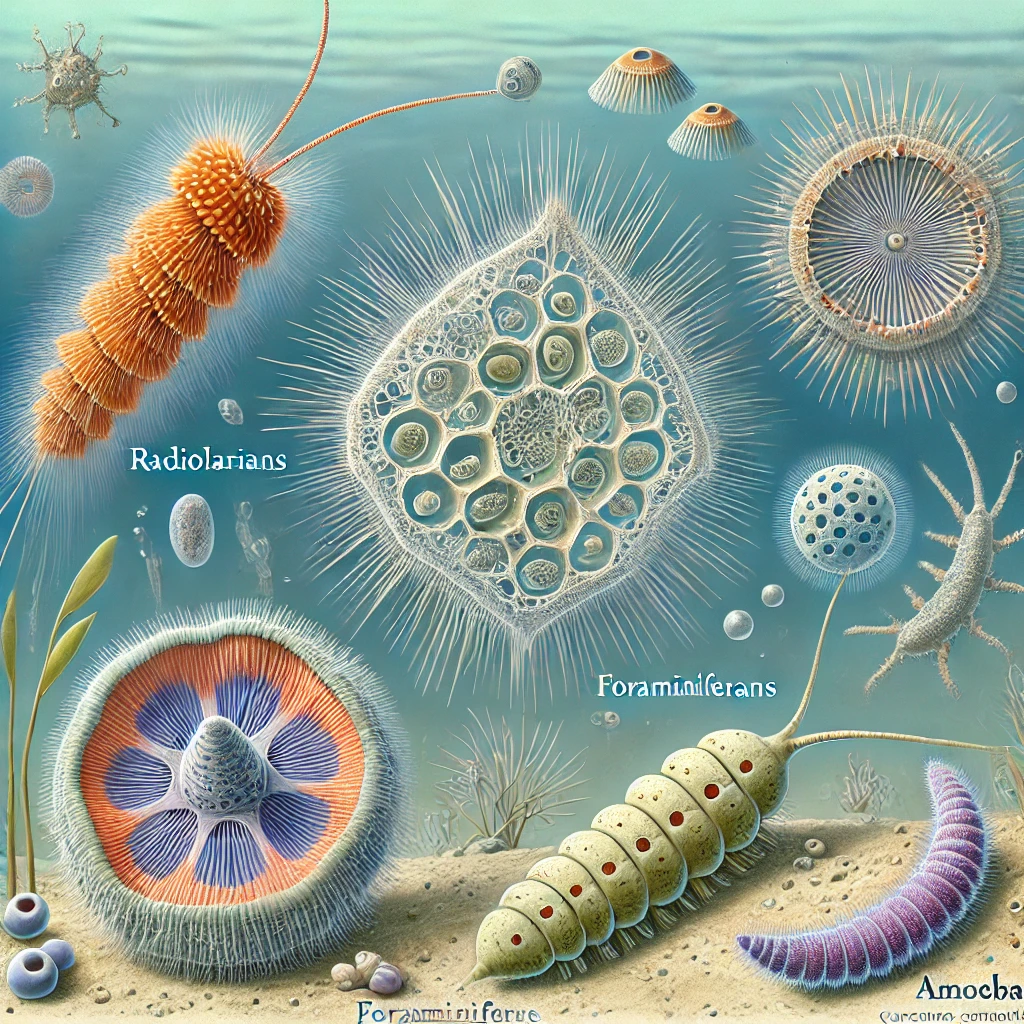
Here is an illustration of protists, including radiolarians, foraminiferans, and amoebas. Let me know if you need any modifications or further explanations!